
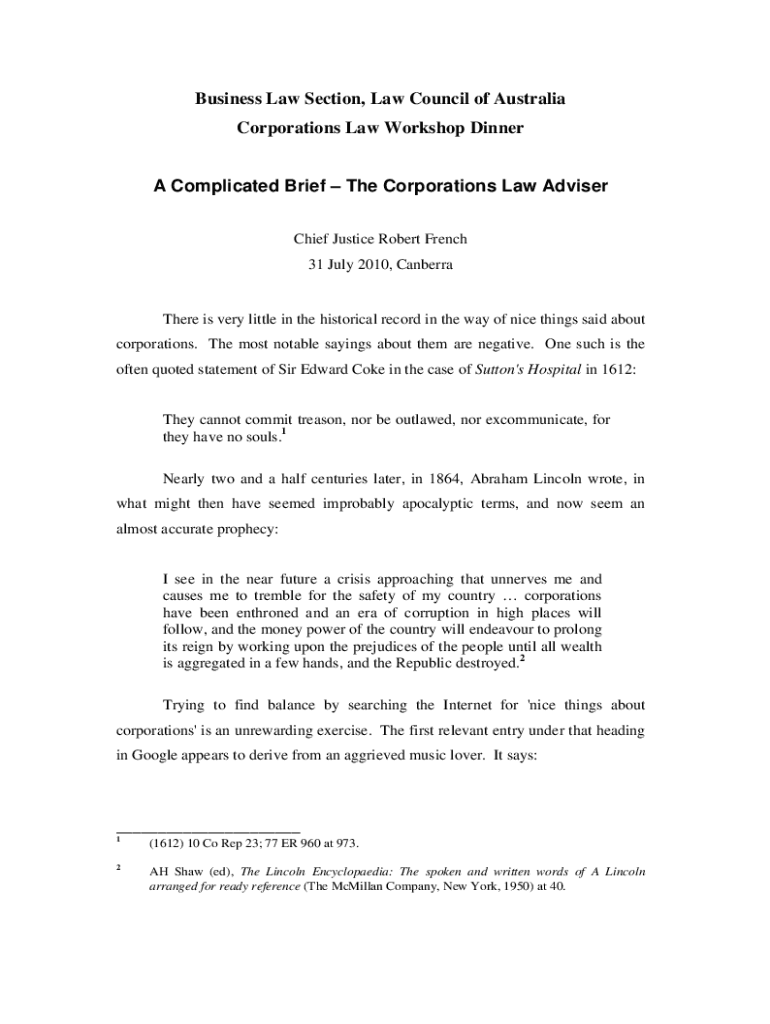







Definition & Meaning
The term "Business Law Section, Law Council of Australia Corporations Law" refers to a specialized segment within Australia's legal framework that deals with regulations and practices governing corporations. This section is part of the Law Council of Australia, which provides expert guidance and regulatory oversight concerning corporate governance, mergers and acquisitions, securities, and compliance with the Corporations Act 2001. The primary goal is to ensure a transparent, fair, and regulated marketplace that upholds the lawful conduct of business entities in Australia.
Key Elements of the Business Law Section, Law Council of Australia Corporations Law
Understanding the key components of the "Business Law Section, Law Council of Australia Corporations Law" involves examining the principles it encompasses, including:
- Corporate Governance: Guidelines for decision-making processes within companies, focusing on balancing the interests of stakeholders.
- Securities Regulation: Rules covering the issuing and trading of corporate shares to protect investors and the market.
- Compliance Requirements: Obligations corporations must fulfill to adhere to legal and ethical standards.
Corporate Governance
- Ensures accountability and integrity in business practices.
- Sets frameworks for boards of directors and executive management.
Securities Regulation
- Governs the disclosure requirements for public companies.
- Monitors market activities and enforces actions against securities fraud.
Legal Use of the Business Law Section
The Business Law Section, Law Council of Australia Corporations Law, serves several legal purposes:
- Advisory Role: Provides expert opinions to governmental and corporate bodies on legislation.
- Dispute Resolution: Acts as a reference in litigation concerning corporate disputes.
- Policy Development: Influences legislative amendments to improve business law standards.
How to Use the Business Law Section, Law Council of Australia Corporations Law
Businesses and legal professionals use this section as a guideline to understand their rights and obligations. It is consulted during:
- Drafting Contracts: Ensuring agreements comply with statutory requirements.
- Corporate Planning: Navigating mergers, acquisitions, and reorganization processes.
- Compliance Checks: Regularly auditing business operations to prevent legal infractions.
Steps to Complete the Business Law Section, Law Council of Australia Corporations Law
While this section forms part of broader regulatory processes, engaging with it usually involves:
- Identifying Relevant Provisions: Determine which rules apply to your business activities.
- Documentation and Preparation: Gather necessary information and documents.
- Legal Consultation: Seek expertise from legal professionals to interpret laws accurately.
- Implementation: Apply guidelines to business practices and ensure compliance.
Important Terms Related to Business Law Section
Understanding critical terminologies is essential for navigating the Business Law Section. These include:
- Fiduciary Duty: Obligation of loyalty and care that directors owe to their corporations.
- Prospectus: A legal document issued by companies that are offering securities to the public.
Who Typically Uses the Business Law Section
The primary users include:
- Corporate Lawyers: To advise clients on corporate law matters.
- Business Executives: For strategic planning and decision-making.
- Regulatory Bodies: To ensure compliance and enforce corporate laws.


Penalties for Non-Compliance
Failure to adhere to the regulations in this section can result in:
- Financial Penalties: Fines imposed on individuals or entities.
- Legal Consequences: Litigation, including possible injunctions.
- Reputation Damage: Long-term effects on a company’s public image and trustworthiness.




