






Definition and Meaning of the "Reply - High Court of Australia"
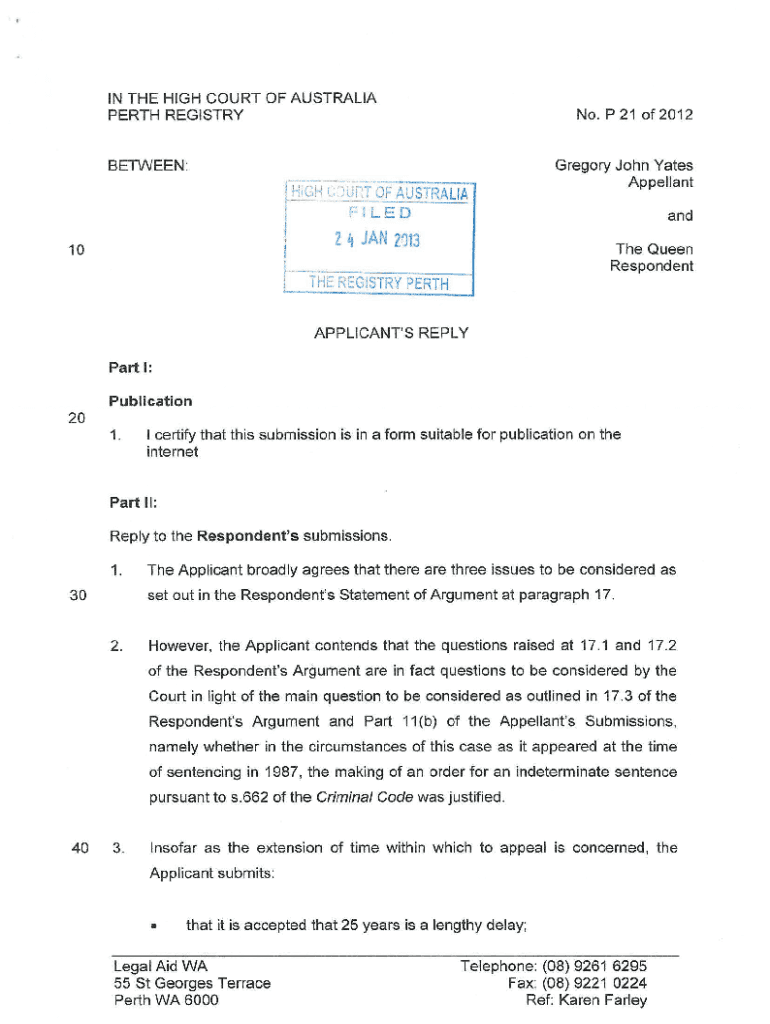
The "Reply - High Court of Australia" serves as a formal response in legal proceedings, typically submitted by the Applicant in an appeal to the High Court. This document is essential in cases where an individual is seeking to contest a judicial decision previously rendered by a lower court. The Reply outlines the key arguments and contentions the Applicant wishes to present to the High Court, focusing on perceived legal errors or oversights that occurred in earlier proceedings. This document is crucial for ensuring that the Applicant's perspective is clearly stated and considered by the judges.
How to Use the "Reply - High Court of Australia"
To effectively use the "Reply - High Court of Australia," follow these steps:
-
Understand the Context: Clearly comprehend the case details and the specific issues under appeal.
-
Structure the Document: Begin with an introduction that outlines your position, followed by the main body where you develop your arguments, and conclude with a summary of your requests to the court.
-
Legal References: Cite relevant legal statutes and previous case law to support your arguments.
-
Language and Tone: Use precise, formal, and objective language throughout the document.
-
Proofreading: Before submission, ensure that the document is free of errors and meticulously checked for factual and legal accuracy.
Steps to Complete the "Reply - High Court of Australia"
Completing the "Reply" involves several critical steps:
-
Research and Preparation: Gather all necessary information and documents related to your case.
-
Drafting: Use a clear format, starting with an introduction, a detailed argument section, and a conclusion.
-
Citing Evidence: Include all pertinent evidence and documentation that support your appeal.
-
Revisions: Review for clarity, coherence, and adherence to legal standards.
-
Final Review: Conduct a final check for typographical errors, logical consistency, and compliance with court submission guidelines.
Key Elements of the "Reply - High Court of Australia"
A complete and effective "Reply" should include:
- Case Details: Clearly outline the case name, number, and relevant parties.
- Grounds of Appeal: Detailed explanation of the errors or misjudgments in the original judgment.
- Supportive Arguments: Structured arguments that logically and clearly present your case.
- Requested Relief: Clearly state what outcome or changes you seek from the High Court.
Who Typically Uses the "Reply - High Court of Australia"
The "Reply - High Court of Australia" is generally used by:
- Applicants and Lawyers: Individuals appealing a decision and their legal representatives.
- Legal Researchers: Professionals conducting in-depth studies into legal precedence and case law.
- Judicial Officers: To review appellant perspectives in preparation for hearing appeals.


Legal Use of the "Reply - High Court of Australia"
The "Reply" serves a critical purpose in appellate law by:
- Clarifying the Appellant's Stance: Helps the High Court understand the specific grievances about the lower court's decision.
- Supporting Judicial Review: Offers the factual and legal foundation the judges need to reassess the case.
Important Terms Related to "Reply - High Court of Australia"
Understanding legal context requires familiarity with these terms:
- Applicant: The person or entity initiating the Reply.
- Indeterminate Sentence: A type of sentence in a criminal case without a fixed time, based on rehabilitation potential.
- Criminal Code: The body of law relating to crimes and their punishments.
Examples of Using the "Reply - High Court of Australia"
An example of a "Reply" involves:
- Indeterminate Sentencing Appeal: An appellant arguing against a past sentence due to insufficient evidence and citing a delay in appeal submission due to intellectual disability.