







Definition & Meaning
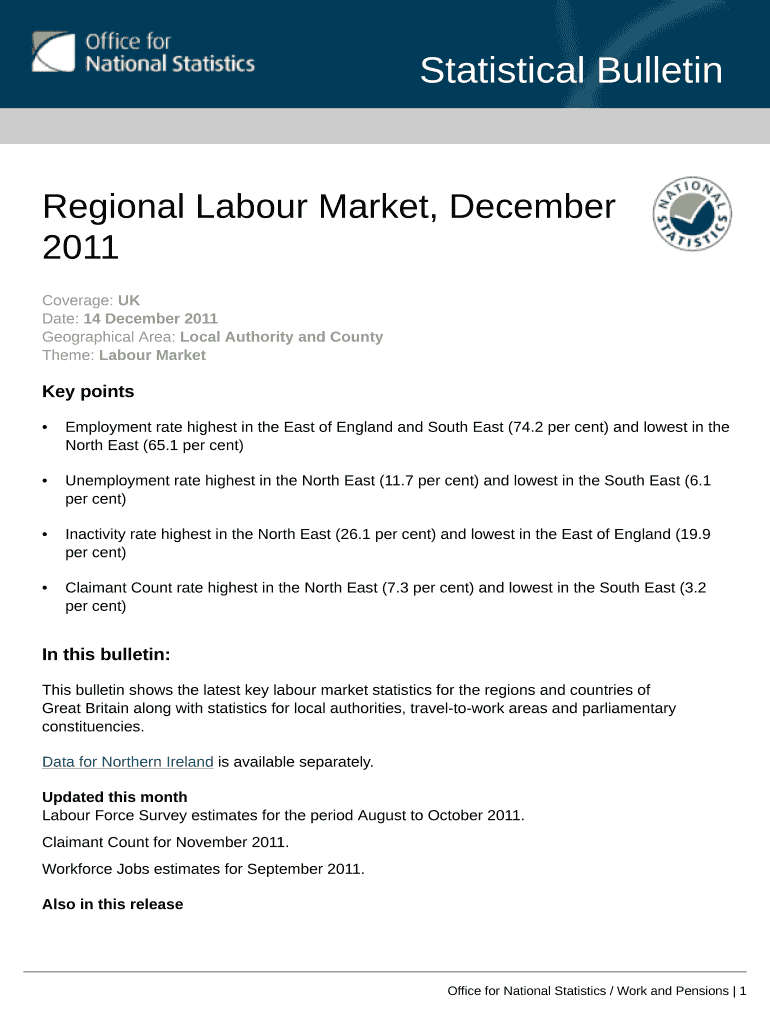
"Coverage UK Date 14 December 2011 Geographical Area Local Authority and County Theme Labour Market" refers to a snapshot of the labor market data in the UK, collected on December 14, 2011. This involves examining employment rates, unemployment statistics, and labor trends within specific geographical regions defined by local authorities and counties. This information is typically used for assessing economic conditions, planning local development, and implementing employment policies.
Key Elements of the Form
The form or report contains critical data points necessary for understanding the labor market nuances as of December 14, 2011. This includes:
- Employment Rates: Data on regional employment levels, highlighting areas with the highest and lowest rates.
- Unemployment Statistics: Details on unemployment numbers, factoring in the volatility across different regions.
- Inactivity Rates: Measurements of demographic groups that are not currently participating in the labor market.
- Survey Data: Information collected from various surveys to provide a comprehensive view of the labor market.
Steps to Complete Analysis Using the Data
- Identify Relevant Regions: Start by selecting the local authorities and counties of interest.
- Access the Data: Gather employment, unemployment, and inactivity statistics from the relevant surveys.
- Analyze Trends: Compare the data across different regions to identify trends and anomalies.
- Prepare Reports: Use the data to compile detailed reports that provide insights into regional labor market conditions.
How to Use the Data
The data from December 14, 2011, can be utilized by local government officials, policy makers, businesses, and researchers to:
- Policy Development: Inform the creation of employment and economic development policies.
- Economic Forecasting: Assist in predicting future labor market trends and economic conditions.
- Resource Allocation: Guide the equitable distribution of resources and support to regions in need.
Legal Use of the Data
The labor market data is legally utilized in the following ways:
- Policy Formulation: Supporting governmental and local authority decisions around job creation and workforce planning.
- Research and Analysis: Used by academics and researchers in conducting studies that require historical labor market insights.
- Public Information: Making data accessible to the public to enhance transparency and allow for informed debates on labor issues.
Examples of Utilizing the Data
- Local Government Planning: A county council uses the data to allocate resources for regional job training programs.
- Business Strategy Development: Companies analyze labor trends to decide where to open new branches or facilities.
- Academic Research: A university study employs the data to investigate correlating factors of unemployment in different regions.
Important Terms Related to the Data
- Local Authority: A local council responsible for the delivery of services and administration in a specific area.
- Labor Inactivity: Individuals not currently employed or actively seeking employment.
- Economic Indicators: Statistics that provide insights into the economic condition of a region.
Software Compatibility
For analyzing and presenting the data, multiple software tools are compatible:
- Microsoft Excel: Useful for data organization, statistical analysis, and visualization.
- SPSS or Stata: Preferred for more advanced statistical analysis.
- Tableau: Ideal for creating interactive data visualizations to enhance understanding and sharing of insights.
Business Types That Benefit Most
Different businesses can leverage the labor market data for distinct purposes:
- Human Resources Firms: To strategize on talent acquisition based on regional employment trends.
- Economic Consultancies: Offering insights to clients regarding the economic landscape and its implications on business operations.
- Educational Institutions: Planning curriculum developments aligned with labor market needs and employment trends.
State-Specific Rules
While this data primarily concerns the UK, parallel practices apply within the U.S. context, where state-specific labor laws and reporting requirements exist. U.S. businesses should adapt these analyses to align with local regulations while acknowledging economic profiling techniques remain similar in approach.




