Definition and Meaning
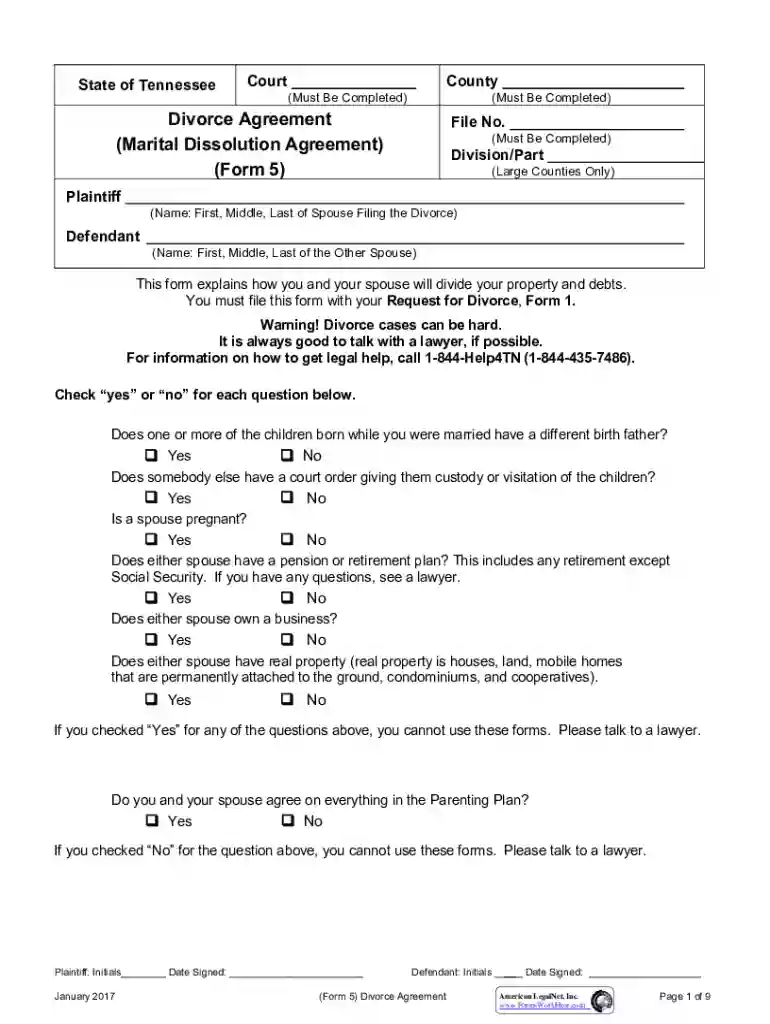
The Divorce Agreement, also referred to as a Marital Dissolution Agreement in Tennessee, serves as a legal document outlining the division of assets, debts, and responsibilities between spouses undergoing a divorce. In Montgomery County, TN, the agreement is a critical component that both parties must consent to, covering areas such as property distribution, alimony, child custody, and name changes. This agreement ensures a structured process in dissolving a marriage, aiming to safeguard both parties' interests under state jurisdiction.
Key Components of the Agreement
- Property Division: Details on how marital assets, including real estate and personal belongings, are allocated.
- Debts and Liabilities: A breakdown of shared debts and how they will be handled by each party.
- Alimony Arrangements: Specifications regarding spousal support, including amount and duration.
- Child Custody and Support: Provisions for child custody arrangements, visitation, and financial support.
How to Use the Divorce Agreement - Montgomery County, TN
To effectively use this form, both spouses must have a comprehensive understanding of their marital assets and liabilities. Initiating the process typically involves:
- Gathering Information: Compile all relevant financial documents, listing assets and debts.
- Drafting the Agreement: Using the gathered information to draft an initial proposal for asset and debt division.
- Legal Consultation: Consulting legal professionals to ensure compliance with Tennessee laws and to finalize the agreement.
- Mutual Agreement: Both parties must thoroughly review and agree to the terms.
Practical Considerations
- Utilize the services of a mediator if discussions become contentious.
- Document any verbal agreements regarding custody or property in writing to avoid misunderstandings.
Steps to Complete the Divorce Agreement - Montgomery County, TN
Completion of the Divorce Agreement requires careful attention to detail and legal precision. The steps are as follows:
- Identify Key Issues: Outline areas of dispute or concern, such as alimony or child support.
- Resolve through Negotiation or Mediation: Work towards agreement on unresolved issues, leveraging mediation if necessary.
- Draft the Agreement: Using information gathered, draft a detailed agreement for review by both parties.
- Review and Revise: Ensure clarity and completeness through thorough review and necessary adjustments.
- Sign and Notarize: Once both parties agree, the document needs to be signed and, often, notarized to validate its legal standing.
Example Scenarios
- Division of retirement accounts must comply with IRS regulations, often requiring a QDRO (Qualified Domestic Relations Order) for certain accounts.
- Child custody arrangements may include specific stipulations regarding schooling or relocation.
Legal Use of the Divorce Agreement - Montgomery County, TN
The legal validity of the Divorce Agreement in Montgomery County stems from its adherence to Tennessee state laws. This legal framework encompasses:
- Compliance: The agreement must align with state statutes and family law principles.
- Court Approval: A judge's approval is required to finalize and enforce the terms as part of the divorce decree.
- Binding Nature: Once signed and ratified, the agreement is legally binding and enforceable by law.
Context and Usage
- In cases of renegotiation, the original agreement often serves as a baseline unless legally modified.
- Legal representation or advice is advisable to ensure rights and obligations are understood and met.
Key Elements of the Divorce Agreement - Montgomery County, TN
Several critical elements make up the Divorce Agreement, each serving a distinct function in the dissolution of marriage:
- Personal Property and Asset Distribution: Lists all assets and outlines the division process.
- Debt Allocation: Specifies responsibility for joint debts, ensuring each party understands their financial obligations.
- Support Obligations: Covers both spousal and child support commitments, including payment schedules and amounts.
Important Considerations
- Ensuring any agreements on future financial arrangements, such as college tuition for children, are explicitly detailed.
- Protecting rights and securing obligations with defined terms to avert potential disputes.
Required Documents
Certain documents are essential for completing a Divorce Agreement in Montgomery County, TN, providing a comprehensive picture of financial and personal circumstances:
- Financial Statements: Includes income statements, tax returns, and bank statements to verify assets and liabilities.
- Property Deeds: Documentation of ownership for marital properties.
- Retirement and Pension Plans: Statements detailing current valuations and terms.
Collection and Preparation
- Ensure all necessary documents are gathered and organized, ideally in consultation with legal professionals.
- Verifying the accuracy of all financial disclosures is crucial for a fair and equitable agreement.
State-Specific Rules for the Divorce Agreement - Montgomery County, TN
Tennessee's specific legal requirements influence the formation of divorce agreements within Montgomery County. These rules ensure consistency with state-level legal expectations:
- Residency Requirement: At least one spouse must meet Tennessee's residency requirement to file for divorce.
- Child Support Guidelines: Adherence to state-determined child support guidelines is mandatory, with potential deviations requiring justification.
Legal Precedents and Variations
- Tennessee's equitable distribution model dictates that assets and debts should be divided fairly, though not necessarily equally.
- Adjustments to standard child custody arrangements must consider the child's best interests, a priority in Tennessee law.
Practical Examples of Using the Divorce Agreement - Montgomery County, TN
Real-world applications of the Divorce Agreement illustrate its versatility and importance in handling complex marital transitions:
- Property Division Scenarios: Couples with significant property may face complex negotiations around valuation and ownership transfer.
- Alimony Considerations: Long-term marriages may involve detailed alimony calculations accounting for earning disparities and standard of living.
Lessons Learned from Case Studies
- The importance of precise language and clarity in articulating financial arrangements to prevent future disputes.
- Establishing proactive communication channels and mediation options can facilitate smoother negotiation processes.