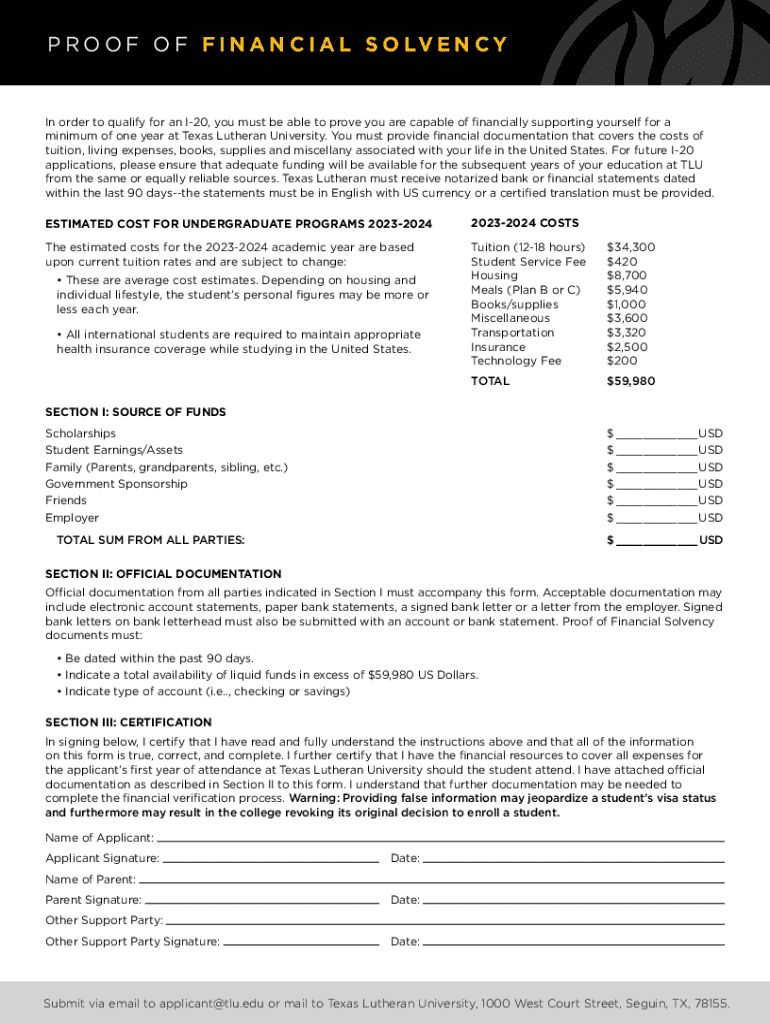







Definition and Meaning of Proof of Financial Solvency
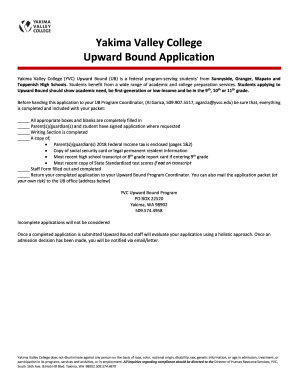
Proof of financial solvency is a documented confirmation that an individual or an entity can meet their financial obligations. This typically involves showcasing liquid assets, income streams, or creditworthiness to demonstrate the capability to cover costs and debts. In various contexts, this proof might be necessary for educational applications, visa qualifications, and loan approvals. For instance, international students applying to universities in the United States must often provide proof of financial solvency to secure their I-20 form, which is essential for obtaining a student visa.
How to Obtain Proof of Financial Solvency
Obtaining proof of financial solvency involves collecting and presenting relevant financial documents that confirm your ability to fulfill financial commitments. Generally, this can include:
- Bank Statements: Monthly statements that reflect a stable account balance.
- Income Verification: Pay stubs or a letter from an employer highlighting regular income.
- Tax Returns: Recent tax filings that show consistent income sources.
- Asset Statements: Documentation of stocks, bonds, or property ownership that adds to financial stability.
When applying for an I-20 or similar purposes, these documents must be translated into English, if originally in another language, and often converted into U.S. dollars.
Key Elements of the Proof of Financial Solvency
Key components in demonstrating financial solvency include:
- Consistency of Income: Regular and adequate earnings to support projected expenses.
- Asset Liquidity: Availability of cash or cash-equivalent assets that can quickly cover obligations.
- Debt Levels: A manageable amount of existing debt that does not overshadow income.
- Financial Documentation: Clear and organized presentation of financial records to potential creditors or institutions.
These factors collectively contribute to a positive assessment of financial solvency, providing assurance to entities requiring proof.
Steps to Complete the Proof of Financial Solvency
To effectively complete a proof of financial solvency, follow these steps:
- Gather Documentation: Collect all necessary financial records such as bank statements, tax returns, and pay stubs.
- Verify Completeness: Ensure that all documents are up-to-date and accurately reflect your financial status.
- Convert and Translate: If applying for international purposes, convert all financial amounts to the relevant currency and translate documents if needed.
- Collate and Present: Organize the documents in a logical order and present them clearly and professionally when required.
- Review for Accuracy: Double-check for accuracy and completeness before submission.
Following these steps ensures a comprehensive and accurate submission of proof, minimizing the risk of delays or rejections.
Who Typically Uses the Proof of Financial Solvency
The proof of financial solvency is used by various individuals and entities, including:
- International Students: To secure visas for studying abroad by demonstrating the ability to cover tuition and living expenses.
- Loan Applicants: Individuals or businesses applying for loans to exhibit creditworthiness.
- Families Sponsoring Relatives: Providing evidence of financial capability when sponsoring a relative's immigration.
- Businesses Seeking Credit: Companies needing to prove financial stability to negotiate credit terms with suppliers.
Each use case requires similar yet tailored documentation depending on the specific needs and regulations involved.


Legal Use of the Proof of Financial Solvency
Legally, proof of financial solvency is a critical tool in ensuring transparency and adherence to financial standards. In the U.S., legal requirements may vary but often include:
- Compliance with Financial Standards: Ensuring all financial proofs adhere to the legal and regulatory standards set by governing bodies.
- Disclosure Obligations: Meeting obligations to disclose accurate financial information to interested parties, such as educational institutions or financial institutions.
- Avoiding Penalties: Providing the required proof to avoid penalties related to misrepresentation or non-compliance in official processes.
Ensuring legal compliance when presenting proof prevents potential legal issues.
State-Specific Rules for Proof of Financial Solvency
Different states may have unique rules governing proof of financial solvency:
- Documentation Standards: Variations in the type or format of acceptable financial documentation.
- Submission Processes: State-specific guidelines on how and where to submit documents, including possible online submission portals for ease.
- Regulatory Differences: Specific state regulations governing the minimum financial standards required for specific purposes, such as student visa applications or business credit checks.
Understanding and adhering to these state-specific rules ensures successful demonstration of financial solvency across jurisdictions.
Important Terms Related to Proof of Financial Solvency
Several key terms are associated with proof of financial solvency:
- Solvency Ratio: A measure used to assess the financial health of an entity by comparing its total assets to total liabilities.
- Creditworthiness: The perceived ability of a borrower to repay a debt, an essential factor for lenders.
- Liquidity: The ease with which an asset can be converted into cash without affecting its market price.
- Guarantor: A person or entity that agrees to fulfill another's debt obligations should that party default.
Understanding these terms helps in navigating the financial requirements effectively and efficiently.