




01. Edit your form online
Type text, add images, blackout confidential details, add comments, highlights and more.

Type text, add images, blackout confidential details, add comments, highlights and more.

Draw your signature, type it, upload its image, or use your mobile device as a signature pad.

Send it via email, link, or fax. You can also download it, export it or print it out.
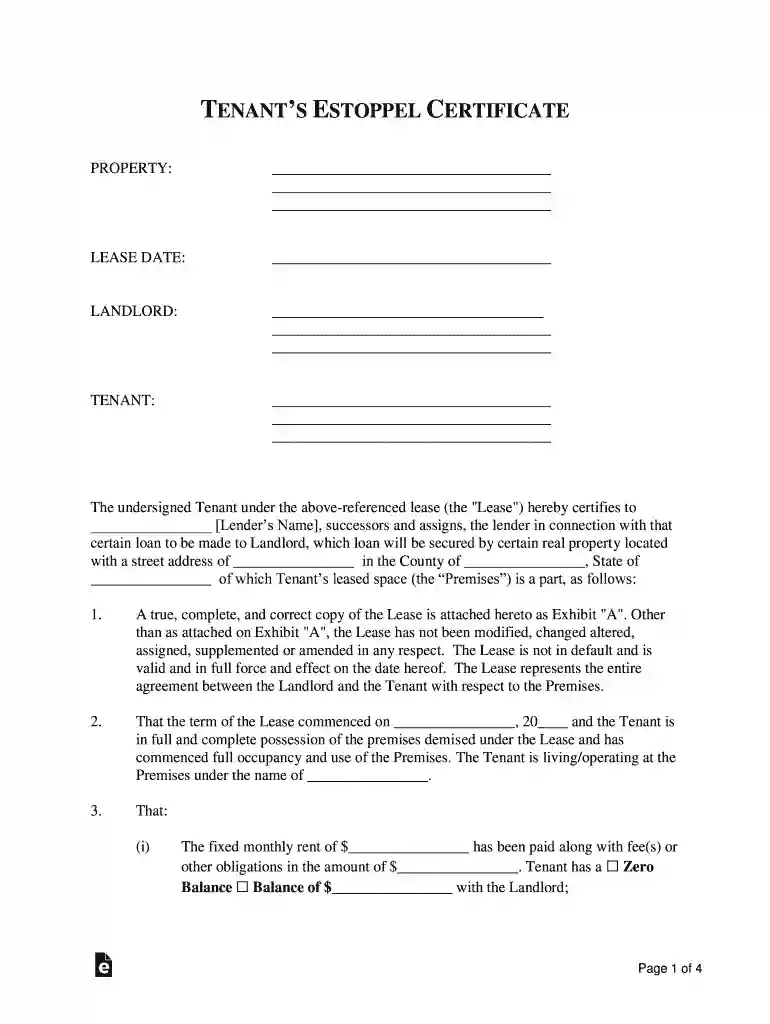
An Estoppel Letter, also referred to as a Tenant's Estoppel Certificate, serves as a crucial document in verifying the terms of an existing lease agreement between a tenant and a landlord. It legally validates the status of the lease, assuring involved third parties—such as potential lenders or buyers—of the tenant's compliance with the lease terms. In contexts where property sales or financing is considered, this document provides reassurance regarding the tenant’s financial obligations and adherence to the lease agreement.
Estoppel Letters are predominantly used in scenarios where a property is sold, or when refinancing is sought. By solidifying lease details, they mitigate potential disputes regarding tenant obligations. These documents are typically utilized by:
Legally, Estoppel Letters bind the signatory to the statements made within the document, holding them accountable. For landlords and tenants, inaccuracies can lead to potential legal disputes or financial liabilities. They serve not only as a verification tool but also as protection against unfounded claims or misunderstandings in legal proceedings.
Primarily the forms are adopted by:


Consider a commercial property sale where the buyer requires assurance of lease details to secure financing. The Estoppel Letter provides this verification, ensuring the lease terms are precisely understood and reducing the risk of post-sale disputes.
While Estoppel Letters are generally uniform, some states might impose specific regulations regarding their content or usage, often influenced by local real estate laws. Thus, understanding regional legal frameworks and consulting with local experts can ensure compliance and maximize efficacy.
In California, specific disclosures regarding tenant claims must be meticulously documented due to stringent consumer protection laws, ensuring clarity and avoiding legal pitfalls associated with misinformation in Estoppel documentation.
In modern digitized settings, Estoppel Letters are increasingly filled and stored electronically:
Platforms like DocHub support digital Estoppel document completion and secure sharing, enabling improved data management and compliance tracking, thereby enhancing operational efficiency.
Failure to provide or incorrectly completing an Estoppel Letter can result in:
A property owner failing to disclose accurate tenant payment history may face challenges from buyers or lenders, leading to financial penalties or even legal action for misrepresentation or fraud.
By understanding and utilizing Estoppel Letters correctly, stakeholders can effectively navigate lease-related processes and transactions, reducing potential legal risks and ensuring transparency in commercial property dealings.
At DocHub, your data security is our priority. We follow HIPAA, SOC2, GDPR, and other standards, so you can work on your documents with confidence.



4 days ago Every tenancy would need a written agreement filed with the Rent Authority Section 4(1) let or take on rent any premises the estoppel rule in
An estoppel certifies the terms, conditions, and current status of a lease, which therefore provides proof of cash flow, which makes it an important step in theRead more


