







Definition & Meaning
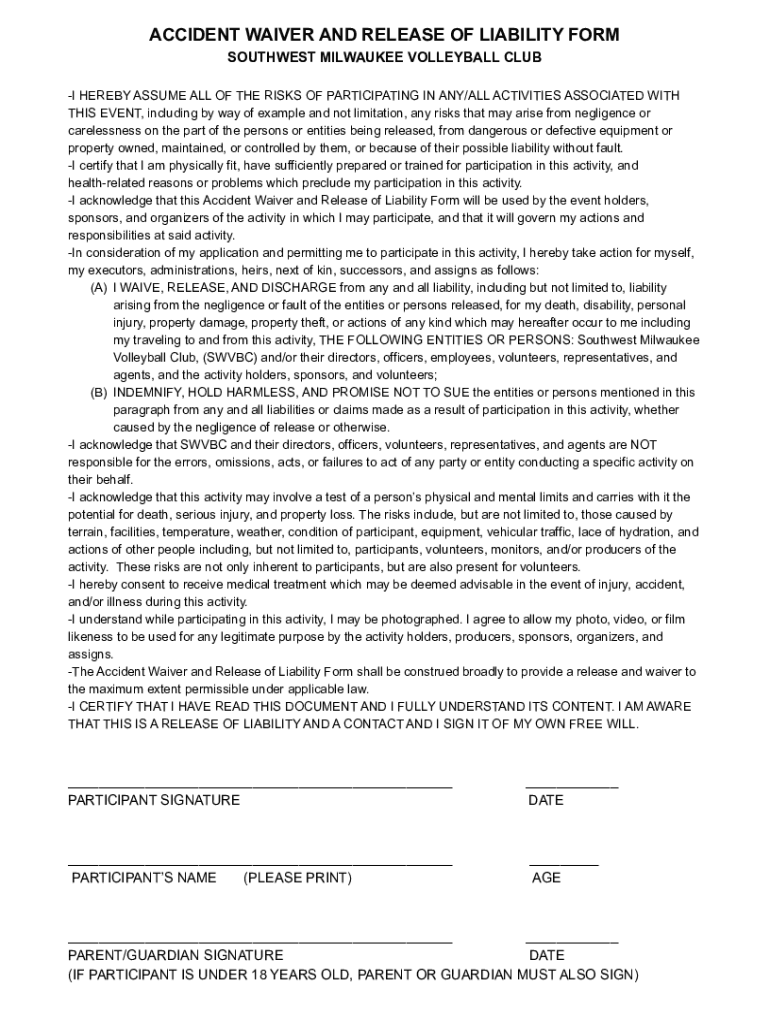
An Accident Waiver and Release of Liability Form is a legal document where participants acknowledge the risks associated with activities and agree to waive liability for injuries or damages. This form is essential for organizers of events or activities, such as the Southwest Milwaukee Volleyball Club, to protect themselves against legal claims from participants who may suffer injuries. It typically includes consent for medical treatment and permission for the use of images taken during the event, underscoring participant understanding and acceptance of the terms.
How to Use the Accident Waiver and Release of Liability Form - Ngin
The form is employed in scenarios where participants engage in activities that carry inherent risks. Organizers distribute this form to participants beforehand, who must read, comprehend, and sign it as a prerequisite for participation. Ensuring participants understand the terms is crucial to prevent any disputes. Event coordinators may also use the form to highlight specific risks involved in their activities.
Step-by-Step Usage
- Distribute the Form: Before the event, send the form to all participants electronically or provide hard copies.
- Facilitate Understanding: Encourage participants to review the document thoroughly and explain any complex terms or conditions.
- Collect Signatures: Secure signatures from all participants, confirming their understanding and agreement.
- Store Securely: Maintain signed forms securely for future reference, preferably in both digital and physical formats.
Key Elements of the Accident Waiver and Release of Liability Form - Ngin
The form comprises several critical sections that outline participant responsibilities and constraints on liability.
Main Sections
- Risk Acknowledgment: Participants explicitly recognize the risks inherent in the activity.
- Waiver of Claims: Participants agree to waive any claims arising from their participation, including injuries or damages.
- Medical Treatment Consent: Participants consent to receive medical treatment if necessary.
- Media Release: Permission for the use of images or footage taken during the event.
Steps to Complete the Accident Waiver and Release of Liability Form - Ngin
Completing this form involves several straightforward steps to ensure it is properly executed and legally binding.
Completion Process
- Fill in Personal Details: Participants must provide their full name, contact information, and any other personal data required.
- Read Thoroughly: Carefully read the entire form, paying close attention to the risks and waivers.
- Acknowledge Understanding: Initial sections to affirm understanding and acceptance of terms.
- Sign and Date: Finally, sign and date the form to formalize the agreement.
Legal Use of the Accident Waiver and Release of Liability Form - Ngin
Legally, this form serves multiple purposes. It provides clear evidence that the participant was informed of and accepted the risks, significantly reducing liability exposure for event organizers. However, for the form to be enforceable, it must be properly drafted, omitting any language that could be deemed unconscionable or misleading. Consultation with legal professionals is advised to ensure compliance with state-specific laws.
Important Terms Related to the Accident Waiver and Release of Liability Form - Ngin
Understanding key terms used in the form is vital for both participants and organizers.
Glossary
- Negligence: A legal term indicating a party's failure to exercise reasonable care, potentially leading to harm.
- Indemnity: An obligation to provide financial restitution for losses or damage, which participants typically agree to waive.
- Force Majeure: Events outside the control of the parties, such as natural disasters, which may affect the agreement.
Examples of Using the Accident Waiver and Release of Liability Form - Ngin
Several practical scenarios illustrate the use of this form:
- Sports Events: Attendees of a community sports tournament sign the waiver to acknowledge the risk of injury during gameplay.
- Adventure Activities: Participants in adventure sports like rock climbing or skydiving sign to accept the inherent dangers and waive claims.
- Corporate Team Building: Companies hosting physical team-building exercises use the form to mitigate liability.
Who Typically Uses the Accident Waiver and Release of Liability Form - Ngin
The form is commonly used by a variety of organizations and individuals:
- Event Organizers: From marathons to festivals, organizers use it to manage risk.
- Recreational Facilities: Gyms, parks, and climbing walls require it from users.
- Professional Instructors: Coaches and trainers often use it when conducting training sessions.


State-Specific Rules for the Accident Waiver and Release of Liability Form - Ngin
While this form is generally used nationwide, certain states may have specific requirements or restrictions regarding its enforceability. For instance, some states might have more stringent consumer protection laws, affecting the form's language or the validity of waivers. Legal advice is recommended to align with state regulations, ensuring the form's enforceability in the jurisdiction where it is used.




