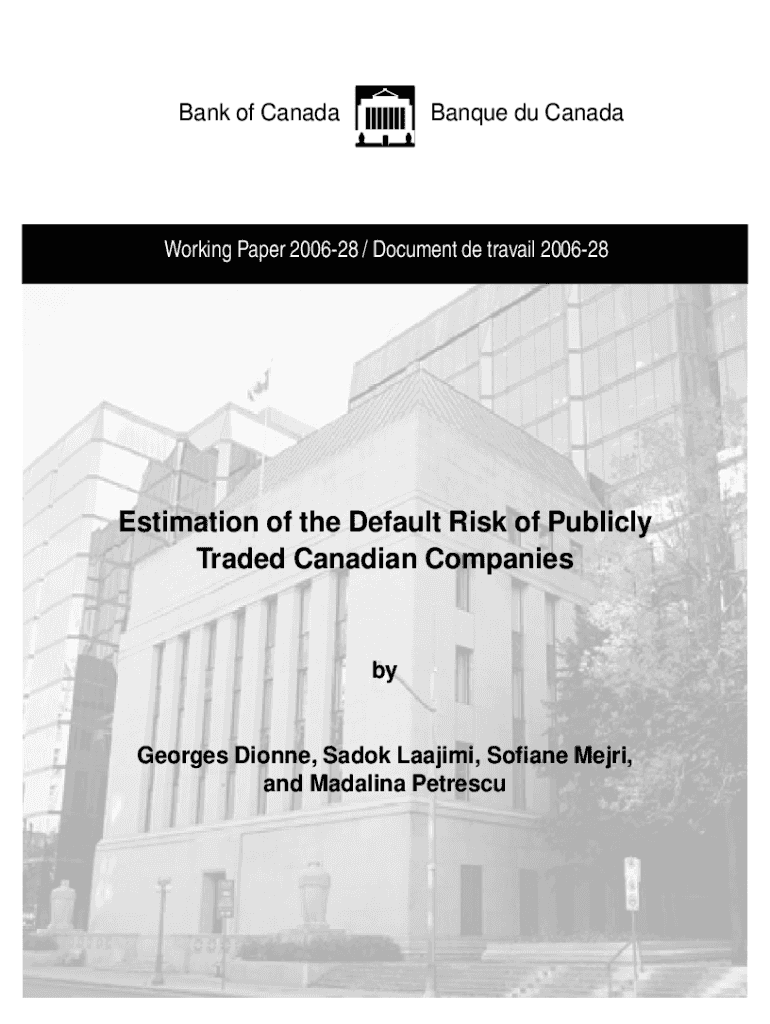







Understanding the Estimation of Default Risk
Estimating the default risk of publicly traded Canadian companies involves assessing the likelihood that a company will fail to meet its debt obligations. This process is crucial for investors, financial analysts, and risk managers who need to gauge the financial health and stability of these corporations. The method typically incorporates both quantitative and qualitative data, such as financial ratios, market trends, and economic indicators. Understanding these elements can help predict potential financial distress, guiding investment decisions and risk management strategies.
How to Use Default Risk Estimations
To effectively use default risk estimations, stakeholders must integrate these insights into broader financial analyses. Financial analysts can leverage these estimations to adjust investment portfolios, prioritizing lower-risk opportunities while remaining vigilant about potential high-risk investments that might promise higher returns. Risk managers can use this data to refine credit policies and mitigate potential losses. Furthermore, regulatory bodies might utilize these estimations to monitor and ensure the financial stability of markets and institutions.
Practical Applications
- Portfolio Management: Adjust investment strategies based on a company's default probability.
- Credit Assessment: Improve lending decisions by evaluating the borrower's risk level.
- Regulatory Oversight: Monitor market health and financial institution compliance.
Steps to Complete a Default Risk Estimation
- Data Collection: Gather relevant data, including financial statements, stock market performance, and economic indicators.
- Model Selection: Choose an appropriate risk assessment model that suits the specific characteristics of Canadian companies.
- Analysis Execution: Apply the model to the collected data to generate a default risk score.
- Result Interpretation: Analyze and interpret the results to make informed financial decisions.
Key Considerations
- Accuracy: Ensure data accuracy and model precision to avoid misleading outcomes.
- Frequency: Regularly update estimations to reflect current market conditions.
Key Elements of Default Risk Estimation
Several core elements contribute to the accuracy and reliability of default risk estimations. These include:
- Market Valuation: Considering stock prices and market trends to assess a company's perceived value.
- Financial Health Indicators: Using financial ratios such as debt-to-equity and current ratios to evaluate fiscal stability.
- Economic Factors: Accounting for broader economic conditions impacting market sectors.
Who Typically Uses Default Risk Estimations
Default risk estimations are valuable tools for various stakeholders, including:
- Investors: To evaluate potential risks and returns on investments.
- Credit Analysts: To determine the creditworthiness of companies seeking funding.
- Corporate Managers: To assess and mitigate their company's financial risk exposure.
- Regulatory Authorities: To oversee market risk and protect against systemic failures.
Examples of Using Default Risk Estimations
Consider an investor choosing between investing in two companies. One company has a high default risk score, indicating financial instability, while the other demonstrates lower risk. The estimation informs the investor's decision to favor the more stable investment. Similarly, a bank uses these estimations to decide credit limits for corporate loans, reducing exposure to potentially defaulting borrowers.
Real-World Scenario
A Canadian telecommunications company shows signs of financial distress, with declining profits and increasing debt. The estimated default risk prompts stakeholders to reevaluate their investment and credit strategies regarding this company.
Importance of Default Risk Estimation
Why should stakeholders prioritize the estimation of default risk? Understanding and managing default risk is vital to:
- Protect Investments: Safeguard assets against potential losses from company defaults.
- Enhance Credit Decisions: Improve the reliability of lending practices.
- Ensure Financial Stability: Maintain a stable and resilient financial market.
Required Documents for Default Risk Analysis
Conducting a thorough default risk analysis necessitates access to various documents:
- Financial Statements: Balance sheets, income statements, and cash flow statements.
- Market Data: Stock price histories and trading volumes.
- Economic Reports: Macro-economic indicators relevant to industry sectors.
Legal and Compliance Aspects
Using default risk estimations in compliance with legal standards is critical. Adhering to regulations, such as those set by securities and financial authorities, ensures that these analyses are not only beneficial but also conform to industry standards and prevent potential legal complications.