






Definition & Meaning
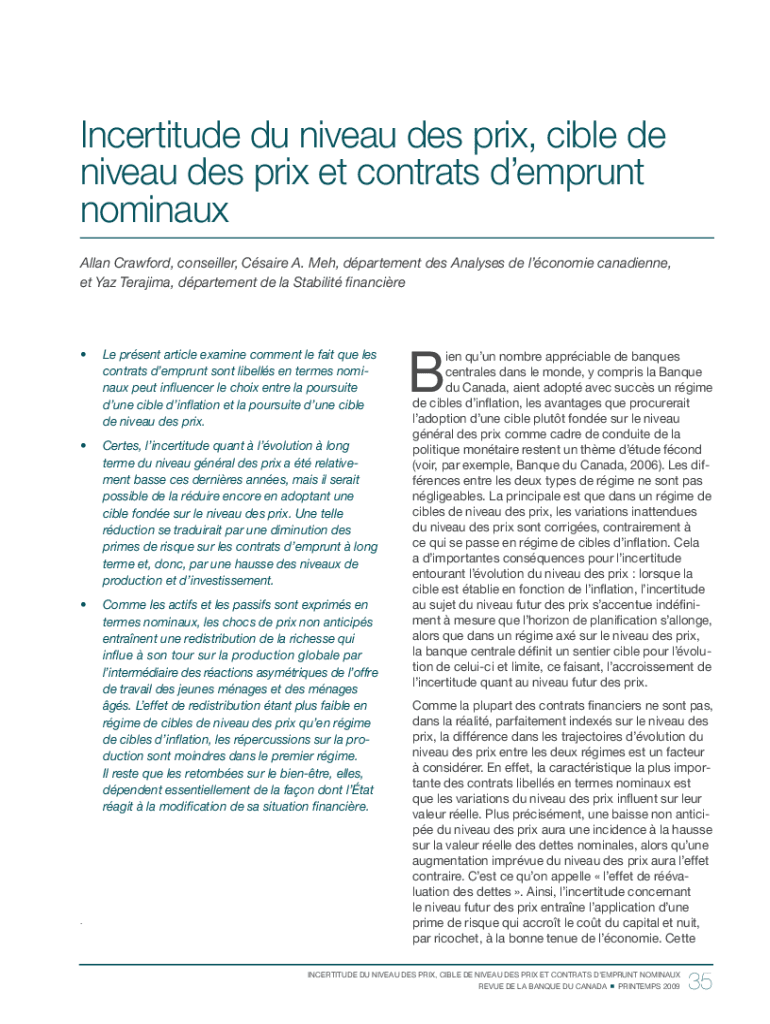
The concept of "Incertitude du niveau des prix, cible de - Banque du Canada" refers to the uncertainty surrounding price levels and the Bank of Canada's target for price stability. It involves a framework where the central bank aims to maintain a specific price level target, as opposed to an inflation rate target. This system seeks to deliver economic predictability, minimize the risks associated with long-term borrowing, and enhance economic stability.
Price Level Targeting
- This approach focuses on stabilizing the overall price level rather than the inflation rate.
- It implies an adjustment in monetary policy to counteract deviations from a predetermined price path, aiming for long-term price stability.
Economic Implications
- The strategy may reduce risk premiums on long-term loans by decreasing uncertainty about future price levels.
- It can enhance economic output and investment by providing a predictable economic environment.
Key Elements of the Incertitude du niveau des prix, cible de - Banque du Canada
Understanding the framework involves identifying its fundamental components and how they interact to achieve economic goals.
Central Bank's Role
- The Bank of Canada sets and communicates the targeted price level to guide monetary policy.
- It adjusts interest rates as necessary to ensure adherence to the predetermined price path.
Impact on Inflation and Output
- Reduces unanticipated price shocks that can redistribute wealth and disrupt production.
- Provides a more stable economic environment compared to inflation targeting.
How to Use the Incertitude du niveau des prix, cible de - Banque du Canada
Applying this concept involves integration into monetary policy decisions and strategic planning for economic stakeholders.
Policymaker Guidelines
- Utilize historical data and economic forecasts to set a robust price path.
- Monitor economic indicators actively to adjust policies, maintaining alignment with the target.
Business Strategy Adaptation
- Businesses can plan long-term investments more confidently with a stable economic forecast.
- Understand the potential impact on borrowing costs and financial planning.
Important Terms Related to Incertitude du niveau des prix, cible de - Banque du Canada
Grasping the terminology integral to price level targeting helps in comprehending its practical application.
Price Path
- A pre-established trajectory for the overall price level that guides monetary policy actions.
- Provides benchmarks for assessing the effectiveness of monetary policy.
Monetary Policy Instruments
- Tools like interest rate adjustments and open market operations used to influence the economic environment.
- Ensures adherence to the price level target by influencing inflation and economic activity.
Legal Use of the Incertitude du niveau des prix, cible de - Banque du Canada
Legal frameworks guide the implementation and compliance with monetary policies centered on price level targeting.
Regulatory Compliance
- Governed by statutes and regulations that define the Bank of Canada's powers and objectives.
- Ensures transparency and accountability in achieving price stability objectives.
Implications for Contracts
- Encourages the formulation of contracts with clauses sensitive to price level fluctuations.
- Enhances the predictability of long-term financial agreements.
Examples of Using the Incertitude du niveau des prix, cible de - Banque du Canada
Real-world applications demonstrate the effectiveness and challenges of price level targeting.
Case Studies
- Countries like Sweden have experimented with similar frameworks to maintain economic stability.
- Outlines experienced benefits in terms of reduced inflation volatility and sustained economic growth.
Comparative Analysis
- Evaluates the outcomes relative to inflation targeting regimes.
- Highlights differences in economic resilience and adaptability.
Steps to Complete the Incertitude du niveau des prix, cible de - Banque du Canada
Implementing this price level targeting involves a systematic approach for central banks and stakeholders.
- Setting the Target: Determining the desired price path based on economic objectives and conditions.
- Monitoring and Adjustment: Continuously reviewing economic data and adjusting policies to stay aligned with the target.
- Public Communication: Clearly communicating policy changes and their expected impact on the economy.
- Assessment and Review: Periodically evaluating the effectiveness of the policy framework and making necessary changes.
Who Typically Uses the Incertitude du niveau des prix, cible de - Banque du Canada
Identifying the primary beneficiaries of this approach helps in understanding its reach and impact.


Central Banks
- Key implementers responsible for maintaining economic stability through targeted policies.
- Makes adjustments based on domestic and global economic indicators.
Businesses and Investors
- Beneficiaries of a stable economic environment that facilitates long-term financial planning and investment.
- Reduces risks associated with unexpected price volatility and its economic impacts.