






Definition and Meaning
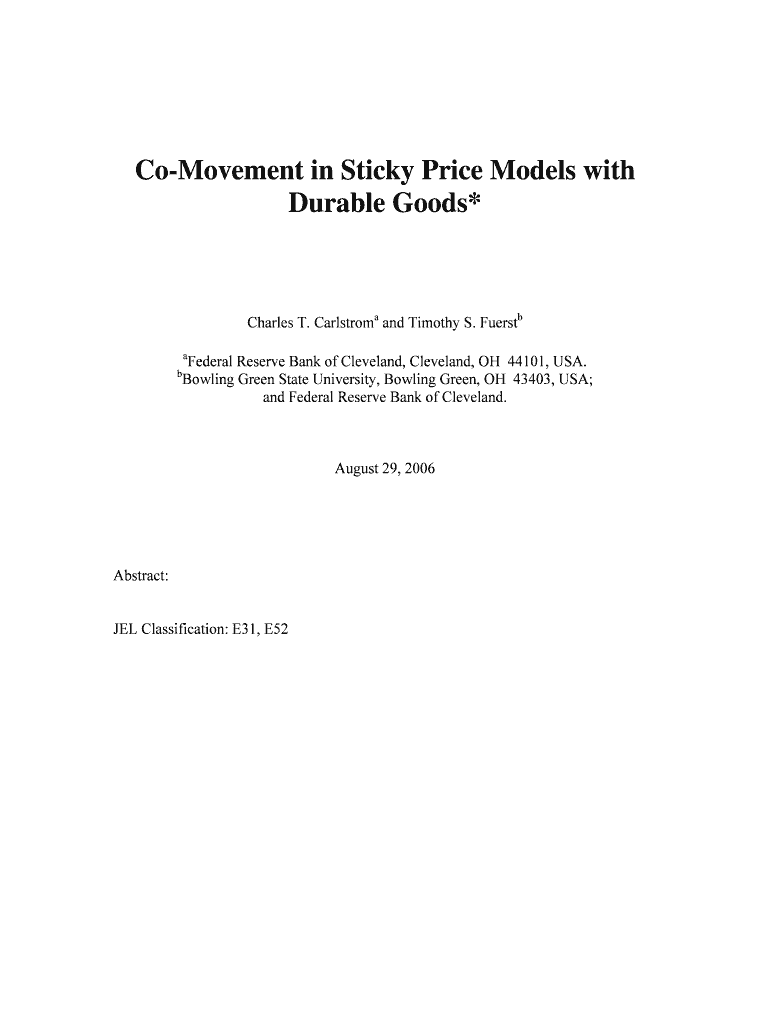
The concept of "Co-Movement in Sticky Price Models with" explores how changes in prices, particularly in sectors like durable and non-durable goods, align or diverge based on their inherent price flexibility. In these economic models, prices of durable goods, such as residential housing, are often more flexible compared to non-durable goods. This flexibility can lead to disparities in how these sectors respond to economic policies or shocks. Understanding this co-movement is essential for economists to predict and interpret economic trends accurately.
How to Use Co-Movement in Sticky Price Models
To effectively analyze co-movement in sticky price models, consider the following steps:
- Identify Sectors: Focus on sectors with varying levels of price stickiness, such as durable and non-durable goods.
- Analyze Price Data: Gather historical price data to observe trends and fluctuations.
- Apply Economic Theories: Utilize relevant economic theories to interpret how price stickiness affects co-movement across sectors.
- Evaluate Policy Impacts: Investigate how different monetary policies influence price changes in these sectors.
This step-by-step approach allows for comprehensive analysis and understanding of co-movement patterns.
Key Elements of Co-Movement in Sticky Price Models
Exploring the key elements within this framework involves examining several critical components:
- Price Stickiness: Understand the degree of price flexibility or rigidity in various goods.
- Sector Responses: Investigate how sectors with different levels of price stickiness react to economic stimuli.
- Monetary Policy Impact: Analyze how monetary policies affect sectors differently, leading to unique production responses.
- Model Variations: Consider different models that incorporate factors like wage stickiness or credit constraints to solve co-movement puzzles.
These elements are crucial for constructing accurate and reliable sticky-price economic models.
Examples of Using Co-Movement in Sticky Price Models
Practical examples provide clarity on the utility of co-movement models:
- Housing Market Analysis: Real estate price flexibility can lead to different reactions to interest rate changes compared to grocery prices.
- Automobile Prices: The car industry’s reactions to economic slowdowns may not align with sectors like apparel, due to differing price stickiness.
- Monetary Policy Shocks: Evaluate how sudden changes in interest rates cause varied responses in durable and non-durable goods sectors.
These examples highlight the diverse applications and insights gained from using co-movement models in economic analysis.
Important Terms Related to Co-Movement in Sticky Price Models
A clear understanding of these terms is vital for effective use:
- Durable Goods: Items with prolonged use, such as appliances or vehicles.
- Non-Durable Goods: Consumables like food and clothing with short usage spans.
- Price Stickiness: Resistance to changing prices despite economic forces.
- Real Wage Movements: Adjustments in wages, accounting for inflation impacts.
Familiarity with these terms ensures better comprehension and application of co-movement models.
State-Specific Rules for Co-Movement in Sticky Price Models
While the principles of co-movement models generally apply universally, certain state-specific regulations can influence outcomes:
- Tax Incentives: Some states offer specific tax incentives impacting durable goods pricing.
- Housing Regulations: State-level housing policies and real estate taxes can affect residential pricing models.
- Local Economic Policies: Unique regional economic policies impacting sectoral responses.
It's crucial for analysts to consider these variations when applying co-movement models to state-level data.
Why Use Co-Movement in Sticky Price Models
The application of co-movement in sticky price models offers several advantages:
- Enhanced Economic Predictions: Provides detailed insights into sectoral price movements and economic trends.
- Policy Evaluation: Assists in assessing the efficacy of economic policies on different sectors.
- Comprehensive Analysis: Enables a thorough understanding of the dynamic interplay between durable and non-durable goods pricing.
Incorporating co-movement models into economic analysis supports more informed decision-making and improved policy design.
Software Compatibility
For effective analysis and modeling, compatibility with various software platforms is beneficial:
- Excel: Use spreadsheets for data organization and basic model calculations.
- Stata/R: Employ statistical software for advanced econometric analysis.
- Matlab: Useful for creating intricate models and simulations.
These tools streamline the analysis process and enhance the precision of co-movement evaluations.