






Definition & Meaning
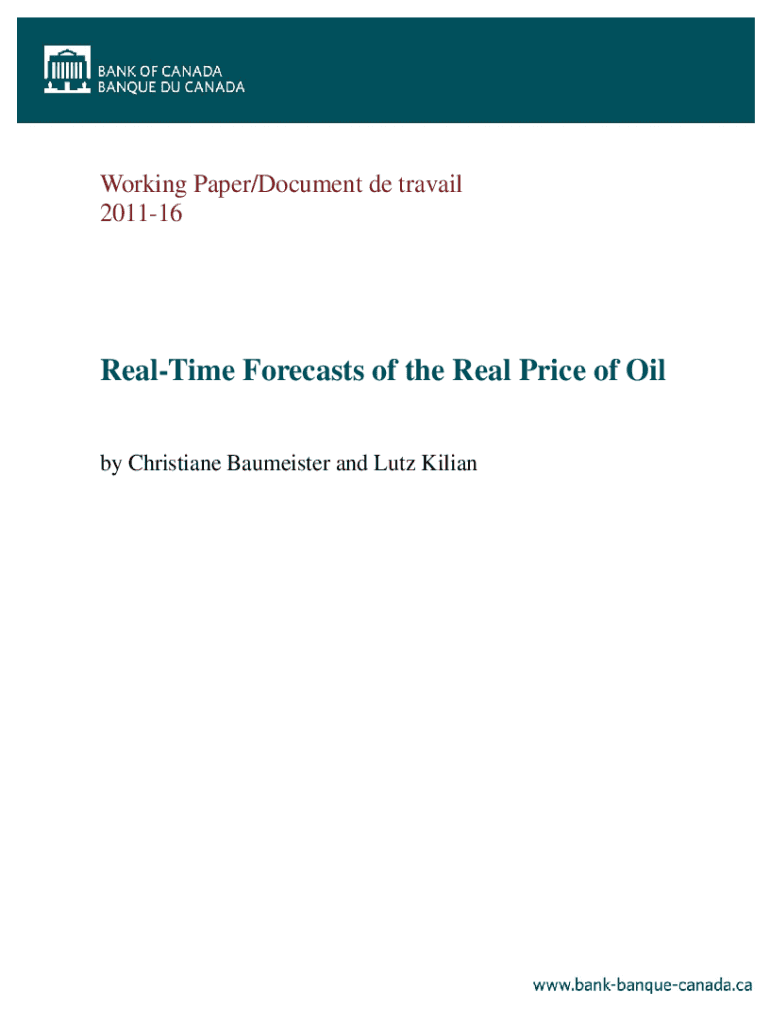
Real-Time Forecasts of the Real Price of Oil - EconPapers refers to the predictive analysis techniques used to estimate future oil prices based on real-time data. This method diverges from traditional approaches by incorporating up-to-the-minute information, allowing for more accurate forecasting. Designed for economists and analysts, it leverages statistical models, such as vector autoregressive (VAR) models, to analyze various factors influencing oil prices, including geopolitical events, supply and demand fluctuations, and market trends.
How to Use the Real-Time Forecasts of the Real Price of Oil - EconPapers
To utilize these forecasts effectively, users should understand the underlying models and data sources. Typically, the process involves:
- Data Collection: Gather real-time data on oil prices and related economic indicators.
- Model Selection: Choose the appropriate forecasting model, often VAR models, for analysis.
- Analysis: Enter the data into the selected model to generate forecasts.
- Interpretation: Assess the model's output to make informed predictions regarding future oil prices.
Steps to Complete the Real-Time Forecasts Process
Completing a real-time forecast requires several steps:
- Identify Data Sources: Use reliable platforms like financial databases and economic reports.
- Input Data: Enter the latest figures into a forecasting software or spreadsheet.
- Run the Model: Execute the selected model to output a forecast.
- Review Results: Compare forecasted prices against expected patterns and global events.
Key Elements of the Real-Time Forecasts
Essential components of this forecasting process include:
- Data Timeliness: Real-time access ensures accuracy in predictions.
- Model Accuracy: Selection of robust models, like recursive VAR, for precise outcomes.
- Scenario Analysis: Evaluate forecasts under various hypothetical conditions.
Important Terms Related to This Process
Understanding these terms can enhance comprehension:
- Vector Autoregressive (VAR) Models: A statistical model used to capture the relationship between multiple time series data points.
- Backcasting: Reconstructing past data using the same predictive models.
- Nowcasting: Estimating the present state of a variable using current data.
Who Typically Uses the Real-Time Forecasts
Primarily, these forecasts are used by:
- Economists: To analyze market trends and predict economic outcomes.
- Oil Traders: For making informed trading decisions.
- Policymakers: To create strategies aligning with economic and market predictions.


Legal Use of Real-Time Forecasts
When using these forecasts, it's important to ensure compliance with relevant legal frameworks. Analysts should consider:
- Data Sharing Regulations: Adhere to laws regarding the use and distribution of market data.
- Intellectual Property: Respect proprietary models and data sources.
Examples of Using Real-Time Forecasts
Real-world applications include:
- Investment Strategy: Traders adjust portfolios based on anticipated oil price changes.
- Policy Development: Governments plan energy policies using future price estimates.
- Corporate Planning: Companies strategize operations in response to projected oil market dynamics.