






Definition & Meaning
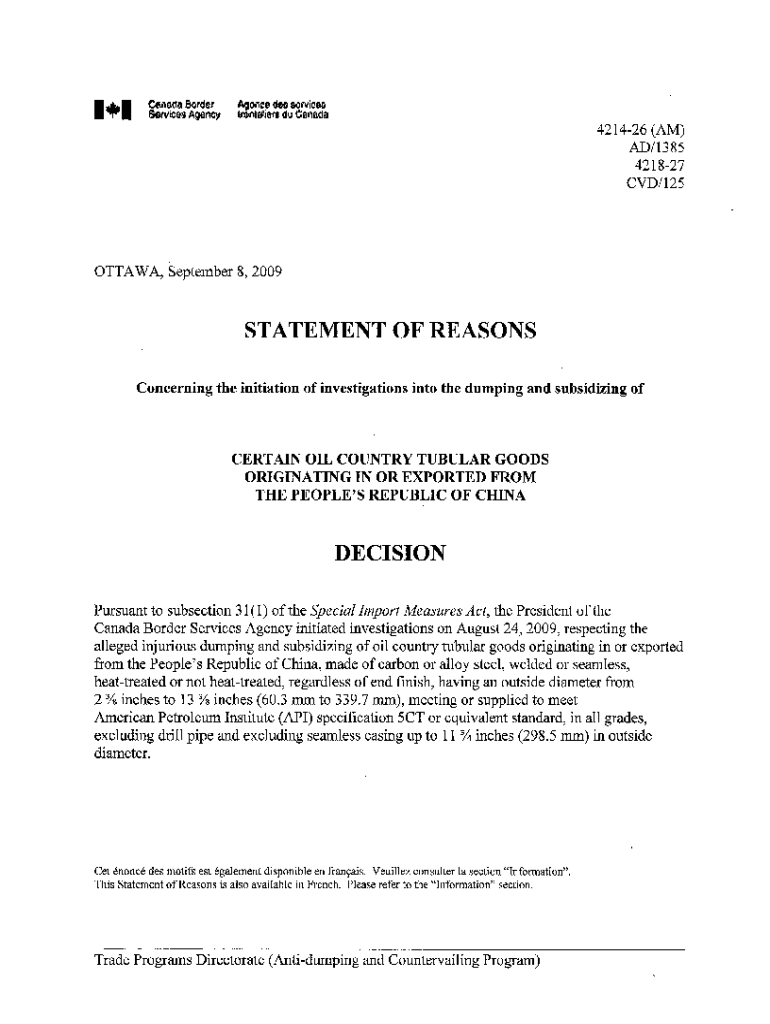
The "Statement of Reasons - Agence des services frontaliers du Canada" refers to a formal document issued by the Canada Border Services Agency (CBSA). It elucidates the initiation and findings of investigations into international trade practices such as dumping and subsidizing of certain goods, in this case, oil country tubular goods (OCTG) from China. The document offers a comprehensive explanation of the allegations put forth by Canadian producers, who claim that these imports are unfairly priced, harming the local industry. It serves as a foundation for understanding the investigations' scope and rationale.
Key Elements of the Statement of Reasons
The statement typically includes several critical elements:
- Allegations: Details on accusations of unfair trade practices, such as dumping, where foreign goods are sold below their normal value.
- Evidence & Analysis: Presentation of proof supporting the claims, including market data and pricing comparisons.
- Product Definitions: Specifies the goods involved, using precise classifications to avoid ambiguity.
- Impact Assessments: Analysis of the potential or actual harm to domestic industries, considering economic factors and market conditions.
- Future Actions: Proposed regulatory or administrative steps by the CBSA, including possible tariffs or trade restrictions.
How to Obtain the Statement of Reasons
Interested parties can obtain the "Statement of Reasons" directly from the CBSA. Various methods are available for accessing these documents:
- Online Access: The CBSA's official website usually hosts these documents, providing a digital version for download.
- Direct Request: Stakeholders can request hard copies from the CBSA via mail or telephone, especially for official or legal use.
- Public Records: As a government document, it might also be accessible through public records or information systems, depending on jurisdictional rules regarding public access to government documents.
Steps to Complete the Investigation Process
Understanding the function of the statement within the investigative process is crucial. Here is a step-by-step breakdown:
- Initiation: The process starts with a formal complaint from domestic producers alleging unfair trade practices.
- Preliminary Investigation: CBSA conducts an initial review to determine if a full investigation is warranted.
- Documentation & Evidence Gathering: Collection of relevant data and evidence supporting the claims.
- Detailed Analysis: Assessment of the dumping and subsidization claims through comprehensive economic and trade analysis.
- Issuance of the Statement of Reasons: The document is released after concluding the investigation phase, outlining findings and proposed actions.
- Public Participation: Stakeholders are often allowed to comment or provide additional information during a specified period.
Legal Use of the Statement of Reasons
This document plays a critical role in legal and regulatory frameworks. It provides:
- Justification for Trade Measures: Legal grounding for imposing duties or tariffs on unfairly traded goods.
- Reference for Dispute Resolution: It can be used in trade dispute settings, including international bodies like the World Trade Organization (WTO).
- Transparency & Accountability: Ensures CBSA's investigative processes meet legal standards of transparency and accountability.
Examples of Using the Statement of Reasons
To better grasp its application, consider these scenarios:
- Trade Disputes: Canadian manufacturers leverage the statement to argue for protective measures in trade tribunals.
- Policy Development: Government agencies use these documents to shape future trade policies and negotiations.
- Market Analysis: Analysts use the detailed findings and data to study market dynamics and the impact of foreign competition on domestic industries.
Important Terms Related to the Statement of Reasons
Familiarity with specific terminology enhances comprehension:
- Dumping: Selling goods in a foreign market at prices lower than the home market or below production cost.
- Subsidization: Government financial support to local producers, making exported goods cheaper and more competitive.
- Injury: Economic harm caused to a domestic industry due to unfair trade practices.
- Countervailing Duties: Tariffs imposed to counteract the effects of subsidies granted to foreign producers.
Penalties for Non-Compliance
Failing to adhere to the findings in the statement can result in:
- Trade Sanctions: Imposition of duties, tariffs, or penalties against non-compliant entities.
- Legal Repercussions: Potential fines and legal actions for disregarding trade regulations and obligations.
- Reputational Damage: Negative impact on a company’s reputation, affecting its market position and stakeholder trust.
Form Submission Methods
To submit relevant documents or responses in relation to the statement:
- Online Platforms: Electronic submission through the CBSA's web portals is usually encouraged for efficiency.
- Mail: Hard copy submissions can also be processed, though they may have longer turnaround times.
- In-Person: Direct submission to CBSA offices is possible for those requiring confirmation of receipt or needing additional assistance.
Who Typically Uses the Statement of Reasons
A wide array of stakeholders utilize this document, including:
- Domestic Producers: Companies and industries seeking to protect market share and competitiveness.
- Trade Lawyers and Advisors: Professionals providing legal guidance on trade compliance and dispute resolution.
- Government Agencies: Entities involved in trade policy development and enforcement.
- International Traders: Businesses involved in importing goods from foreign markets, benefiting from understanding the regulatory landscape.