
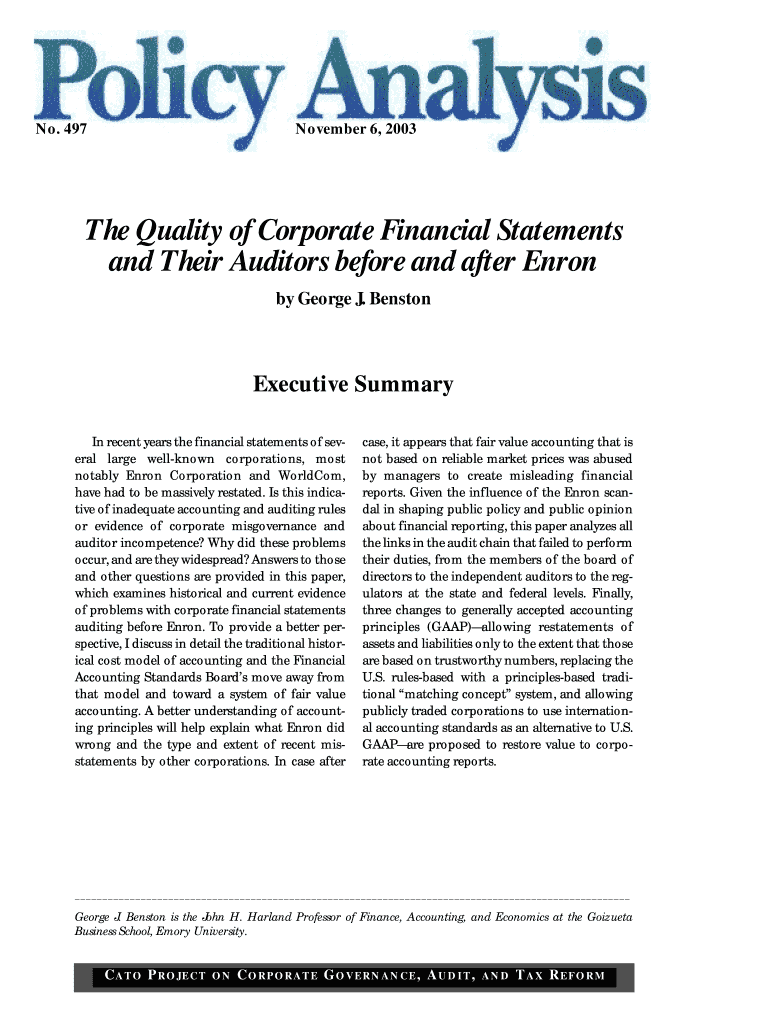







Definition & Meaning
"The Quality of Corporate Financial Statements and - Cato Institute" pertains to the evaluation and review of corporate financial statements, focusing on their accuracy, compliance, and reliability. This encompasses auditing practices, adherence to accounting standards such as Generally Accepted Accounting Principles (GAAP), and the impact of these factors on the transparency and trustworthiness of financial information. The Cato Institute's involvement suggests a perspective that emphasizes regulatory policies, historical analysis, and proposals for reforming financial reporting practices.
Key Elements of Corporate Financial Statements
Corporate financial statements typically include primary documents such as the balance sheet, income statement, and cash flow statement. Each of these elements serves a unique purpose in providing a comprehensive overview of a company's financial position:
- Balance Sheet: Displays assets, liabilities, and equity at a specific point in time.
- Income Statement: Covers revenues, expenses, and profits over a reporting period, illustrating financial performance.
- Cash Flow Statement: Details the inflow and outflow of cash, categorizing into operations, investing, and financing activities.
These statements are prepared in accordance with GAAP, ensuring consistency, and comparability.
How to Use the Report
To effectively use the insights from "The Quality of Corporate Financial Statements and - Cato Institute," readers should:
- Evaluate Current Practices: Assess how current accounting standards and auditing practices align with the findings.
- Identify Misstatements: Look for common violations of GAAP that could lead to inaccuracies.
- Consider Reforms: Analyze proposed regulatory reforms to understand their potential impact on financial transparency.
- Improve Internal Controls: Implement stronger internal controls and independent audits to enhance financial reporting.
Steps to Complete Financial Document Evaluation
Proper evaluation of corporate financial statements involves:
- Review Historical Context: Understand the history of accounting regulations and the shift from historical cost to fair value accounting.
- Audit with Precision: Ensure audits adhere strictly to GAAP and are carried out by independent public accountants (IPAs).
- Analyze for Misstatements: Detect and correct inaccuracies in financial reports.
- Propose Reforms: Suggest improvements in fair value accounting and principles-based standards to restore trust.
Legal Use and Compliance
Legal use of corporate financial statements involves:
- Regulatory Compliance: Ensuring compliance with GAAP and other relevant regulatory frameworks.
- Accurate Auditing: Accurate and thorough auditing to prevent fraudulent or misleading financial reporting.
- Disclosure Requirements: Adhering to disclosure requirements to maintain transparency in the financial reporting.
Non-compliance can lead to penalties and loss of credibility.
Importance of High-Quality Financial Statements
The quality of corporate financial statements is critical for:
- Stakeholder Trust: Building trust among investors, creditors, and other stakeholders.
- Informed Decision-Making: Providing a foundation for making informed business and investment decisions.
- Market Stability: Contributing to overall market stability by ensuring transparency and accuracy in financial reporting.
Examples of Regulatory Failures
Significant examples, such as the Enron scandal, highlight the importance of maintaining high-quality corporate financial statements. These incidents:
- Demonstrate the consequences of inadequate auditing and violations of accounting standards.
- Have led to regulatory reforms aimed at strengthening financial reporting practices.
Proposed Reforms for Enhanced Financial Reporting
Key reforms suggested in the context of improving financial statement quality include:
- Stricter Fair Value Accounting: Implementing more stringent rules to improve the reliability of fair value measurements.
- Principles-Based Standards: Moving towards standards that emphasize overarching principles rather than detailed rules.
- Accountability Among Stakeholders: Enhancing the accountability of auditors, boards of directors, and regulatory bodies.




