






Definition & Meaning
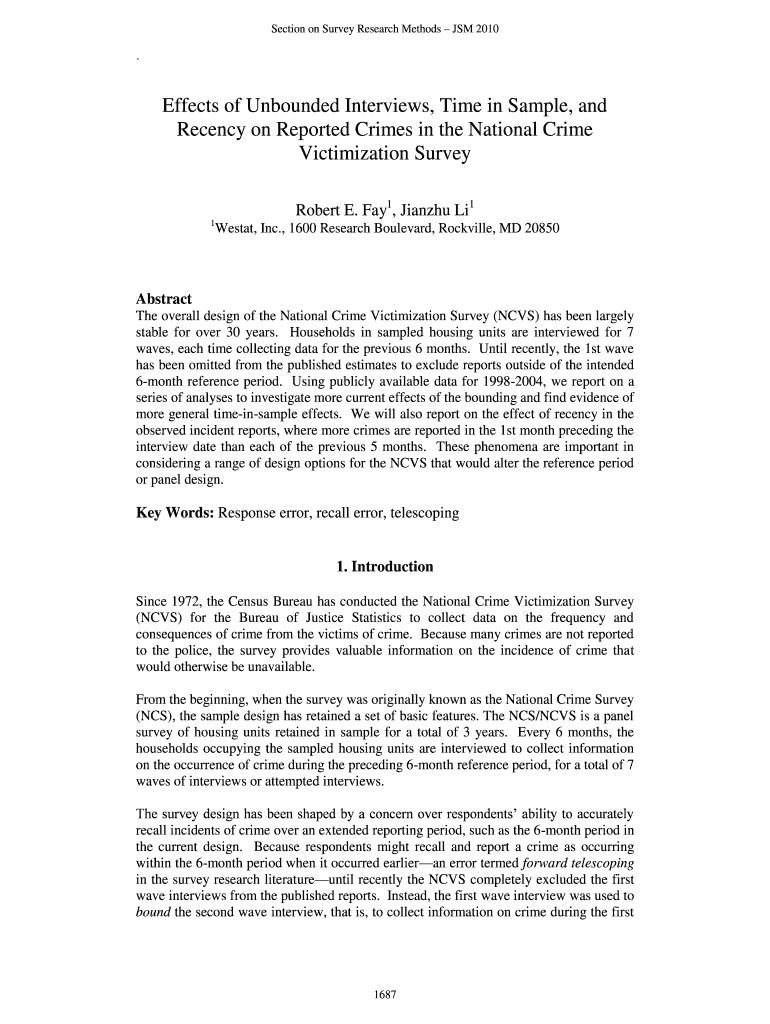
The "Effects of Unbounded Interviews, Time in Sample, and Recency on Reported Crimes in the National Crim" primarily refers to the methodological processes involved in the National Crime Victimization Survey (NCVS), which collects data on crime incidents in the United States. This survey has been instrumental in capturing crime-related data by interviewing households multiple times over various periods, known as waves. Unbounded interviews refer to the initial stage of the survey where no prior interviews exist for comparison, potentially impacting the accuracy due to recall errors or telescoping, where events outside of the reference period are reported.
Importance in Crime Data Collection
- Recall Errors: Participants may misremember the timing of an incident, affecting data accuracy.
- Telescoping: Incidents may be reported as more recent than they actually are, skewing the survey's results.
- Survey Design: Consistency in methodology helps maintain reliable data across years.
Key Elements of the Study
This form examines the critical components that influence crime data collected through surveys:
- Unbounded Interviews: The first interview in a series that sets the baseline without prior data for comparison.
- Time in Sample: Refers to the stage a respondent is at in the survey process, potentially affecting their reporting accuracy.
- Recency Effects: The potential tendency for respondents to more accurately recall events that occurred closer to the interview date.
Variations and Exceptions
- Multiple Waves in Households: Families might respond differently depending on their experience with interviews.
- Survey Period Adjustments: To improve accuracy, the survey design is sometimes adjusted to change reference periods.
How to Use the Findings
The findings of this analysis can be used by researchers and policymakers to refine the NCVS. Adjustments in survey design could markedly improve data quality by minimizing errors and ensuring more accurate crime statistics.
- Assess Current Methodologies: Regular review of current practices to identify potential areas for improvement.
- Adjust Survey Frequency: Changes in the timing between interviews can help mitigate recency effects.
- Train Interviewers: Enhanced training on how to ask questions can reduce recall bias.
Legal Use in Crime Reporting
The insights from this form have significant implications for crime reporting and legal analysis:
- Enhancing Data Standards: The results ensure that crime data standards are maintained at a high level.
- Policy Formulation: Used in creating policies that are data-driven and reflect true crime trends.
Compliance and Penalties
- Legal adherence to survey standards ensures the credibility of reported crime data.
- Non-compliance with these standardized methodologies may lead to inaccuracies and potentially misleading policy decisions.
Who Typically Uses the Findings?
These findings are valuable for a range of individuals and entities:
- Researchers and Academics: Employ the study to gain insights into victimization trends and methodological improvements.
- Policymakers and Law Enforcement: Use the data to shape public policies and safety strategies.
- Crime Analysts: Leverage findings for deeper analysis of crime trends and factors.


Important Terms Related to the Study
Understanding key terminology in this study helps clarify its impact and application:
- Unbounded Interview: Initial interview without a prior frame of reference.
- Time in Sample: A respondent's position within the survey cycles.
- Recency Bias: The tendency to report more recent incidents with greater accuracy.
Examples of Practical Application
Specific case studies and examples illustrate the real-world application of this study:
- Crime Prevention Strategies: Using accurate data to design community safety programs.
- Improved Crime Statistics: Adjusted methodologies could lead to more precise crime reporting and better allocation of resources.
Steps to Complete the Survey
Completing the survey effectively involves several critical steps:
- Initial Interview Setup: Establish unbounded interviews to get baseline data.
- Schedule Follow-ups: Conduct subsequent interviews at regular intervals.
- Data Verification: Ensure accuracy through cross-checks and consistency in questioning.
- Data Analysis: Regular analysis to identify and address any discrepancies.
Variants and Alternatives
Several versions and related methodologies exist that can complement this study:
- Alternative Crime Surveys: Comparative methods in different regions or sectors.
- Updated Questionnaires: New surveys might incorporate lessons learned from this study to improve data integrity.
State-Specific Rules and Regulations
While this study focuses broadly, certain states may apply specific rules impacting the implementation of findings:
- Localized Crime Trends: Some states tailor methodologies to address unique local crime patterns.
This comprehensive exploration of the "Effects of Unbounded Interviews, Time in Sample, and Recency on Reported Crimes in the National Crim" document offers extensive insight into the methodologies that shape national crime data in the United States. Through understanding these factors, stakeholders can significantly enhance the quality and utility of crime reporting.