






Definition and Meaning of Decomposing Design Effects
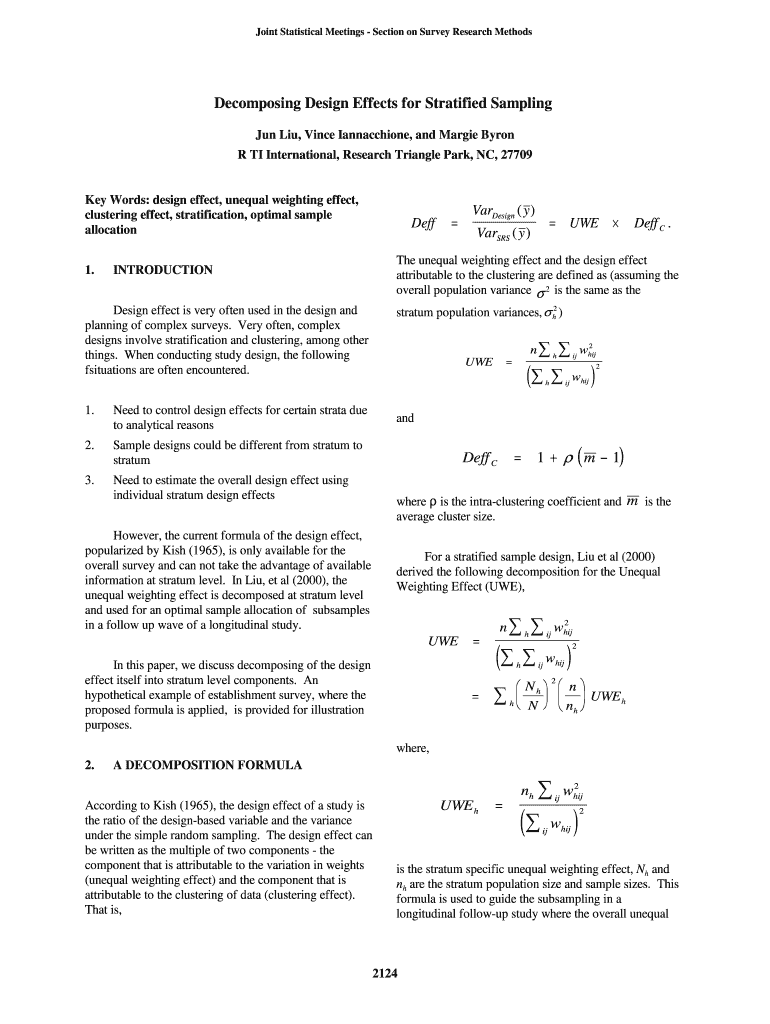
Decomposing design effects in stratified sampling involves breaking down the influence that different structural elements of a survey have on variance inflation. Typically, design effects help to assess the efficiency of a sampling design compared to simple random sampling. In the context of stratified sampling, where the population is divided into homogeneous subgroups called strata, decomposing these effects allows researchers to identify specific factors such as unequal weighting and clustering that may contribute to increased variance. Understanding these components is essential for optimizing sample allocation and improving survey accuracy, particularly in studies focused on diverse populations across various strata.
Key Components of Design Effects
- Unequal Weighting Effect: Results from assigning different weights to units in different strata.
- Clustering Effect: Arises when samples are drawn in clusters rather than individually, impacting variance.
How to Use the Form for Decomposing Design Effects
Using the form for decomposing design effects in stratified sampling involves several key procedures. To begin, identify all relevant strata within your population and the criteria for their stratification. This ensures that your sampling reflects the diverse characteristics present within the population, leading to more accurate statistical inferences.
Step-by-Step Use
- Identify Strata: Determine the criteria for stratification based on research goals.
- Assign Weights: Calculate appropriate weights for each stratum, factoring in population and sample sizes.
- Collect Data: Use weighted sampling to collect data across all designated strata.
- Analyze Variation: Decompose the total design effect to isolate contributions from unequal weighting and clustering.
Steps to Complete the Form
Completing the form for decomposing design effects in stratified sampling involves a systematic process. Follow these steps to ensure the process is handled efficiently and accurately:
Detailed Procedure
- Define Objectives: Clearly outline what you aim to achieve with the stratified sampling.
- Select Strata: Choose strata that are internally homogeneous yet distinct from each other.
- Sample Allocation: Determine an optimal sample size for each stratum.
- Collect Samples: Implement the sampling plan and gather data.
- Compute Design Effects: Use statistical software to calculate and decompose the design effects.
- Interpret Results: Analyze the findings to assess efficiency and make necessary adjustments.
Importance of Decomposing Design Effects
Decomposing design effects is crucial for researchers using stratified sampling methods, especially because it provides insights into the efficiency of the sampling framework. By understanding these effects, researchers can enhance survey reliability and data validity, ultimately leading to more robust statistical conclusions.
Benefits
- Enhanced Accuracy: Improved precision in estimating population parameters.
- Resource Optimization: Efficient use of resources by minimizing unnecessary data collection.
- Informed Decision-Making: Better-informed decisions regarding sample designs.
Who Typically Uses the Form
The form for decomposing design effects is primarily utilized by researchers, data analysts, and statisticians engaged in survey research and public policy analysis. These professionals rely on stratified sampling to ensure diverse representation and accurate statistical inference in their work.


Target Users
- Academic Researchers: For longitudinal and cross-sectional studies.
- Government Agencies: In population census and resource allocation.
- Market Analysts: To gauge consumer behaviors across different demographics.
Important Terms Related to Decomposing Design Effects
When discussing decomposing design effects in stratified sampling, several technical terms arise frequently. Familiarity with these terms is essential for those working in survey design and analysis.
Technical Vocabulary
- Stratum (plural: strata): A subset of the population used for sampling.
- Design Effect: The ratio of the variance of the sampling method to that of simple random sampling.
- Sampling Frame: A list of elements from which the sample is drawn.
- Weighting: Assigning different weights to strata to reflect their actual population proportions.
Examples of Using the Form
To illustrate the use of the decomposing design effects form, consider a hypothetical example focused on public health research. Suppose researchers aim to assess health disparities across racial groups within a city. By stratifying the population based on race and utilizing the form, researchers can allocate resources efficiently to capture insights that are reflective of each group's experience.
Example Scenarios
- Health Surveys: Stratifying communities based on demographics to assess specific health outcomes.
- Educational Research: Evaluating student performance across different school districts.
- Market Research: Analyzing consumer preferences in varied economic sectors.
Software Compatibility for Analyzing Design Effects
For effective analysis of decomposed design effects, using compatible software tools is critical. Various statistical software packages offer functionalities tailored to stratified sampling analysis.
Recommended Software
- SPSS: Provides advanced statistical analysis including design effect computation.
- R: Equipped with packages like 'survey' for handling complex survey designs.
- STATA: Offers robust tools for survey data analysis including handling of stratified and clustered data.