







Definition & Meaning
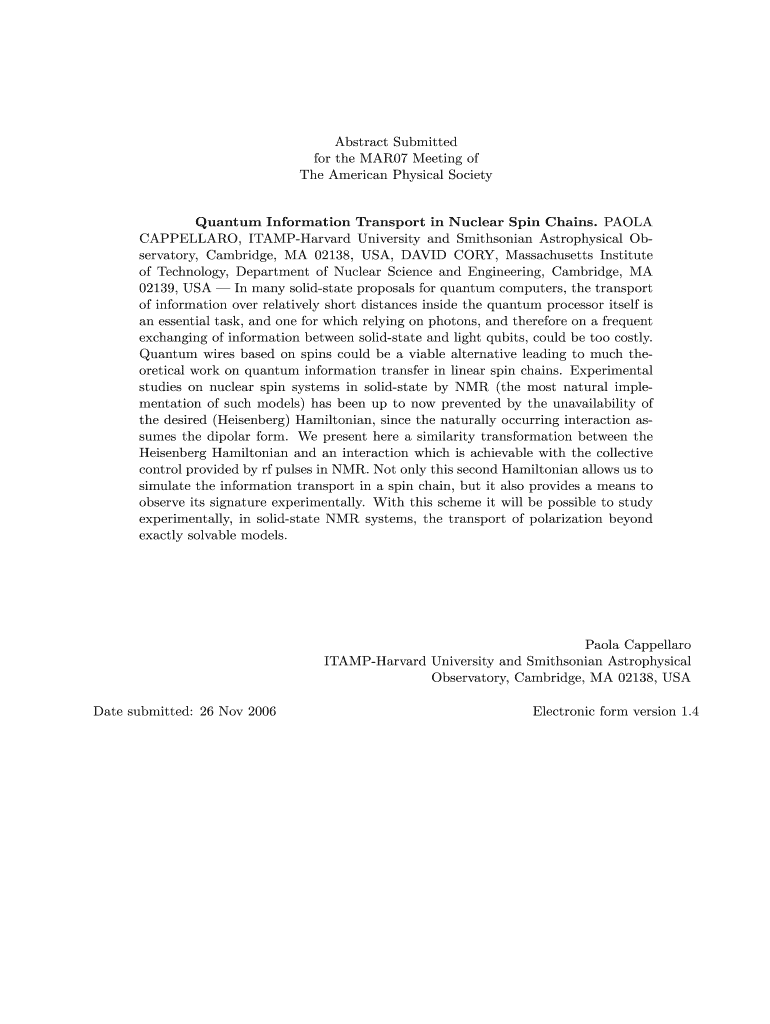
Quantum Information Transport in Nuclear Spin Chains refers to the study and application of transporting quantum information through nuclear spin chains. This involves the use of spin-based quantum wires, which are considered an alternative to photon-based information transfer in quantum processors. These quantum wires leverage nuclear magnetic resonance (NMR) to simulate and observe information transport at the quantum level. The goal is to enable efficient, scalable quantum communication and computation.
Important Terms Related to Quantum Information Transport
Understanding Quantum Information Transport involves several key terms:
- Nuclear Spin Chains: Sequences of atomic nuclei whose spins are entangled and utilized to transport quantum information.
- Heisenberg Hamiltonian: A mathematical model describing how spins in a system interact, essential for simulating quantum transport.
- Spin-Based Quantum Wires: Conduits that use spin properties for quantum information transfer, presenting an alternative to photons.
- Nuclear Magnetic Resonance (NMR): A technique used to manipulate spins in certain materials, thereby allowing the observation and control of quantum information transport.
How to Use Quantum Information Transport
To use Quantum Information Transport in Nuclear Spin Chains effectively, individuals need to comprehend the underlying physics of spin systems. Researchers typically implement these technologies in controlled laboratory environments, encoding quantum information onto spins and observing their interactions using NMR techniques. Practical applications could span quantum computing and secure quantum communication networks, where precise manipulation and understanding of spin dynamics are crucial.
Key Elements of Quantum Information Transport
Several critical elements define the functionality and efficiency of Quantum Information Transport in Nuclear Spin Chains:
- Spin Initialization and Readout: Accurately preparing spin states and measuring outcomes is fundamental for transporting information reliably.
- Similarity Transformation in NMR Systems: A method to simulate quantum dynamics and observe experimental signatures, facilitating information transport.
- Coherence Time: The duration over which a quantum state maintains its integrity, significantly impacting the performance of quantum information systems.
Examples of Using Quantum Information Transport
Real-world examples demonstrate the application of Quantum Information Transport in various fields:
- Researchers at universities conduct experiments that rely on the Heisenberg Hamiltonian to investigate information transport at the quantum level.
- In the tech industry, companies explore spin-based systems as they develop next-generation quantum processors, aiming for cost-effective and scalable solutions.
- Security firms implement quantum communication protocols that utilize spin chains for unbreakable encryption mechanisms.
Legal Use and Compliance
While quantum information transport is primarily a scientific and technological domain, it is necessary to consider legal permissions and compliance, especially in research and development. Institutions working on nuclear spin chains must adhere to international research guidelines, ensuring ethical and safe experimentation. Furthermore, compliance with data protection laws is critical when applying quantum communication techniques in the business and security sectors.
State-Specific Rules
Though quantum technologies are mostly governed by federal and international regulations, developments in certain states or countries may have localized rules concerning research on nuclear technologies, use of specific materials in spin chains, or collaborative international research efforts. Staying informed about these state-specific rules ensures compliance and supports smooth project execution.
Digital vs. Paper Version
The study and application of Quantum Information Transport in Nuclear Spin Chains primarily occur in digital and computational environments:
- Digital Simulation: Most research and development are undertaken through digital simulations that model spin interactions and quantum state evolutions.
- Electronic Documentation: Experiment records, research papers, and results are compiled digitally, facilitating easy sharing and collaboration across institutions.
Software Compatibility
Various software platforms support simulations and studies involving Quantum Information Transport:
- Quantum Computing Frameworks: Platforms such as Qiskit and PennyLane are commonly used for developing algorithms related to quantum information transport.
- Spin Dynamics Software: SPECIFIC software assists in simulating NMR experiments and understanding spin chain behaviors.
Who Typically Uses Quantum Information Transport
Quantum Information Transport technologies are crucial for:
- Researchers in Quantum Physics: Exploring fundamental particles and their interactions.
- Tech Companies: Pioneering innovations in quantum computing solutions.
- Security Firms: Developing secure communication channels through quantum encryption based on spin systems.
- Universities and Academic Institutions: Conducting advanced research in quantum information science.




