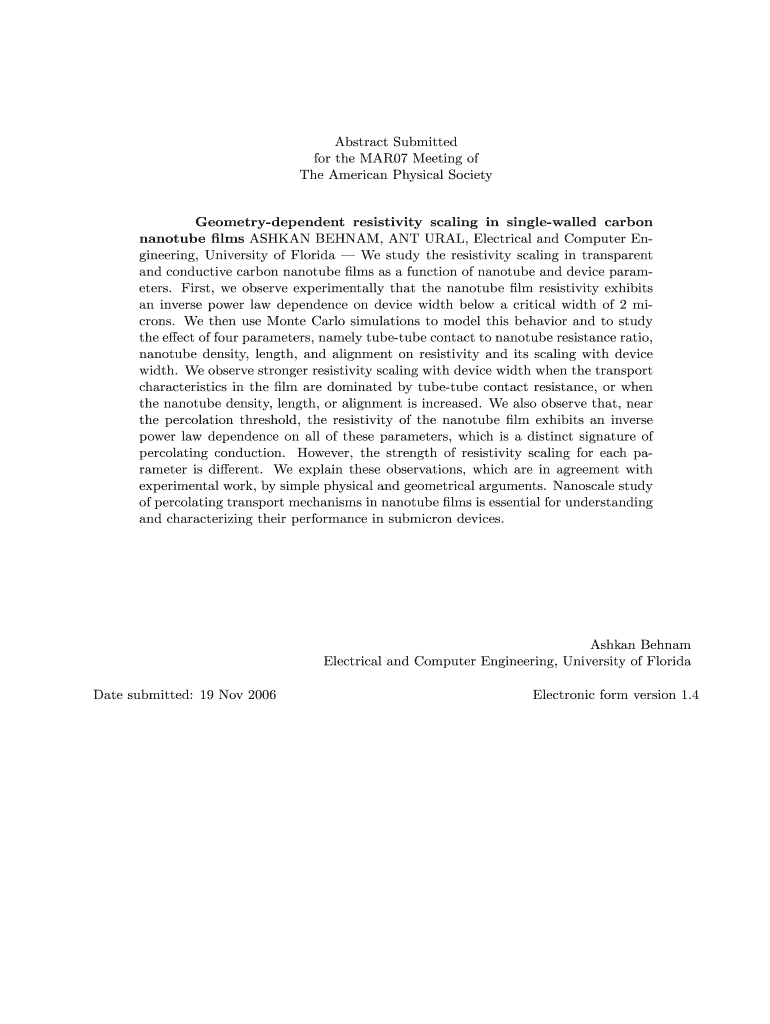







Definition & Meaning
The concept of "geometry-dependent resistivity scaling in single-walled carbon nanotube films" refers to how the electrical resistivity of these films changes with various geometrical device parameters. This phenomenon is particularly pronounced in configurations where device width, tube-tube contact resistance, and nanotube density play crucial roles. In such systems, resistivity often follows an inverse power law relative to the device width, especially when the width is below two microns. Understanding these relationships is vital for enhancing device efficiency in nanotechnology applications.
How to Use the Geometry-dependent Resistivity Scaling
When dealing with single-walled carbon nanotube films, you apply the principles of geometry-dependent resistivity scaling to predict and optimize the performance of nanodevices. Start by:
- Analyzing the device width: Ensure the width measurements are accurate, as resistivity exhibits significant change below two microns.
- Evaluating tube-tube contact resistance: This factor can drastically affect overall resistivity and should be minimized for optimal performance.
- Assessing nanotube density: Recognize that higher densities may lead to lower resistivity owing to increased connectivity among nanotubes.
This approach helps in tailoring device properties for specific applications by manipulating these variables for desired outcomes.
Steps to Complete the Geometry-dependent Resistivity Scaling
Completing a study or application involving geometry-dependent resistivity scaling involves several steps:
- Device Fabrication: Begin with the precise fabrication of carbon nanotube films, ensuring the control of film thickness and uniformity.
- Parameter Measurement: Measure key parameters such as device width, nanotube length, and alignment. Utilize tools like scanning electron microscopes for accurate measurements.
- Data Collection: Use methods like Monte Carlo simulations to collect data on how resistivity changes under varying conditions.
- Analysis: Analyze the relationship between experimental data and theoretical models, focusing on deviations and edge cases.
This structured approach allows researchers to gain a comprehensive understanding of the electrical properties of nanotube films.
Key Elements of the Geometry-dependent Resistivity Scaling
Several crucial elements define the geometry-dependent resistivity scaling in single-walled carbon nanotube films:
- Device Width: A critical factor, as changes in width, especially below two microns, significantly impact resistivity.
- Nanotube Alignment: Proper alignment can enhance conductivity by facilitating electron movement.
- Tube-Tube Contact Resistance: Influences overall conductivity and is a primary point of resistance within the film.
- Nanotube Density: Affects the number of conduction pathways and is directly related to resistivity.
Each element plays an integrated role in determining the film's electrical performance.
Examples of Using the Geometry-dependent Resistivity Scaling
Consider a scenario where engineers design a new type of transistor using single-walled carbon nanotube films. By applying geometry-dependent resistivity scaling methods:
- Prototype Development: The team uses simulations to adjust the device width and nanotube alignment, optimizing for minimal resistivity.
- Material Efficiency: In another example, materials scientists might use these principles to enhance the efficiency of solar cells by reducing losses through tailored film geometries.
Such applications highlight the practical benefits of understanding resistivity scaling in nanotube films.
Legally Binding Applications
While mainly a scientific concept, the practical applications of geometry-dependent resistivity scaling can be involved in legal areas such as patenting new nanotechnology devices. Legal compliance might include ensuring that new inventions meet specific industry standards for efficiency and reliability based on this principle.
Software Compatibility
For those using software tools in research or commercial applications, geometry-dependent resistivity scaling in single-walled carbon nanotubes is typically compatible with:
- Simulation Software: Programs like COMSOL Multiphysics or Lumerical offer modules for modeling electrical properties, accommodating the specific needs of resistivity studies.
- Data Analysis Tools: Software such as MATLAB or R can process complex datasets obtained from experiments, offering analysis capabilities tailored to studying resistivity trends.
These tools facilitate comprehensive research and practical applications in fields like nanoelectronics.
Business Types That Benefit Most
Various business entities can benefit from understanding and leveraging geometry-dependent resistivity scaling:
- Nanotechnology Firms: Companies specializing in nanomaterials research use this knowledge to develop new products.
- Electronics Manufacturers: Manufacturers implementing advanced materials in consumer electronics may utilize these principles to enhance device performance.
These businesses can gain competitive advantages by optimizing material properties for better efficiency and functionality.
Quick Facts
- Monte Carlo Simulations: Aids in modeling resistivity changes and is a crucial tool for researchers.
- Device Width Impact: A size less than two microns is where significant changes in resistivity are observed.
- Innovative Applications: Key in developing next-generation electronic components like transistors and solar cells.