01. Edit your form online
Type text, add images, blackout confidential details, add comments, highlights and more.

Type text, add images, blackout confidential details, add comments, highlights and more.

Draw your signature, type it, upload its image, or use your mobile device as a signature pad.

Send it via email, link, or fax. You can also download it, export it or print it out.
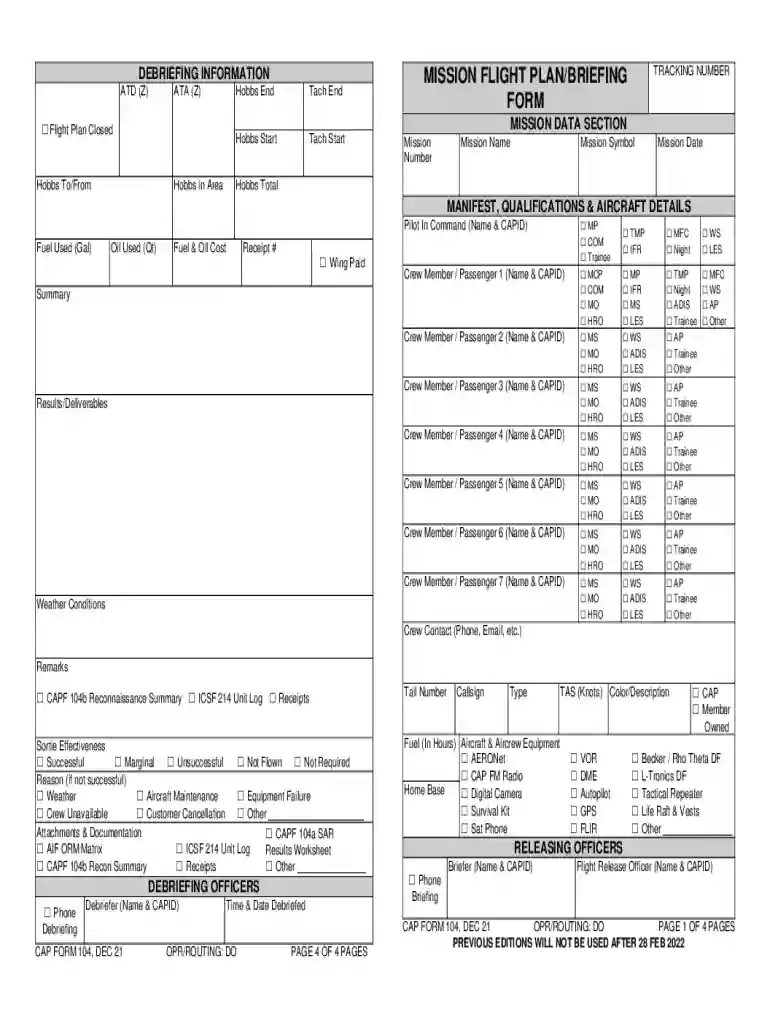
The "Debriefing Information Mission Flight" form is a structured document used within aviation, specifically for post-mission evaluations. This form is essential for documenting key aspects of flight missions, ensuring that detailed records are maintained for both safety and operational analysis. The debriefing form includes spaces for mission data, crew information, and performance assessments, providing a comprehensive overview of the mission's outcomes. This allows organizations to review their operations, identify any areas for improvement, and maintain a clear history of flight activities. The creation and maintenance of these records are crucial for compliance with industry standards and legal requirements.
Completing the "Debriefing Information Mission Flight" form involves several key steps to ensure comprehensive and accurate data collection:
Collect Mission Data: Begin by gathering all essential mission data such as flight identification, date, departure and arrival locations, and mission objectives. This section forms the basis of the debriefing and should be filled out as precisely as possible.
Document Crew Information: List the names and roles of the crew members involved in the mission. Include their qualifications and any specific contributions they made during the mission. This information is crucial for evaluating the team's performance and ensuring that all crew members meet the necessary standards.
Assess Risk Factors: Evaluate any risk factors encountered during the mission. This could include environmental conditions, mechanical issues, or logistical challenges. Documenting these factors helps in assessing the mission's overall safety and planning future operations.
Include Debriefing Notes: After the mission, conduct a debriefing session to gather insights from the crew. Note any incidents, performance reviews, and suggestions for future missions. This section allows for continuous improvement and adaptation of strategies.
Review & Finalize: Once all sections are completed, review the form for accuracy and completeness. Ensure that all necessary fields are filled and make any necessary corrections before submitting the form for record-keeping.
The primary components of the "Debriefing Information Mission Flight" form are designed to capture every detail of the mission comprehensively:
Utilizing the "Debriefing Information Mission Flight" form effectively involves integrating it into the standard operating procedures for flight missions:
Integration with Training Programs: Organizations should incorporate the form into training programs, teaching crew members how to accurately complete it during post-mission processes.
Standardized Debriefing Protocols: Establish protocols for conducting debriefing sessions. By standardizing these protocols, you ensure consistency in how information is captured and analyzed.
Utilization for Performance Reviews: Use the completed forms for performance reviews, helping to identify patterns and areas for development within the team and operations.
The primary users of the "Debriefing Information Mission Flight" form include:


Compliance with legal and regulatory standards is paramount when using the "Debriefing Information Mission Flight":
The use of the "Debriefing Information Mission Flight" form offers several benefits:
When considering the use of the "Debriefing Information Mission Flight" form in a digital format, software compatibility is an important factor:
When filling out the "Debriefing Information Mission Flight" form, certain documents are typically required to ensure all necessary data is accurately captured:
These documents provide the foundation needed to complete the debriefing form accurately, ensuring that all mission details are captured and reviewed effectively.
We've got more versions of the DEBRIEFING INFORMATION MISSION FLIGHT form. Select the right DEBRIEFING INFORMATION MISSION FLIGHT version from the list and start editing it straight away!
At DocHub, your data security is our priority. We follow HIPAA, SOC2, GDPR, and other standards, so you can work on your documents with confidence.