




01. Edit your form online
Type text, add images, blackout confidential details, add comments, highlights and more.

Type text, add images, blackout confidential details, add comments, highlights and more.

Draw your signature, type it, upload its image, or use your mobile device as a signature pad.

Send it via email, link, or fax. You can also download it, export it or print it out.
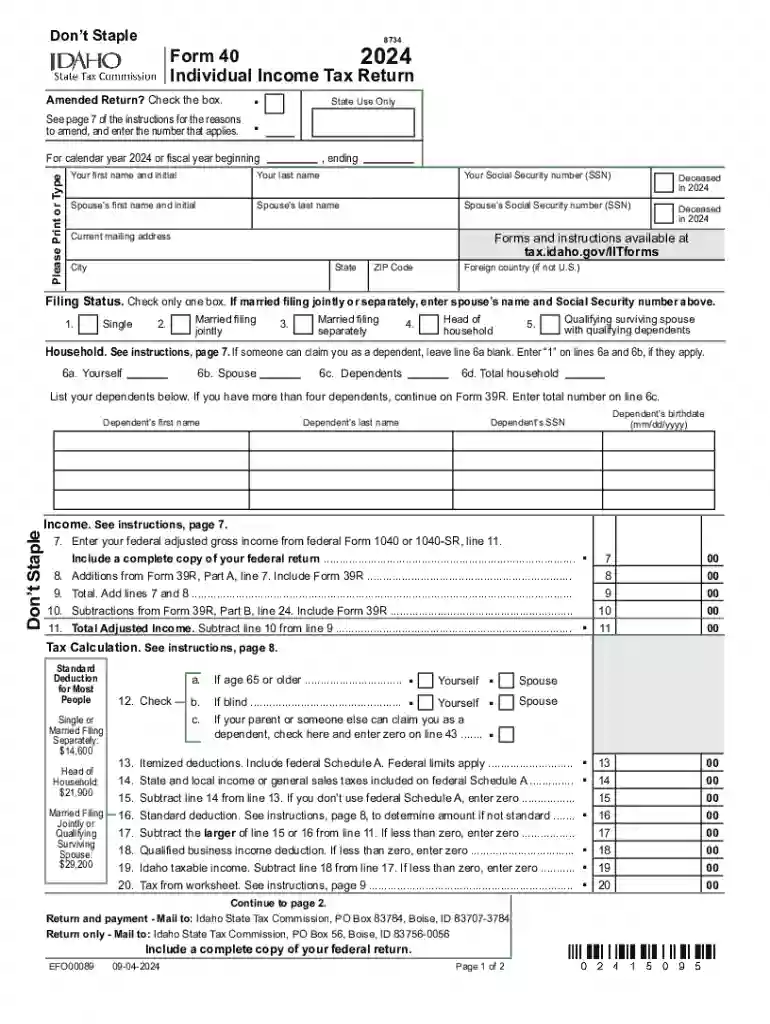
Form 40 is the official Idaho Individual Income Tax Return document for taxpayers in the state. This form is essential for reporting income, claiming tax credits, declaring deductions, and determining the amount owed to or refunded by the Idaho State Tax Commission. It plays a critical role in ensuring compliance with state tax laws for individuals residing or earning income within Idaho.
Gather Necessary Documents: Before filling out the Form 40, collect all relevant documents, including W-2s, 1099s, and any other income or deduction records.
Enter Personal Information: Begin by completing the personal information section, including name, address, and Social Security number.
Income Reporting: Accurately report all sources of income, including wages, business income, and any other Idaho-sourced earnings. Attach additional schedules as needed.
Deductions and Credits: Utilize sections dedicated to deductions and credits, such as the grocery credit or credits for contributions to charitable organizations.
Calculate Taxes: Follow the instructions to calculate any Idaho state taxes owed or assess a refund due based on your reported income and deductions.
Review and Submit: Carefully review the form for completeness and accuracy before submitting it either online or via mail.
Personal Information Section: Ensures accurate identification and correspondence.
Income Statements: Details various income streams subject to Idaho taxation.
Deductions and Credits: Outlines potential tax reduction strategies and eligibility for state credits.
Tax Calculation: Provides a structured method for determining tax liabilities or refunds.
Signatures: Certifies the accuracy of the information provided, requiring the taxpayer's signature.
Filing Status: A classification that determines the tax rate and standard deduction limits. Common statuses include single, married filing jointly, and head of household.
Idaho Adjusted Gross Income (AGI): The total income as adjusted for Idaho's specific deductions and exemptions.
Grocery Credit: A tax credit available to offset state sales tax on food purchases.
Charitable Contributions: Deductions available for donations to qualifying Idaho charitable organizations.
Filing Thresholds: Idaho taxpayers must file if their gross income exceeds a certain threshold based on filing status and age.
Interest and Dividend Income: Idaho requires reporting of any interest and dividend income, even if the taxpayer does not meet the federal filing requirement for such incomes.
Part-Year Resident Allocations: Accurate reporting is required by part-year residents to reflect only the income earned during their residency period in Idaho.
W-2 Forms: For wage and salary income.
1099 Forms: For any miscellaneous income such as freelance or contractor earnings.
Documentation for Deductions and Credits: Proof such as receipts, donation records, and other relevant documentation.
Online Filing: Through Idaho's Taxpayer Access Point (TAP), allowing fast processing and confirmation.
Mail Submission: Traditional paper filing option for taxpayers preferring physical documentation.
Professional Filing Services: Utilizing CPAs or tax service companies for submission to ensure accurate and compliant filing.
Failure to File: Incurring penalties for not submitting Form 40 by the deadline, resulting in added fees and potential legal consequences.
Underpayment Penalties: Additional charges for not remitting sufficient estimated tax payments throughout the year.
Interest on Unpaid Taxes: Accrued interest from unpaid taxes not settled by the filing deadline.
Digital Filing Advantages: Faster processing times, error checking, and immediate confirmation upon submission.
Paper Filing Considerations: Requires comprehensive review to ensure all necessary attachments and schedules are included. Suitable for individuals preferring physical documentation for records.
Case Study: Self-Employed Professional: A self-employed consultant uses Form 40 to report business income, declare deductions for business expenses, and compute applicable Idaho tax liabilities.
Scenario: Retiree with Multiple Income Sources: A retired individual with a pension, Social Security, and investments utilizes Form 40 to detail their diverse income streams and claim appropriate senior tax credits.
These examples underline Form 40's utility in varying taxpayer scenarios, enabling accurate, state-compliant tax reporting.
We've got more versions of the Form 40 form. Select the right Form 40 version from the list and start editing it straight away!
At DocHub, your data security is our priority. We follow HIPAA, SOC2, GDPR, and other standards, so you can work on your documents with confidence.



Form 4017 CFR 18.04(a) requires every person who owns or controls a reportable position to file a Form 40Statement of Reporting Trader with the Commission.
May 8, 2025 Union Springs 40 solar farm is an operating solar photovoltaic (PV) farm in Union Spring, Cayuga County, New York, United States.
Mar 2, 2026 income tax return but are filing Form 40 to receive a Food Tax Credit refund, you dont need to include a copy of a federal return.


