
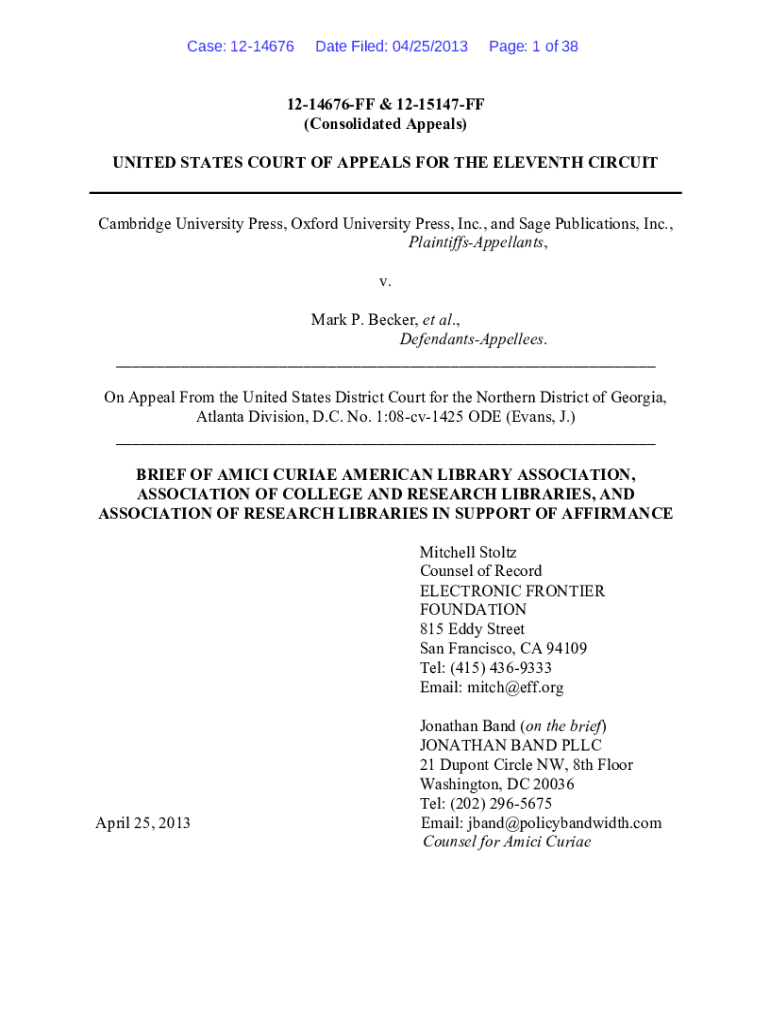







Definition & Meaning
The "brief - Library Copyright Alliance" is a legal document submitted by amici curiae, including associations such as the American Library Association, in support of Georgia State University's (GSU) fair use policy concerning electronic reserves. This brief argues that GSU's practices are consistent with established best practices for fair use, emphasizing the educational importance of using copyrighted materials without incurring excessive licensing fees. The brief underscores the vital role libraries play in promoting knowledge dissemination and protecting public access to educational resources.
How to Use the Brief - Library Copyright Alliance
Utilizing the brief involves understanding its application in legal, educational, and policy-making contexts. It serves as a reference for institutions and legal practitioners advocating for the adaptation and application of fair use policies in educational settings. Libraries and educational institutions can leverage the arguments presented to bolster their case for fair use, specifically when dealing with electronic reserves. Legal firms may also use the brief to support their cases by providing precedence and illustrating the widespread acceptance of specific fair use practices.
Steps to Complete the Brief - Library Copyright Alliance
-
Research and Contextual Analysis:
- Begin by researching related cases and understanding the specific legal context in which the brief will be used.
- Familiarize yourself with fair use best practices and how they align with educational goals.
-
Gather Necessary Documentation:
- Collect all relevant documents that may support your position on fair use.
- Ensure that your arguments align with precedents set by the Library Copyright Alliance brief.
-
Drafting the Brief:
- Incorporate key elements and arguments from the Library Copyright Alliance brief.
- Support claims with evidence, relying on documented cases and educational policies.
-
Review and Finalize:
- Have legal experts review the draft for consistency and accuracy.
- Make necessary revisions to ensure alignment with the objectives and target audience.
-
Submission and Follow-up:
- Submit the completed brief to the appropriate audience, courts, or bodies.
- Follow up on any proceedings that involve the use of the brief.
Key Elements of the Brief - Library Copyright Alliance
The brief is structured to present arguments coherently and persuasively. Key elements include:
- Alignment with Fair Use Practices: Demonstrating how GSU's policies fit within established fair use guidelines.
- Educational Significance: Highlighting the necessity of using copyrighted materials in teaching to enhance learning experiences.
- Impact on Accessibility: Emphasizing how a ruling against these practices could limit access to essential educational resources.
- Legal Precedence: Providing examples of how similar approaches have been legally supported in other contexts.
Legal Use of the Brief - Library Copyright Alliance
The brief is primarily used in the legal context to defend practices that fall under fair use, especially in educational environments. It is cited in legal arguments to:
- Support the fair use of copyrighted material in electronic reserves.
- Advocate for policies that enable educational institutions to access necessary resources without undue financial burden.
- Reinforce the legal understanding of fair use in educational settings.
Who Typically Uses the Brief - Library Copyright Alliance
The brief is frequently utilized by:
- Educational Institutions: Schools and universities seeking to establish or defend fair use policies.
- Library Associations: Organizations working to protect and promote the use of libraries as resources for educational equity.
- Legal Experts: Attorneys and legal scholars advocating for the fair use of copyrighted materials in educational contexts.

Important Terms Related to the Brief - Library Copyright Alliance
- Fair Use: A legal doctrine allowing limited use of copyrighted material without permission under certain conditions, crucial for educational settings.
- Amici Curiae: "Friends of the court" who submit documents offering additional perspectives on legal matters.
- Electronic Reserves: Digital copies of course materials made available to students, often involving fair use considerations.
Examples of Using the Brief - Library Copyright Alliance
- Case Studies: Analyzing past cases where the brief was instrumental in shaping legal outcomes favoring fair use.
- Policy Development: Institutions using the arguments within the brief to create fair use policies that align with educational objectives.
- Advocacy Campaigns: Library and educational advocacy groups referencing the brief in campaigns to raise awareness about fair use.
Who Issues the Brief - Library Copyright Alliance
This type of legal brief is issued by collaborative groups of library associations and educational institutions, often coordinated by the American Library Association and associated entities within the Library Copyright Alliance. These groups aim to influence and support judicial decisions related to fair use policies in educational settings.




