






Definition & Meaning
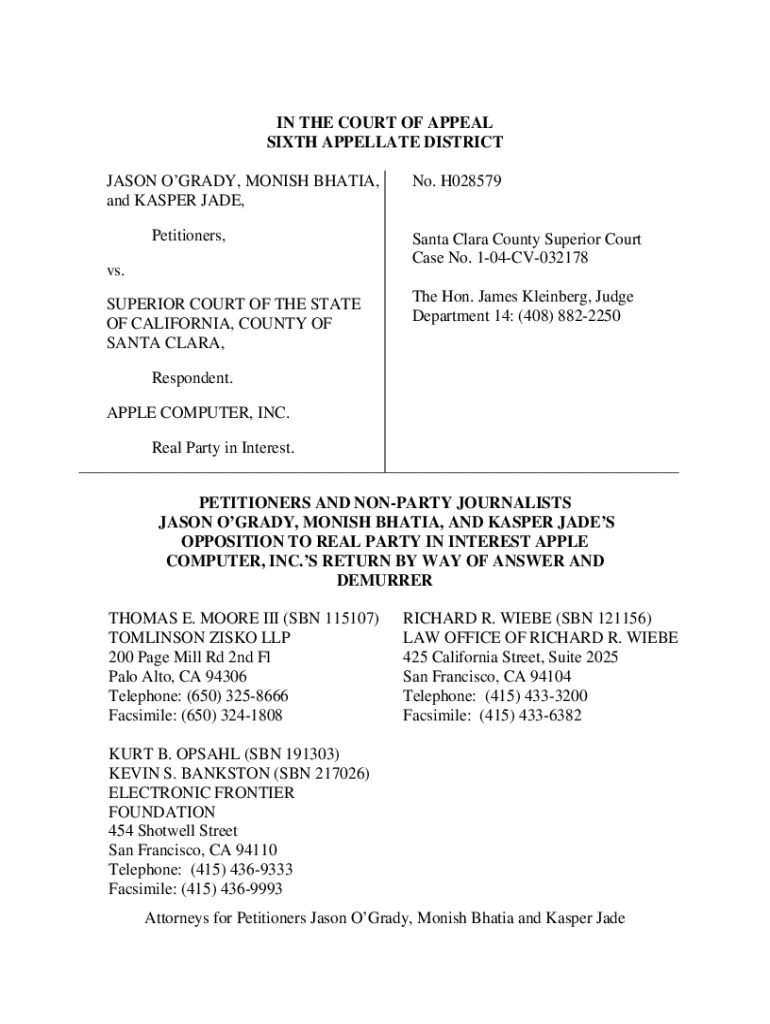
The "In the Court of Appeal Sixth Appellate District - Electronic Frontier" refers to legal documentation or proceedings associated with the sixth appellate district's court, likely involving Electronic Frontier Foundation (EFF) issues or cases. This designation indicates that the matter is of legal significance and pertains to appellate review, often involving digital rights or freedom of speech, as typically championed by organizations like the Electronic Frontier Foundation. The process and significance of such cases often involve an examination of lower court decisions and the application of constitutional rights in the digital age.
Steps to Complete the Process
Completing any case or motion within the Court of Appeal requires following specific steps to ensure proper filing and representation.
-
Understand the Case: Begin by thoroughly understanding the legal issue at hand. Review the lower court's decision and the reasons for appeal.
-
Draft Legal Documentation: Prepare all necessary legal documents, including briefs and additional evidentiary support. Ensure clarity, citation accuracy, and adherence to legal standards.
-
File with the Court: Submit your documentation to the Court of Appeal, respecting all deadlines and submission guidelines, whether online or in-person.
-
Serve Documents: Provide copies of your submissions to all involved parties, adhering to the appropriate legal protocols for serving documents.
-
Attend Hearings: Be prepared to attend any hearings and present oral arguments if required. Understand your legal rights and be ready for questioning.
-
Await Judgment: Monitor your case's status frequently and be prepared for additional submissions or actions based on preliminary decisions.
-
Follow Up: If your appeal is successful, take action in accordance with the court's ruling. If not, evaluate further appellate options.
Key Elements of the Process
Understanding the critical components of dealing with cases within the Sixth Appellate District is essential for accurate and effective engagement.
- Legal Representation: Having a knowledgeable attorney is crucial due to the complex nature of appellate law.
- Detailed Record: Maintaining a comprehensive record of all documents is necessary for presenting a coherent case.
- Adherence to Legal Standards: Ensuring all submissions comply with the specific requirements of appellate court procedures.
- Thorough Preparation: Interpretation and presentation of constitutional or statutory elements require in-depth legal research and strategy.
Legal Use of the Process
The legal framework surrounding cases in the Court of Appeal, particularly concerning digital rights organizations like the Electronic Frontier Foundation, often includes defense against infringement on digital expression rights, privacy, and access to information.
- Constitutional Rights: These proceedings often hinge on the first amendment's protection of free speech, particularly as it applies to digital platforms.
- Precedent-Setting: Cases have the potential to set important legal precedents affecting future interpretations of digital rights.
- Privacy Concerns: Many issues involve debates around data privacy, encryption, and governmental reach into digital communications.
Examples of Using the Court
Several notable cases have shaped the understanding and application of digital rights and have gone through the Court of Appeal.
- Legal Challenges to Mass Surveillance: Organizations such as the EFF have used appellate processes to challenge expansive government surveillance programs.
- Protecting Journalist Sources: In some cases, the courts have ruled on extending privileges to digital journalists akin to traditional media protections.
- Encryption and Security: Legal cases surrounding the limits and allowance of digital encryption technologies, especially when confronting federal demands for access.
State-Specific Rules
Though federal laws set a broad stage, state-specific regulations govern many aspects of appellate procedure within the Californian Sixth Appellate District.
- Court Procedures: California has unique procedural guidelines that dictate how cases move through the appellate system, including specific filing formats and timelines.
- Local Precedents: Local case law may influence interpretations, requiring attorneys to focus on state-based legal research alongside federal law.
State-by-State Differences
While Californian cases in the Sixth Appellate District offer robust protections and procedures, other states may differ significantly.
- Varied Jurisprudence: Different states may have contrasting interpretations of digital rights and free speech, affecting appellate outcomes.
- Diverse Precedents: Variations in case law affecting freedom of the press and digital rights can be significant, altering strategy for similar cases in other jurisdictions.
Required Documents
Engaging with the Court of Appeal necessitates meticulous preparation and submission of specific legal documents.
- Appellate Briefs: Comprehensive arguments and legal reasoning that form the core of the appeal.
- Record of Appeal: Compiling all documents from previous court cases that pertain to the appeal.
- Legal Motions: Any motions for procedural aspects, such as extensions or stays, during the appeal process.