




01. Edit your form online
Type text, add images, blackout confidential details, add comments, highlights and more.

Type text, add images, blackout confidential details, add comments, highlights and more.

Draw your signature, type it, upload its image, or use your mobile device as a signature pad.

Send it via email, link, or fax. You can also download it, export it or print it out.
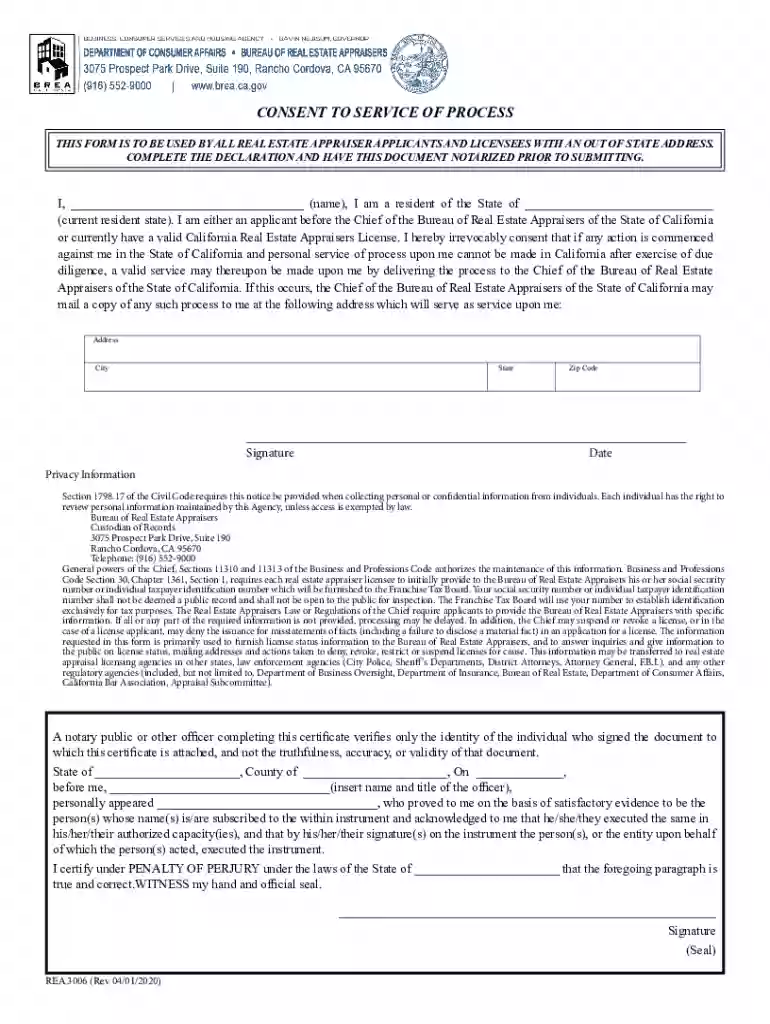
The "Consent to Service of Process" form serves as a crucial legal instrument, particularly for real estate appraiser applicants and licensees domiciled outside their principal operating state. It authorizes a designated authority, often the Chief of the Bureau of Real Estate Appraisers in California, to accept legal documents on behalf of the applicant or licensee. This arrangement is essential as it ensures that legal proceedings can be appropriately maintained even if the individual resides outside the jurisdiction where the process is initiated.
The form is vital for maintaining legal accountability and ensuring that individuals and entities cannot evade legal actions by residing outside the state's jurisdiction. It facilitates smoother legal processes by minimizing delays in serving legal papers, thus maintaining the integrity of the judicial process.
Suppose a real estate appraiser operates in multiple states but is primarily based in Texas. If legal action is initiated in California relating to their practice, having a "Consent to Service of Process" allows California's Bureau of Real Estate Appraisers to receive documents on the appraiser's behalf, avoiding the need for personal service across state lines.
The proper use of a "Consent to Service of Process" involves several methodical steps to ensure it meets all legal requirements.
Obtain the Form: Acquire the appropriate form from the relevant state's real estate appraiser licensing board or agency. It is often available on their official websites.
Fill Out the Form: Ensure all required fields, such as name and address, are accurately completed.
Designate the Recipient: Clearly specify the individual or institution authorized to accept legal documents on your behalf. Typically, this is a state official or agency.
Notarization: The form may require notarization to validate the consent legally. This confirms your identity and willingness to consent voluntarily.
Submit the Form: Send the completed, notarized form to the designated agency, either via mail or online submission, if available.
Missteps such as incorrect details or failure to notarize can invalidate the form, impacting its legal effectiveness. For accuracy, double-check all entries and understand state-specific requirements.
Completing the "Consent to Service of Process" demands attention to detail to fulfill legal obligations.
Review Instructions: Each state's instructions may vary and should be carefully reviewed before starting.
Gather Required Information: Have all necessary personal and professional information readily available.
Complete the Document: Fill in all sections, ensuring accuracy to prevent potential disputes about the form's validity.
Verify the Designation: Confirm the appointed entity's willingness to accept this role. They should acknowledge and understand their responsibility.
An applicant applying for a real estate appraiser license in a state different from their primary residence must submit this form alongside other licensing documentation to comply with state laws.
This form contains crucial elements, each serving a specific legal purpose.
Personal Information: Includes the individual's full name and current residential address pertinent for identification.
Legal Authority: Specification of the entity designated for accepting service of process, ensuring that legal communications reach their intended target.
Notarization Section: Provides a formal seal verifying the authenticity and voluntary consent of the individual signing the document.
Including all mandated provisions, as instructed by the issuing state’s real estate authority, protects the form's enforceability and the applicant’s standing.
Understanding the legal application of the "Consent to Service of Process" is crucial for its correct utilization.
Cross-State Business Operations: Allows real estate professionals operating across state boundaries to manage legal obligations through an in-state representative.
Judicial Efficiency: Ensures legal documents are served in compliance with jurisdictional rules, avoiding procedural delays in litigation or regulatory oversight.
Compliance with state laws and regulations is non-negotiable; failure to submit a valid consent can lead to issues like licensing delays or regulatory penalties.
This form primarily serves specific professional and legal constituencies.


Real Estate Professionals: Including appraisers and agents who frequently engage in inter-state business activities.
Corporate Entities: Businesses with operations in various states, requiring legal conformity across jurisdictions for any litigations or official notices.

A real estate appraiser licensed in New York but conducting appraisals in California would use this form to facilitate legal document handling by a California entity.
Each state may impose unique stipulations governing the "Consent to Service of Process."
Document Requirements: Different states might request additional documents or specific identification alongside the consent form.
Submission Procedures: While some states permit online submission, others may require notarized paper copies mailed directly to the relevant department.
In California, submission might include extra privacy disclosures and confirm compliance with state-specific notarial laws and processes.
Non-compliance with the "Consent to Service of Process" can carry significant penalties.
Legal Risks: Can result in legal actions proceeding without the individual’s knowledge—a major disadvantage.
Operational Impacts: License suspension or revocation by the state’s regulatory body due to non-adherence.
Financial Penalties: Fines or fees applicable as per state regulations for failing to fulfill statutory obligations.
Failure to provide valid consent might cause a real estate appraiser to miss critical deadlines in responding to legal actions, significantly impacting their professional licensing and personal legal standing.
We've got more versions of the Consent to Service of Process form. Select the right Consent to Service of Process version from the list and start editing it straight away!
At DocHub, your data security is our priority. We follow HIPAA, SOC2, GDPR, and other standards, so you can work on your documents with confidence.


Jul 15, 2026 Consent (Article 6 (1) (a) GDPR) - The data subject has given consent to the processing of his or her personal data for one or more specificRead more
Consent to Service of Process to give irrevocable consent that actions may be commenced against said entity in the proper court of any jurisdiction


