




01. Edit your form online
Type text, add images, blackout confidential details, add comments, highlights and more.

Type text, add images, blackout confidential details, add comments, highlights and more.

Draw your signature, type it, upload its image, or use your mobile device as a signature pad.

Send it via email, link, or fax. You can also download it, export it or print it out.
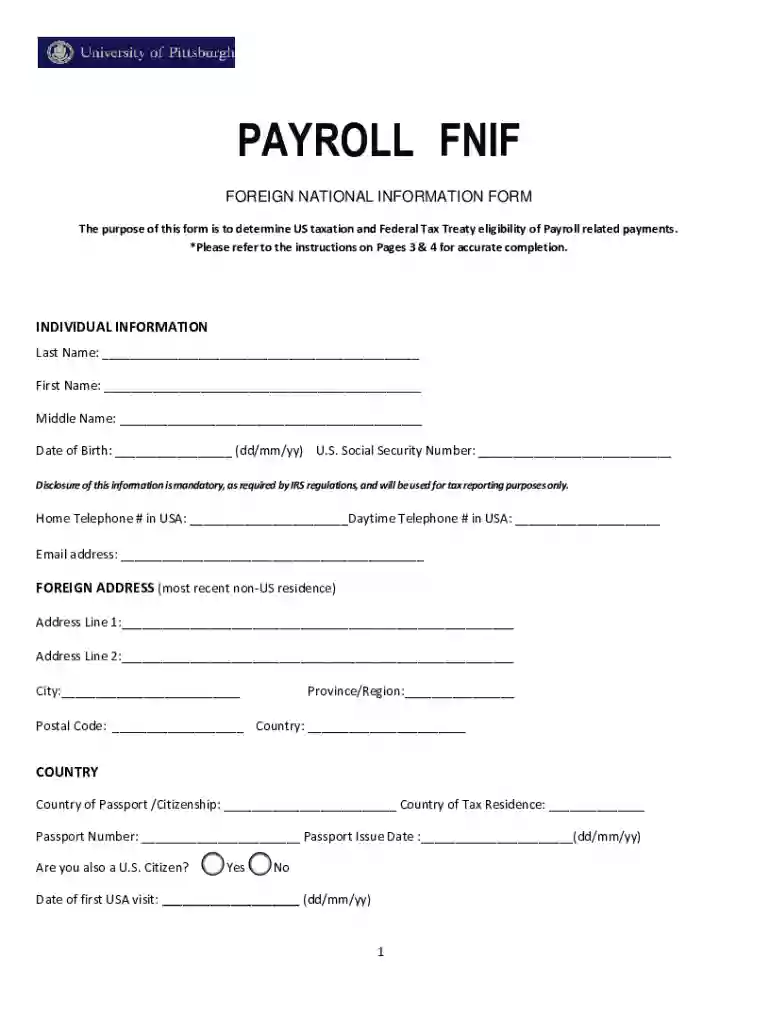
The Payroll Fnif, or Foreign National Information Form, is a crucial document used to evaluate eligibility concerning the U.S. taxation system and Federal Tax Treaties for payroll payments made to foreign nationals. This form is essential in ensuring compliance with U.S. tax laws by accurately collecting personal and tax-related information from individuals who may have international ties or obligations. The form helps determine tax residency status, which affects withholding rates and tax liability.
Foreign nationals requiring the Payroll Fnif can typically obtain it from their employer's payroll department. It may also be accessible through the organization's human resources website or directly upon employment onboarding for those working in roles likely to require payroll considerations associated with international status. Contacting the payroll or human resources department is recommended to ensure you receive the correct version of the form tailored to any specific organizational requirements.
Thoroughly understanding and accurately completing these sections is crucial to avoid discrepancies or delays in tax processing.
The Payroll Fnif is primarily used by foreign nationals working in the U.S. who may have to deal with unique tax circumstances due to their international status. These individuals could be students, researchers, professionals on work visas, or any other foreign national with income sourced from U.S.-based employment. Employers also rely on this form to ensure they withhold the correct amount of taxes and comply with both domestic and international regulations.


To complete the Payroll Fnif, certain documents are necessary to verify the information provided:
Having these documents ready will streamline the completion and verification process significantly.
Failure to complete or inaccurately fill out the Payroll Fnif can result in several consequences:
Ensuring complete and accurate submission is vital to avoid these potential pitfalls.
The IRS provides guidelines outlining the expectations for foreign nationals regarding their tax obligations in the U.S. Relevant documents such as Publication 519 (U.S. Tax Guide for Aliens) can offer detailed instructions on maintaining compliance, alongside information about treaties that may influence your tax statues. Adhering to these guidelines while completing the Payroll Fnif ensures compliance with U.S. laws and structured tax payments.
Completing the Payroll Fnif offers several submission options:
Each method of submission has unique workflows but ensures your form is securely received and processed accordingly.
Digital Version: Offers convenience and efficiency, allowing edits and faster processing with digital records.
Paper Version: Traditional and reliable, preferred in lower-tech environments.
Selecting between digital or paper should align with personal or organizational capabilities for optimal efficiency.
We've got more versions of the Payroll Fnif form. Select the right Payroll Fnif version from the list and start editing it straight away!
At DocHub, your data security is our priority. We follow HIPAA, SOC2, GDPR, and other standards, so you can work on your documents with confidence.


The packet contains a Foreign National Information Form (FNIF) to be completed by the employee and a list of the required documentation needed to process theirRead more
Jul 23, 2026 Nonresident alien individuals married to U.S. citizens or residents may choose to be treated as resident aliens for certain income tax purposes.Read more


