01. Edit your form online
Type text, add images, blackout confidential details, add comments, highlights and more.

Type text, add images, blackout confidential details, add comments, highlights and more.

Draw your signature, type it, upload its image, or use your mobile device as a signature pad.

Send it via email, link, or fax. You can also download it, export it or print it out.
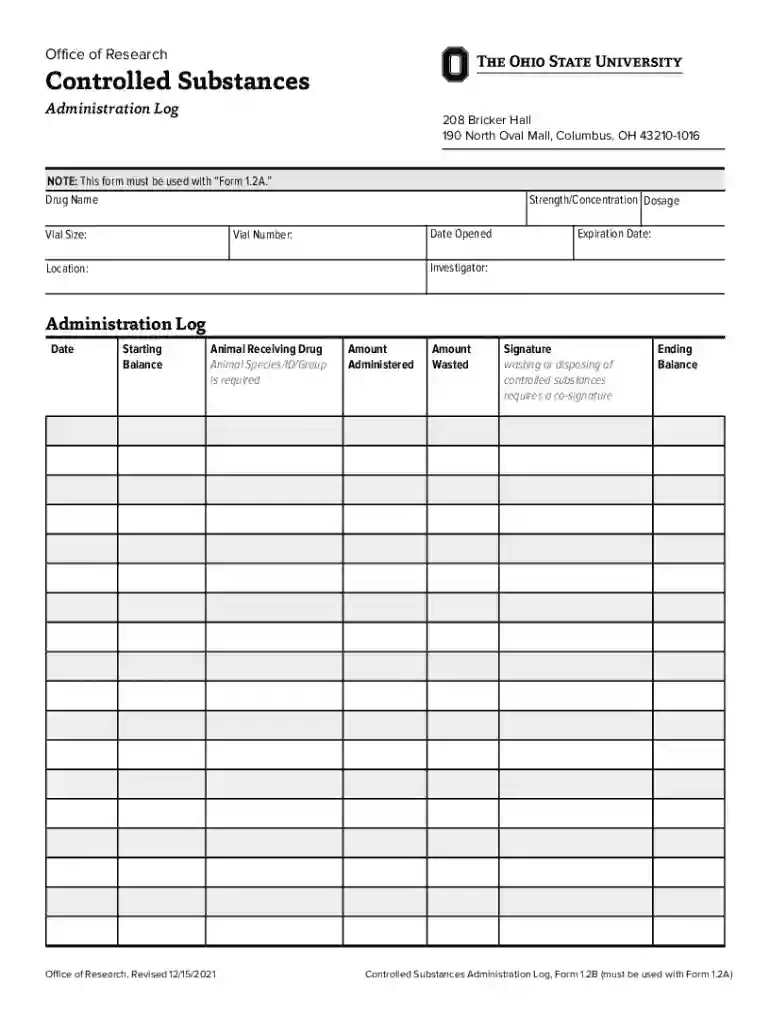
The Controlled Substances Administration Log is a crucial tool in managing and documenting the distribution and disposal of controlled substances. Specifically used by institutions like the Office of Research at Ohio State University, this log provides a structured format to ensure compliance with federal and state regulations regarding the handling of these substances. The log captures essential details such as the drug name, vial size, dosage, investigator, and animal information, which are critical for maintaining transparency and accountability in research environments. This meticulous record-keeping helps prevent misuse and ensures proper disposal of substances.
The log serves as a comprehensive record containing essential data points necessary for accurate tracking and accountability:
These elements are vital for creating a detailed and reliable audit trail, ensuring compliance with regulatory standards.
Completing the Controlled Substances Administration Log requires meticulous attention to detail to ensure all relevant information is documented accurately. Here’s a step-by-step guide:
A precise approach in filling out each section is critical to maintain the integrity of the log for both compliance and research documentation purposes.
The meticulous use of the Controlled Substances Administration Log is essential for several reasons. Firstly, it ensures compliance with legal regulations concerning controlled substances, thereby reducing the risk of legal issues. It also facilitates accurate record-keeping, which is vital for audits and inspections. Furthermore, by documenting every stage of handling controlled substances, the log aids in preventing diversion and misuse, promoting ethical and safe research practices.
Utilizing this log correctly shields organizations from potential legal repercussions associated with non-compliance. It substantiates that controlled substances are managed responsibly and in accordance with established guidelines.
This log is predominantly used by research facilities, universities, and pharmaceutical companies engaged in studies involving controlled substances. Staff members such as researchers, laboratory technicians, and compliance officers are primarily responsible for maintaining these records, ensuring that all activities relating to the handling of controlled substances are well-documented and supervised.
Responsibilities typically include:
To obtain a Controlled Substances Administration Log, entities must contact the relevant regulatory bodies or internal compliance departments within their institution. These logs are typically provided as part of the entity's compliance toolkit to align with federal and state regulations. Institutions may also develop customized versions of the log to cater to specific research needs, provided they adhere to the overarching regulatory framework.
Regulations regarding controlled substances can vary by state, necessitating familiarity with local laws. It's crucial to understand both federal guidelines and specific state requirements to ensure comprehensive compliance.
Understanding these nuances helps organizations avoid potential legal pitfalls and maintain a seamless research operation.
The choice between digital and paper versions of the Controlled Substances Administration Log can depend on institutional preferences and compliance requirements. Digital logs offer advantages such as streamlined data entry and easier archiving, while paper logs can be more straightforward for smaller operations without digital infrastructure.
Choosing the appropriate format can enhance efficiency and ensure seamless integration with existing document management systems.
We've got more versions of the Controlled Substances Administration Log form. Select the right Controlled Substances Administration Log version from the list and start editing it straight away!
At DocHub, your data security is our priority. We follow HIPAA, SOC2, GDPR, and other standards, so you can work on your documents with confidence.