01. Edit your form online
Type text, add images, blackout confidential details, add comments, highlights and more.

Type text, add images, blackout confidential details, add comments, highlights and more.

Draw your signature, type it, upload its image, or use your mobile device as a signature pad.

Send it via email, link, or fax. You can also download it, export it or print it out.
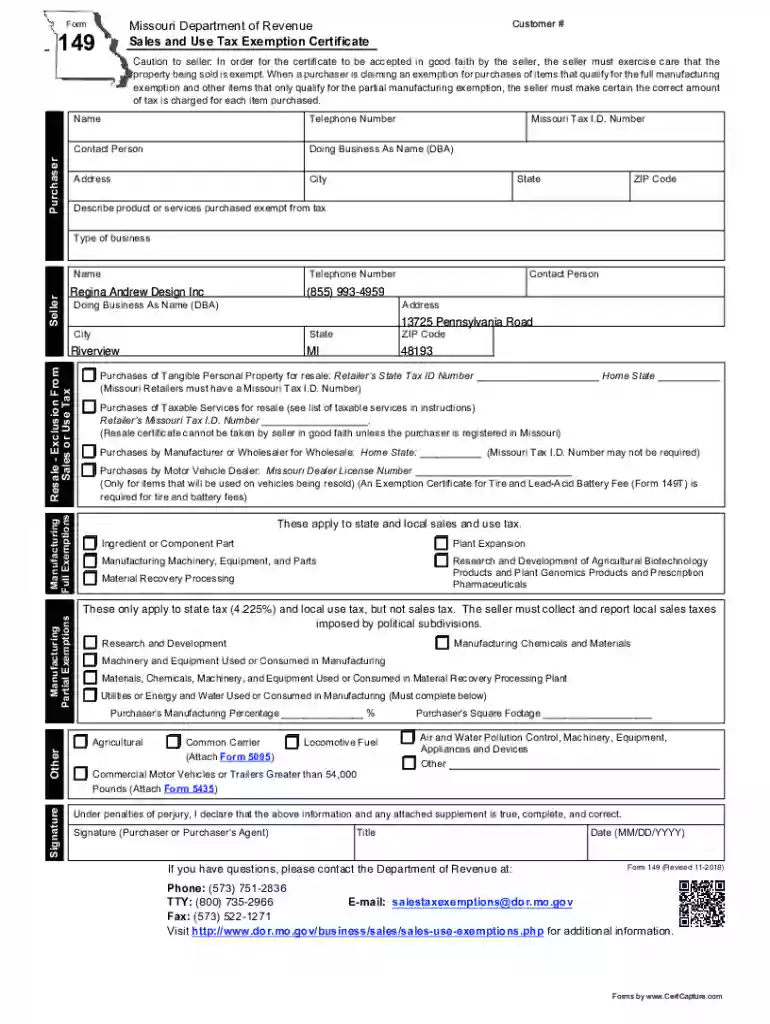
Form 149 Sales and Use Tax Exemption Certificate is a critical document issued by the Missouri Department of Revenue. It serves to allow purchasers to claim exemption from sales and use taxes on specific taxable items. The form is utilized to affirm that the purchaser is conducting a transaction that is legally exempt from sales tax under Missouri law. Featuring sections to indicate purchaser and seller information, as well as the specific type of exemption being claimed, it is a core component of tax compliance for businesses and individuals engaging in qualified transactions.
The application of Form 149 involves several steps to ensure compliance with Missouri tax law. Buyers should fill in the appropriate sections to identify themselves and the transaction. Typically, this includes their full contact details, tax identification numbers, and a clear description of the goods or services eligible for exemption. Sellers must retain this form in their records to justify the non-collection of sales tax during audits. Users need to ensure accuracy and completeness when filling out the form to avoid discrepancies.
Filling out Form 149 involves a structured process to ensure adherence to compliance requirements:
To qualify for using Form 149, the purchaser must meet specific eligibility criteria defined by the Missouri Department of Revenue. Primarily, the transaction should fall within one of the recognized exempt categories, such as manufacturing and agricultural activities, or resale. Furthermore, the purchaser must provide a valid tax identification number and maintain accurate records of the transaction. Businesses engaging in eligible activities should regularly review the criteria to ensure compliance and avoid penalties.


Form 149 is predominantly utilized by businesses in industries where transactions commonly qualify for sales tax exemptions. These include:
These organizations rely on Form 149 to streamline their tax processes and effectively manage costs associated with business operations.
The legal framework surrounding the use of Form 149 mandates strict adherence to state laws regarding sales tax exemptions. Misuse or inaccuracies in the form can lead to penalties, including fines and potential audits. It is incumbent upon both purchasers and sellers to ensure the form's correct application, as it acts as a declaration that the transaction is rightfully exempt from sales tax. Misrepresentation can attract severe legal consequences, including retroactive tax assessments.
Form 149 is composed of several essential elements necessary for its validity:
Correct completion of these elements is crucial to uphold the certificate's validity.
As Form 149 is specific to the state of Missouri, businesses operating in or conducting transactions within the state should be particularly mindful of Missouri’s rules. This includes understanding the types of transactions that are exempt, the acceptable documentation required, and being aware of Missouri Department of Revenue's guidelines. Deviations from these rules, even if inadvertently, could lead to rejection of the exemption request or future compliance issues during audits.
Accompanying Form 149, recipients may also need to provide additional documentation to validate their exemption claim such as:
These documents substantiate the form's claims and form part of the compliance records for both parties involved.
At DocHub, your data security is our priority. We follow HIPAA, SOC2, GDPR, and other standards, so you can work on your documents with confidence.