






Definition & Meaning
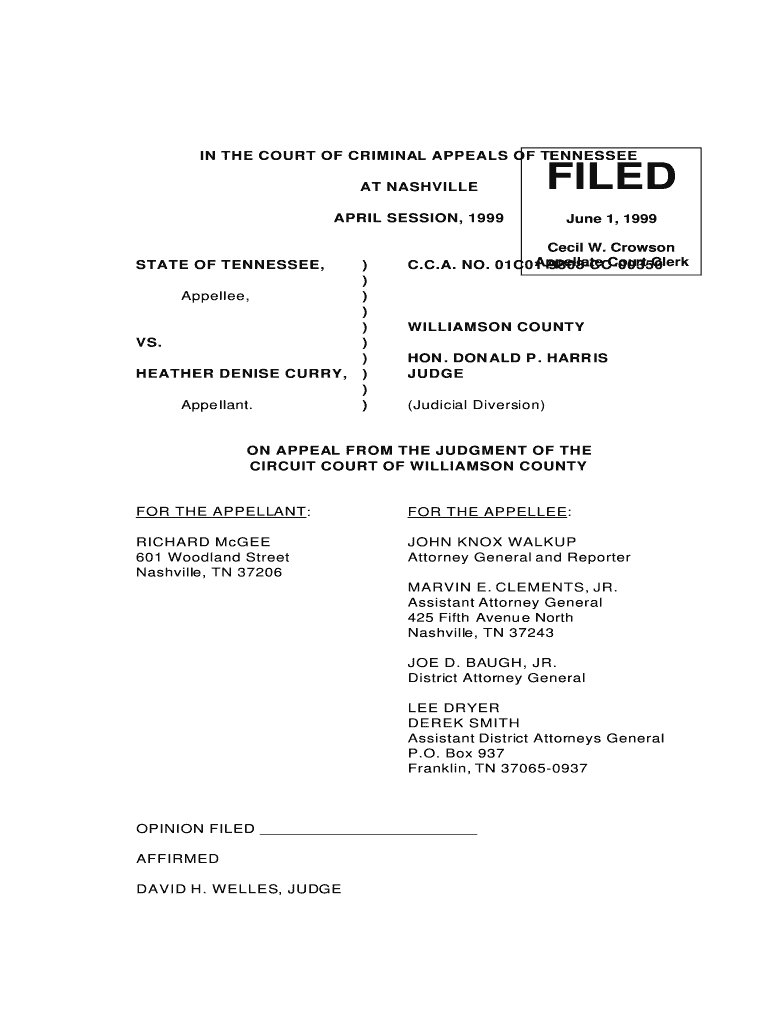
The document titled "IN THE COURT OF CRIMINAL APPEALS OF TENNESSEE AT NASHVILLE FILED APRIL SESSION, 1999 June 1, 1999 ST" is a court opinion from the Tennessee Court of Criminal Appeals. This type of document typically outlines the appellate court's decision on a criminal case that has been appealed from a lower court. In this instance, the document discusses the appeal of Heather Denise Curry, who was convicted of attempted theft. The document provides insight into the court's judgment, including the legal reasoning behind affirming the trial court's decision to deny Curry's request for judicial diversion.
Key Elements of the Court Opinion
- Appellant and Charges: Heather Denise Curry had been charged and convicted of attempted theft. The focus of the appeal was on the denial of judicial diversion.
- Judicial Diversion: The court opinion explores judicial diversion under Tennessee law, which allows certain defendants to avoid a formal conviction and record if they meet specific criteria.
- Credibility Issues: The document reveals that Curry misrepresented facts during her testimony, significantly affecting her credibility and influencing the court's decision.
- Trial Court’s Discretion: The appellate court examined whether the trial court abused its discretion in denying judicial diversion. The finding was that there was no abuse of discretion.
Steps to Complete and File Court Opinions
- Receive Judgment: The court delivers a judgment which is documented in a formal opinion.
- Draft the Opinion: Legal clerks and judges work collaboratively to draft the opinion, ensuring all aspects of the case and applicable legal standards are addressed.
- Review and Finalize: The draft opinion is reviewed, revised, and finalized by the court's panel of judges.
- File the Opinion: The finalized document is filed with the court clerk and made part of the public record.
Who Typically Uses This Court Opinion
- Legal Professionals: Lawyers use the court opinions to understand legal precedents and strategize future cases.
- Defendants and Appellants: Individuals like Heather Denise Curry, who are directly involved in the case, utilize the opinion to understand the reasoning for the appellate court’s decision.
- Law Students and Academics: These groups study court opinions to learn about the application of law and court procedures.
- Judges and Court Officers: Use such opinions to reference past decisions in new or ongoing cases.
Legal Use and Implications
Court opinions from appellate courts such as the Tennessee Court of Criminal Appeals are crucial legal documents. They:
- Establish precedents that lower courts within Tennessee must follow.
- Provide interpretative guidance on state laws, especially concerning judicial diversion.
- Serve as educational resources for legal reasoning and the application of discretion in judicial matters.
State-Specific Rules for Judicial Diversion
- Eligibility: Various factors determine eligibility, including the nature of the offense and the defendant’s past criminal history.
- Conditions for Diversion: Defendants may be required to meet specific conditions, such as counseling or community service, to qualify.
- Impact of Denial: If denied, as in Curry’s case, the defendant proceeds with a formal conviction on record.
Importance of Court Opinions in the Legal System
- Precedent Setting: Court opinions serve as authoritative examples for handling similar future cases.
- Clarification of Law: They clarify ambiguities in legal statutes and procedural application, guiding lower courts.
- Accountability: Provide transparency into the judicial decision-making process and ensure accountability.
Examples and Case Studies Using the Court Opinion
- Heather Denise Curry’s Case: Illustrates how misrepresenting facts can impact credibility and influence court decisions on judicial diversion.
- Judicial Discretion: Other cases referenced may explore limits and checks on judicial discretion during appellate reviews.
- Criteria for Success: Successful diversion cases might highlight adherence to criteria like first-time offenses and specific compliance with probation conditions.
Conclusion on the Court Opinion
This court opinion from the Tennessee Court of Criminal Appeals provides comprehensive insight into the appellate process and judicial treatment of requests for diversion. It underscores the significance of credibility and factual representation in judicial outcomes. By examining past opinions, legal professionals gain a broader understanding of the evolving interpretations and applications of law within the state.