
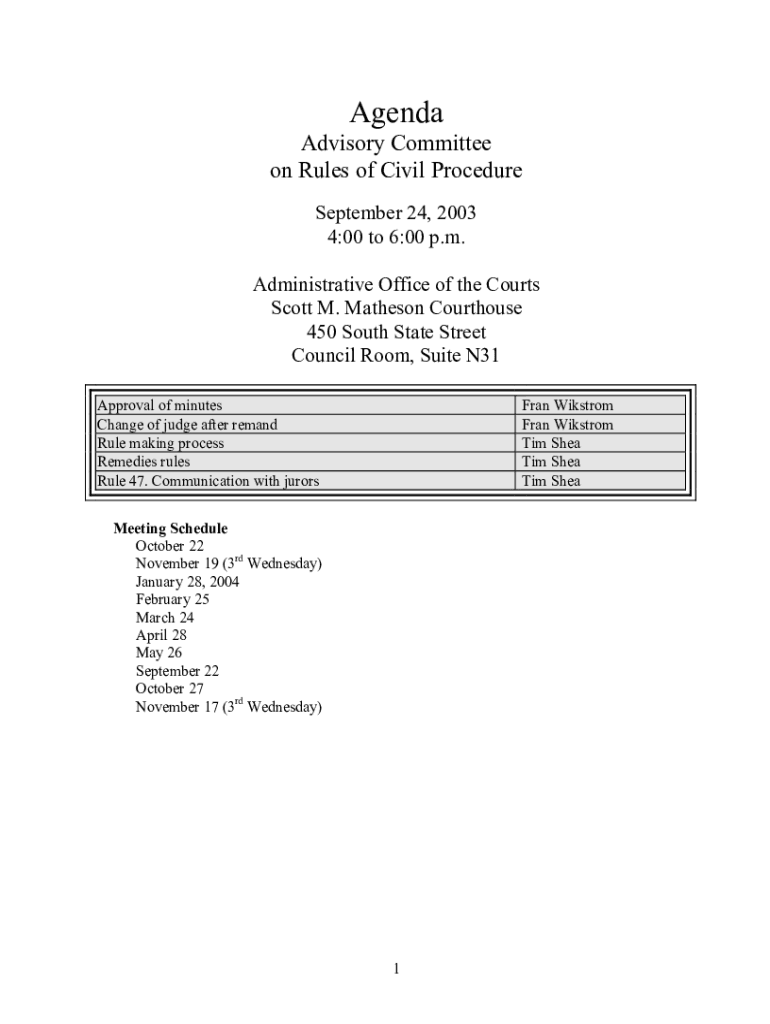







Definition and Importance of the Agenda and Minutes of Advisory Committee on Rules of Civil Procedure
The agenda and minutes of the Advisory Committee on Rules of Civil Procedure serve as official records of the committee's meetings. These documents provide a detailed account of the topics discussed, decisions made, and actions planned regarding amendments to the rules of civil procedure. They are crucial for maintaining transparency and accountability in the rule-making process, ensuring that all stakeholders are informed of potential changes affecting civil litigation practices.
Key Elements Included
- Meeting Agenda: Outlines topics and issues scheduled for discussion, such as proposed rule changes, reports from subcommittees, and any unresolved business.
- Discussion Summaries: Captures dialogue on each agenda item, highlighting differing viewpoints and the rationale behind decisions.
- Action Points: Lists decisions taken, including any rule amendments approved, tasks assigned, or follow-up needed for future meetings.
- Attendees and Roles: Identifies committee members present, including chairs and any invited experts or observers.
How to Use the Agenda and Minutes of Advisory Committee on Rules of Civil Procedure
The agenda and minutes are used by legal professionals, policymakers, and public stakeholders to track changes in civil procedure rules. They help ensure that legal practitioners remain informed about procedural updates and adjust their practices accordingly.
Practical Applications
- Legal Research: Attorneys use these documents to anticipate rule changes that could affect case strategies.
- Policy Making: Legislators and legal organizations review minutes to guide future legislative proposals or reforms.
- Public Awareness: Advocacy groups analyze minutes to understand the implications of rule changes on public interest issues.
Steps to Obtain the Agenda and Minutes of Advisory Committee on Rules of Civil Procedure
Acquiring these documents involves specific processes that vary depending on jurisdiction and availability.
General Acquisition Process
- Visit the Official Website: Most advisory committees upload meeting agendas and minutes to their official court or government web pages.
- Public Records Request: If documents are not readily available online, you may submit a formal request for access to public records.
- Library Resources: Some law libraries maintain archives of these documents for public use.
Steps to Complete the Agenda and Minutes Process
Committee members tasked with drafting and approving the agenda and minutes follow a structured procedure.
Drafting and Approval Stages
- Pre-Meeting Preparation: Compile topics needing discussion and distribute the agenda to all members in advance.
- Note-taking During Meetings: Record all significant discussions, decisions, and motions accurately.
- Post-Meeting Review: Circulate draft minutes for approval and address any amendments suggested by members.
- Finalization and Distribution: Once approved, share the final minutes with committee members and make them accessible to the public if applicable.
Legal Use of the Agenda and Minutes of Advisory Committee on Rules of Civil Procedure
The legal community utilizes these documents to ensure that procedural rules are developed and amended according to proper governance standards.
Legal Relevance
- Documentation of Process: They serve as evidence of the committee's adherence to appropriate procedural frameworks.
- Audit Trail: Provide a verifiable record of discussions and decisions, crucial for accountability and transparency in legal proceedings.
- Rule Amendments: Lawyers use these documents to prepare for upcoming rule changes which may affect litigation strategies and court procedures.
Who Typically Uses the Agenda and Minutes of Advisory Committee on Rules of Civil Procedure
A diverse set of individuals and organizations rely on these documents for various purposes.


Primary Users
- Lawyers and Judges: Track procedural changes affecting court operations and case management.
- Policy Analysts: Evaluate the impact of rule amendments on legal processes and public policy.
- Academics and Researchers: Study the evolution and reasoning behind procedural changes.
- Public Interest Groups: Monitor developments that may influence public access to justice or ethical considerations.
State-Specific Rules for the Agenda and Minutes of Advisory Committee on Rules of Civil Procedure
Different states may have unique protocols regarding how advisory committee meetings are conducted and documented.
Variation by State
- Accessibility: Some states publicly share all committee minutes, while others may restrict access to government or legal professions.
- Meeting Frequency: The regularity with which committees meet and produce agendas/minutes can vary, affecting how often updates to rules occur.
- Public Participation: States may differ on whether the public can attend meetings or provide input on agendas, impacting how citizen feedback is incorporated.
Examples of Using the Agenda and Minutes of Advisory Committee on Rules of Civil Procedure
Real-world examples illustrate the application and value of these documents.
Case Studies
- Example 1: A litigation firm uses committee minutes to prepare arguments for a high-stakes case requiring adjustment to the latest amendments in discovery rules.
- Example 2: A non-profit organization cites advisory committee minutes in advocacy work, influencing legislation on procedural reforms related to public interest matters.
Each example underscores the practical influence these documents have on legal practices and policy development.




