






Definition & Meaning
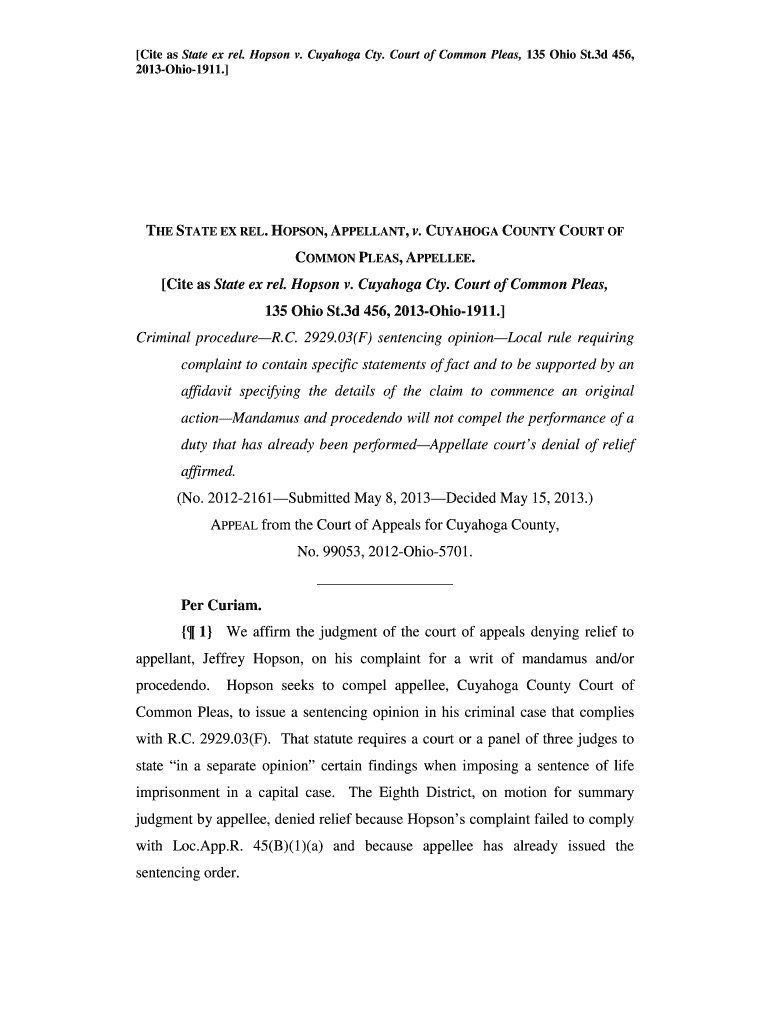
The case "State ex rel Hopson v Cuyahoga County Court of - Supreme Court" refers to a legal proceeding wherein Jeffrey Hopson sought a writ of mandamus against the Cuyahoga County Court of Common Pleas. A writ of mandamus is a court order directing a public agency or governmental body to perform an act required by law when it has neglected or refused to do so. In this context, Hopson aimed to compel the court to issue a sentencing opinion compliant with Ohio Revised Code 2929.03(F) for his life imprisonment sentence.
Legal Use of the Case
The primary legal significance of this case lies in the court's decision regarding the application of a writ of mandamus. The Supreme Court of Ohio affirmed the appellate court's denial of this writ, effectively ruling that Hopson's complaint did not satisfy local rule requirements. Furthermore, the court underscored that a writ of mandamus cannot be used to control or interfere with a court's discretion when an action has already been completed, such as issuing a sentencing opinion.
Steps to Understand the Case
- Background Reading: Familiarize yourself with the Ohio Revised Code 2929.03(F) to understand the legal context for sentencing opinions.
- Analyze Filed Documents: Review the court filings and opinions issued at various stages, focusing on the arguments presented by Hopson and the responses by the courts.
- Court Rulings: Examine the judgments from both the appellate level and the Supreme Court to understand their reasoning and legal basis.
- Consider Precedents: Look into past cases involving writs of mandamus to comprehend how this instrument is typically applied in the Ohio legal system.
Who Typically Uses the Case
This case serves as a critical reference for individuals and legal professionals involved in criminal law in Ohio, particularly those dealing with sentencing disputes. Public defenders, private defense attorneys, and legal scholars focusing on criminal procedure and appellate advocacy often refer to such precedents to inform their practice and research. Additionally, law students might study this case for educational purposes, gaining insights into Ohio’s judicial processes and the limitations of writs of mandamus.


Important Terms Related to the Case
- Writ of Mandamus: Court order for public officials to fulfill their legal duties.
- Sentencing Opinion: Explanation provided by a court detailing the rationale behind a sentencing decision.
- R.C. 2929.03(F): Ohio Revised Code provision governing the sentencing in criminal offenses.
- Local Rule Requirements: Specific procedural rules set by a court that filings must comply with.
Key Elements of the Case
- Writ Denial: The central element is the rejection of the writ of mandamus based on failure to meet procedural requirements.
- Precedent Setting: The case reinforces the principle that mandamus cannot compel actions already fulfilled by a court.
- Local vs. State Law: Highlights the interplay between court-specific rules and state-wide legal standards.
Examples of Similar Cases
Cases similar to "State ex rel Hopson v Cuyahoga County Court of" often involve disputes where defendants seek judicial review of court actions perceived as non-compliant with sentencing laws or procedural rules. A comparable scenario might include challenges to the adequacy of sentencing explanations or requests for clarification of legal reasoning in judgments.
State-Specific Rules
In Ohio, local courts may have unique requirements for the presentation and format of legal documents. This case exemplifies the necessity of understanding and adhering to specific filing protocols, beyond just state law, to successfully petition for writs like mandamus. Practitioners should always verify both local procedural rules and wider state legislation when preparing legal documentation.
Digital vs. Paper Version
Legal documents associated with court cases, such as briefs, opinions, and orders, can be accessed digitally or in paper format. Digital access is often through court libraries, legal databases, or court websites. The convenience of digital formats allows for quicker research and retrieval, though some practitioners still rely on paper versions for annotation and reference during proceedings.
Eligibility Criteria for Filing Writs
To seek a writ of mandamus, plaintiffs must demonstrate:
- A clear legal right to the requested act.
- A corresponding duty on the part of the court or public body to perform the act.
- No adequate remedy available through ordinary legal channels.
Research and a thorough understanding of pertinent legal standards are essential before pursuing such action.