01. Edit your form online
Type text, add images, blackout confidential details, add comments, highlights and more.

Type text, add images, blackout confidential details, add comments, highlights and more.

Draw your signature, type it, upload its image, or use your mobile device as a signature pad.

Send it via email, link, or fax. You can also download it, export it or print it out.
The Girl Scout Gold Award Project Proposal form includes several vital components that must be thoroughly detailed for successful submission. An essential element is the project description, which outlines the issue the project intends to address, how it impacts the community, and the proposed solution. Additionally, the form requires a list of prerequisites that the scout has completed, such as leadership hours and age requirements, which demonstrate preparedness for undertaking the project.
The proposal also includes sections for team members and their roles, which helps illustrate the collaborative efforts involved in the project. Target audience information is crucial, as it identifies who will benefit from the project outcomes. Measurable goals should be clearly defined, providing criteria for success and methods for evaluating whether the project has met its objectives. Lastly, sustainability plans ensure that the project’s impact continues beyond its initial implementation, while promotional strategies detail how the project will be communicated to the community.
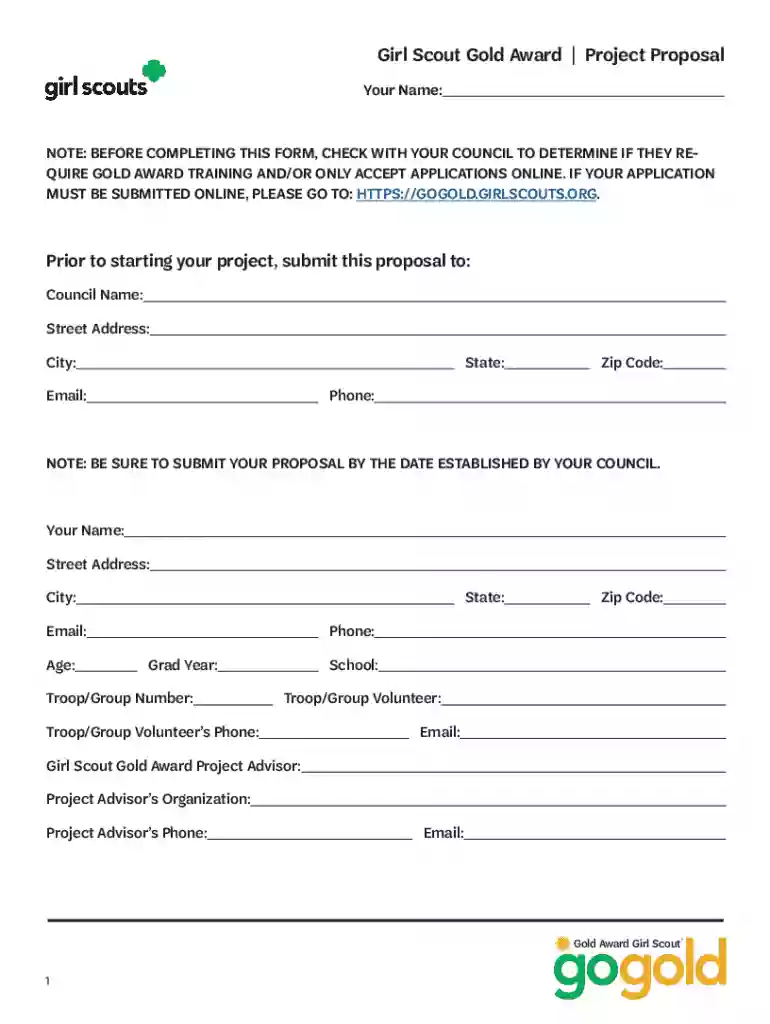
Completing the Girl Scout Gold Award Project Proposal requires careful attention to detail and adherence to the specified structure. The process begins with gathering personal information, including contact details and a brief scouting history. Once these details are logged, scouts should draft their project description, ensuring it addresses a community issue and provides a viable solution.
Next, scouts must identify team members who will support their project, describing their roles and responsibilities. Following this, scouts need to define the target audience and articulate the benefits the project will bring to them. Setting measurable goals is a crucial step, providing clear benchmarks for success. After goals are set, scouts should outline their sustainability plans, ensuring the project will have a lasting impact. Lastly, they should develop promotional strategies to effectively communicate their project to a broader audience.
To be eligible to submit the Girl Scout Gold Award Project Proposal, scouts must meet specific prerequisites. They must be high school-aged Girl Scouts, typically in grades nine through twelve, who have earned their Silver Award. Additionally, they should have completed a set number of leadership hours and other preparatory requirements, such as badge work and volunteer service, demonstrating their readiness to lead a comprehensive project.
Furthermore, scouts must undergo proposal review and approval from their local council before commencing their projects. This ensures that the proposed project aligns with the goals of the Gold Award and adheres to council guidelines.


The primary users of the Girl Scout Gold Award Project Proposal are Girl Scouts who aspire to achieve the highest honor within the organization—the Gold Award. Typically, these scouts are highly motivated individuals who have demonstrated leadership potential and a commitment to community service. Beyond the scouts themselves, troop leaders, mentors, and council representatives are also key stakeholders in the process, providing guidance and support to ensure the proposal meets all necessary criteria.

The Girl Scout Gold Award Project Proposal can be obtained from several sources. Scouts can access the form through their local council’s website or obtain a copy from their troop leader. Some councils provide the form in a digital format, allowing for direct input of information, while others may offer a printable version for manual completion. Additionally, attending council-hosted workshops or webinars may provide valuable insights and resources for completing the proposal.
The Girl Scout Gold Award Project Proposal is available in both digital and paper versions, each with distinct advantages. The digital version is often more convenient, allowing for easy updates and edits. It also enables scouts to share their drafts with mentors and team members for feedback efficiently. In contrast, the paper version may be preferred by some for its tactile qualities, providing a physical copy that can be annotated and referenced during brainstorming sessions.
Choosing between these versions depends on the scout’s preference, access to technology, and requirements from their local council. It's important that scouts have the option that best suits their workflow and circumstances.
Several key terms are critical to understanding and completing the Girl Scout Gold Award Project Proposal. Sustainability refers to how the project will maintain its impact over time without ongoing intervention. Measurable goals are specific outcomes the project aims to achieve, which can be quantitatively evaluated. Target audience defines the particular group that will benefit from the project, while prerequisites relate to the requirements a scout must meet before starting their project, such as earning badges or completing volunteer hours.
Understanding these terms is vital for accurately preparing the proposal and setting clear, attainable objectives.
The application process for the Girl Scout Gold Award Project Proposal involves several stages. Initially, scouts draft and refine their proposals, often with input from mentors or troop leaders. Once the proposal is complete, it is submitted to their local council for review. The approval process typically involves meetings or interviews with council representatives to discuss the project’s feasibility and alignment with Gold Award standards.
Approval times can vary, depending on the council’s schedule and the complexity of the project. Scouts should plan for this process and submit their proposal well ahead of any planned start date to accommodate potential revisions.
While the Girl Scout Gold Award standards are nationally recognized, individual states and local councils may have specific rules or additional requirements. These may include region-specific community needs that projects must address, varying definitions of acceptable sustainability measures, or distinct application timelines. Scouts should familiarize themselves with their state or council’s particular guidelines to ensure compliance.
Consulting their local council’s resources, attending informational meetings, and maintaining open communication with council representatives can provide clarity on any state-specific rules scouts must follow.
Real-world examples of successful Girl Scout Gold Award projects can be invaluable for scouts in the planning phase. Projects range from environmental conservation initiatives to educational programs addressing critical issues like literacy or STEM awareness. For instance, a scout might develop a community garden to provide fresh produce to underserved areas or create a workshop series teaching digital literacy to seniors.
These examples not only illustrate the diversity of projects possible but also provide inspiration and practical insights into developing impactful, sustainable initiatives that meet community needs.
We've got more versions of the Girl Scout Gold Award Project Proposal form. Select the right Girl Scout Gold Award Project Proposal version from the list and start editing it straight away!
At DocHub, your data security is our priority. We follow HIPAA, SOC2, GDPR, and other standards, so you can work on your documents with confidence.