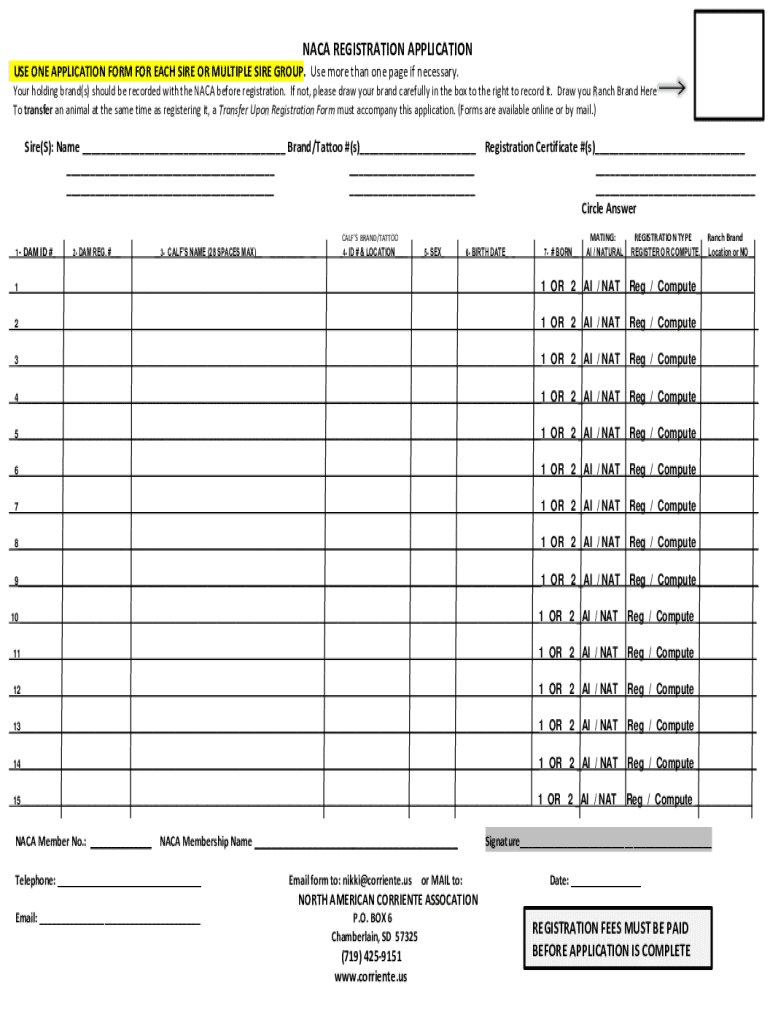







Definition & Meaning
The NACA Registration Application is a formal document used primarily for the registration of livestock, particularly focusing on sires and their offspring. This application is essential for recording ranch brands and transferring ownership of animals at the time of registration. It provides necessary details about the sire, dam, and calf, ensuring that all lineage and breeding information is accurately documented. Registration not only facilitates the tracking and management of breeding lines but also serves as proof of ownership and pedigree, which are crucial for livestock valuation and sales.
Steps to Complete the NACA Registration Application
-
Gather Necessary Information: Before starting the application, collect detailed information about the sire, dam, and calf, including their breed, age, and identifying marks or brands. Ensure all the data is accurate to prevent any errors in the registration process.
-
Record Ranch Brands: Accurately document the ranch brand associated with the animals. This step is vital for identification and proves the authenticity of the ranch’s breeding stock.
-
Fill Out the Application Form: Use the form to enter all necessary information. Pay particular attention to sections detailing the animal's lineage and ownership history. Errors here can lead to delays or rejections.
-
Attach Supporting Documents: Include any required documentation, such as proof of ownership or previous registrations, to validate the information provided.
-
Submit the Application: Choose the method of submission — whether via email, postal mail, or in-person delivery. Ensure all documents are included and that the form is complete.
-
Pay Registration Fees: Complete the financial transaction for the registration fees. Note that applications may not be processed without the accompanying fee.
Important Terms Related to NACA Registration Application
- Sire: The father of a livestock animal.
- Dam: The mother of a livestock animal.
- Calf: An offspring within a certain age range, typically up to a year.
- Breed: The specific stock or variety the animal belongs to.
- Ranch Brand: A unique identifier burned into livestock skin to signify ownership.
- Pedigree: A detailed genealogical record used to trace the animal’s lineage.
Required Documents
When completing a NACA Registration Application, several documents may be necessary to substantiate the registration:
- Proof of Ownership: Documentation showing rightful ownership of the sire, dam, and calf.
- Previous Registration Papers: If applicable, provide copies of any prior registration certificates.
- Brand Registration Certificate: Validates the authenticity of the ranch brand.
- Bill of Sale: If the animal was recently purchased, provide the transaction details as proof of purchase.
Form Submission Methods (Online / Mail / In-Person)
- Online Submission: Scan all documents and complete the form electronically. Submit via the designated email address or web portal. This method is often the quickest.
- Mail Submission: Send hard copies of the completed form and accompanying documents to the designated mailing address. Include a self-addressed, stamped envelope if confirmation of receipt is desired.
- In-Person Submission: Visit the relevant office or authority to submit your application directly. This can provide an opportunity to correct errors immediately and get instant feedback.
Legal Use of the NACA Registration Application
The NACA Registration Application serves several legal functions:
- Ownership Proof: Acts as an official document proving the rightful ownership of an animal, which is crucial in disputes.
- Pedigree Verification: It legally confirms the lineage, which is important for selling or breeding purposes.
- Breed Standards Compliance: Ensures that registered animals meet the standards of breed associations, which is often required for competition or sales in regulated markets.
Application Process & Approval Time
The process typically follows these stages:
- Initial Submission: Submitting the completed form with all required documentation.
- Review and Verification: Officials verify the information provided, checking for completeness and accuracy.
- Approval: Once verified, the application is approved, and the registration certificate is issued. This can take several weeks, depending on the backlog and the accuracy of the initial submission.
- Follow-Up: If there are issues or missing information, additional documentation may be requested, potentially extending the process.
Who Typically Uses the NACA Registration Application
- Ranch Owners: To maintain accurate records of breeding stock and manage the valuation of their livestock.
- Breeders: To establish pedigree information and enhance the marketability of their animals.
- Livestock Buyers: For confirming the pedigree and health history of potential purchases.
- Feedlots and Farms: For the management and certification of their livestock’s genealogy and ownership.


Key Elements of the NACA Registration Application
- Animal Identification: Detailed description and identification marks for the sire, dam, and calf.
- Ownership History: Comprehensive account of the ownership lineage, showing consistent title transfer.
- Breed Information: Certification of the animal’s breed, ensuring compliance with breed standards.
- Registration Fees: Evidencing payment, which is a prerequisite for processing the application.
Eligibility Criteria
To use the NACA Registration Application, the following criteria must typically be met:
- Ownership: Proof of ownership or authorized rights to register the animal.
- Brand Registration: A valid, recorded ranch brand.
- Pedigree Documentation: If applicable, previous pedigree or registration documents.
- Fee Payment: Completed payment for the registration fee.

State-Specific Rules for the NACA Registration Application
While many elements of the NACA Registration Application are standard, specific states may impose additional requirements, such as:
- Additional Fees: State-specific fees that apply during the registration process.
- Local Brand Laws: Requirements for brand registration compliance specific to individual states.
- Regulatory Compliance: Ensuring alignment with state agriculture laws, which might include additional health or welfare checks for specific breeds or livestock categories.