






Definition and Meaning
The Civil Service Injury Benefits Scheme (Amendment - GOV UK) is a provision specifically designed to provide financial benefits to civil service employees who suffer injuries related to their official duties. It includes specific criteria that define what constitutes a qualifying injury and outlines the process whereby injured employees can obtain benefits. The scheme serves as a critical support mechanism, ensuring that civil servants receive appropriate compensation and assistance when they face work-related injuries.
Eligibility Criteria
The Civil Service Injury Benefits Scheme establishes clear eligibility criteria that applicants must meet to qualify for benefits. Primarily, the individual must be a civil service employee who has sustained an injury while performing official duties. The injury must significantly impact the employee's ability to perform their job. Additionally, applicants must provide thorough documentation proving the injury occurred in the line of duty. Applicants should work closely with their employers to ensure all eligibility requirements are met and documented.


Steps to Complete the Civil Service Injury Benefits Scheme
-
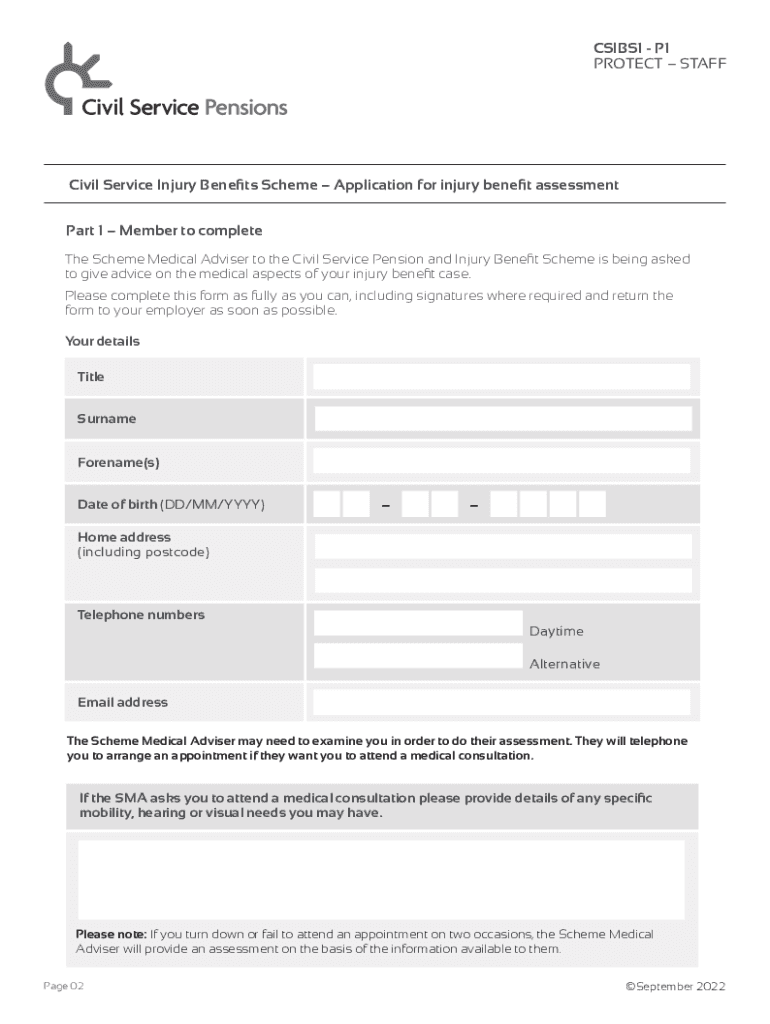
Obtain the Application Form: The first step involves acquiring the scheme's official application form, which can be accessed through the relevant government department or website.
-
Complete Personal Information: Fill out the initial sections with personal details, ensuring accuracy and completeness.
-
Medical Consent and Documentation: Provide medical consent and attach relevant medical documents that verify the injury and its connection to the civil service duties.
-
Employer Verification: Have the employer complete their section of the form, confirming the nature and circumstances of the injury.
-
Submit the Form: Once all sections are completed, submit the form through the designated submission channels.
Required Documents
To successfully apply for benefits under this scheme, applicants need to compile a specific set of documents:
- Personal Identification: Proof of identity, such as a valid government-issued ID.
- Medical Reports: Comprehensive medical reports detailing the injury, treatment, and impact on work capacity.
- Employer Confirmation: A document from the employer confirming the injury occurred during work-related activities.
- Witness Statements: If applicable, statements from witnesses who can verify the circumstances of the injury.
Who Issues the Form
The form for the Civil Service Injury Benefits Scheme is issued by the relevant government department that oversees civil service employment matters. In the UK, this responsibility may fall to the department responsible for public sector employees or a specialized agency that manages occupational health and safety for civil servants.
Application Process and Approval Time
The application process involves several key stages:
-
Initial Submission: The applicant submits the form and all required documents to the issuing department.
-
Review: The application is reviewed by a Scheme Medical Adviser who assesses the injury against the qualifying criteria.
-
Decision: The authorities decide whether the application meets all requirements and qualifies for benefits.
-
Notification: Applicants are notified of the outcome, with approved applications leading to benefit disbursement.
The review and approval time can vary based on the complexity of the case, but applicants should expect a processing period of several weeks after submission.
Legal Use of the Civil Service Injury Benefits Scheme
This scheme is legally established to ensure compliance with statutory requirements for providing benefits to injured civil servants. It outlines the legal framework under which benefits are provided, including the specific responsibilities of both employers and employees. Adherence to the procedure is mandatory to ensure the scheme's fair and lawful operation.
Important Terms Related to Civil Service Injury Benefits Scheme
Understanding the terminology associated with the scheme is crucial:
- Qualifying Injury: Injuries that occur during the execution of official duties and meet specific criteria outlined in the scheme.
- Scheme Medical Adviser: A professional who evaluates the injury and determines eligibility for benefits.
- Benefit Disbursement: The process of releasing funds or compensations to employees who meet eligibility requirements.
Key Elements of the Civil Service Injury Benefits Scheme
The key elements of this scheme include:
- Comprehensive Coverage: Provides financial support for various work-related injuries.
- Eligibility Criteria: Detailed guidelines to determine who qualifies for benefits.
- Documentation Requirements: Specifies what documentation is needed for an application.
- Evaluation Process: Involves medical assessment and employer verification to ensure claims' validity.
Examples of Using the Civil Service Injury Benefits Scheme
Consider these examples to understand real-world applications of the scheme:
-
A civil servant sustains a back injury while moving heavy files at the workplace. The medical report confirms the injury, and the employer verifies the circumstances. The employee applies for benefits under the scheme and receives compensation.
-
An administrative officer is injured while attending an official event. Witnesses provide statements, and the officer presents medical records and employer verification to qualify for benefits, ensuring support during recovery.
By understanding these scenarios, applicants can see how the scheme functions and supports civil servants in various situations.