01. Edit your form online
Type text, add images, blackout confidential details, add comments, highlights and more.

Type text, add images, blackout confidential details, add comments, highlights and more.

Draw your signature, type it, upload its image, or use your mobile device as a signature pad.

Send it via email, link, or fax. You can also download it, export it or print it out.
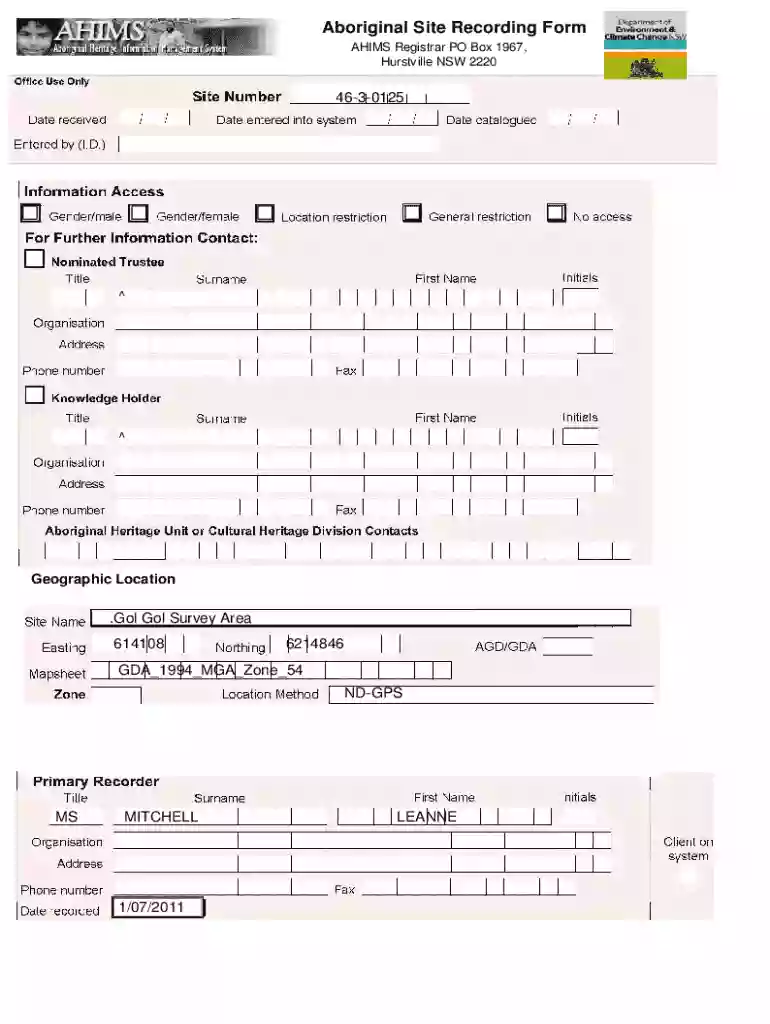
The Aboriginal Site Recording Form is a crucial document used to document and evaluate Aboriginal cultural heritage sites specifically within the Gol Gol Survey Area, New South Wales. This form plays a vital role in preserving the cultural significance of these sites, providing detailed records that ensure their protection. It is designed to capture comprehensive details regarding the geographical location, environmental characteristics, and cultural significance of each site.
This form serves as an official record that helps maintain the integrity of Aboriginal heritage sites. It includes sections that record specific environmental and cultural aspects essential for ongoing site management and conservation. Identifying and documenting these aspects is vital for protecting these sites from potential threats, such as vehicle damage or unauthorized camping.
Using the Aboriginal Site Recording Form efficiently requires careful attention to multiple components. The form consists of several sections, each designed to capture specific information about the site. Users must ensure that they complete each section thoroughly to provide an accurate and comprehensive record. Below is a general guide on using the form effectively:
Geographic Location: Begin by detailing the specific geographic coordinates of the site. This step is crucial for identifying the location accurately.
Environmental Characteristics: Document the landform, vegetation, and any observable land use in the area. These details are significant for understanding the site's context within its natural environment.
Cultural Features: Specify any cultural or historical elements present at the site. This may include artifacts, rock formations, or other features significant to Aboriginal heritage.
Community Interpretation: Include insights or interpretations from the local Aboriginal community, ensuring the form captures cultural narratives and values associated with the site.
Completing the Aboriginal Site Recording Form involves several methodical steps to ensure accuracy and completeness:
Site Visit and Data Collection: Conduct an on-site visit to gather all necessary data. This includes taking photographs, making observational notes, and using precise instruments for measuring geographic coordinates.
Information Verification: Cross-check collected data with existing records and engage with local Aboriginal representatives to verify cultural details.
Form Completion: Fill out each section of the form, ensuring all information is accurate and clearly presented. Pay consistent attention to details, particularly when documenting cultural features.
Review and Submission: Once completed, review the form for any errors or omissions. After a final verification, submit the form to the appropriate preservation authorities or governing body.
The Aboriginal Site Recording Form comprises several key elements critical for thorough documentation:
Geographical Data: Essential for mapping the site's location and understanding its spatial context.
Environmental Context: Information about the landform, vegetation, and land use provides a backdrop for evaluating the site's ecological status.
Cultural Significance: Highlights the presence of artifacts, structural features, and narratives tied to the site, underscoring its heritage value.
Threats and Conservation Needs: Identifies potential threats such as erosion, human activity, and need for conservation measures to protect the site for future generations.
The legal use of the Aboriginal Site Recording Form is governed by heritage protection laws in New South Wales. Users of the form must adhere to relevant legal frameworks and ensure that all information is collected and reported in compliance with these guidelines. The form also plays a critical role in any legal proceedings related to the protection of Aboriginal sites by providing an official record and evidence of a site's historical and cultural significance.
Professionals using this form must be well-versed in the pertinent legalities and should engage in consultations with Aboriginal communities throughout the process to ensure cultural sensitivity and legal compliance.
The following are practical examples of how the Aboriginal Site Recording Form may be employed:
Heritage Site Preservation: Used by archaeologists and cultural heritage managers to document and preserve newly discovered Aboriginal sites during surveys or construction assessments.
Cultural Education Programs: Utilized to gather information for educational materials and programs aimed at raising awareness and understanding of Aboriginal cultural heritage.
Policy Development: Helps inform government policies on land use and environmental conservation areas by providing detailed records of culturally significant sites.
This form is typically used by:
Archaeologists and Researchers: Experts in cultural heritage who document and study Aboriginal sites.
Government and Environmental Authorities: Regulatory bodies tasked with monitoring and protecting cultural heritage areas.
Indigenous Community Leaders: Aboriginal representatives who advocate for the preservation of their cultural heritage and advise on site significance.
Government departments and cultural heritage management organizations coordinate efforts to ensure the form is properly used and the data collected serves its intended purpose of heritage protection.


Knowledge of specific terms related to the Aboriginal Site Recording Form enhances understanding and effective usage:
Cultural Heritage: Refers to the legacy of physical artifacts and intangible attributes of a group or society, including traditions, history, and values.
Archaeological Assessment: The examination and evaluation of a site to determine its historical and cultural significance.
Landform and Vegetation: Terms used to describe the natural features and plant life present at a site which may hold cultural importance.
These terms are essential for contextualizing the form's sections, ensuring each part of the document serves its role in preserving Aboriginal cultural heritage.
We've got more versions of the Aboriginal Site Recording Form form. Select the right Aboriginal Site Recording Form version from the list and start editing it straight away!
At DocHub, your data security is our priority. We follow HIPAA, SOC2, GDPR, and other standards, so you can work on your documents with confidence.