






Definition and Role of Record Officers
Record Officers play a crucial role in managing and preserving important documents within state agencies in Kentucky, often governed by the Kentucky Department for Libraries and Archives (KDLA). The roles are typically segmented into levels, such as Record Officer 1, 2, and 3, each responsible for different tiers of record management and oversight. These officers ensure that records are effectively categorized, archived, and maintained according to state laws and administrative rules, which are designed to safeguard public records and enhance transparency.
Responsibilities of Record Officer 1
- Assist with the initial categorization and filing of documents.
- Perform basic archival tasks and data entry.
- Coordinate with department personnel to ensure proper recordkeeping.
Responsibilities of Record Officer 2
- Oversee the accuracy and integrity of records.
- Implement record retention and disposition schedules.
- Conduct regular audits and compliance checks.
Responsibilities of Record Officer 3
- Manage large-scale document processing and storage systems.
- Develop and implement policies for record management.
- Lead training for department staff on best practices in recordkeeping.
How to Use the Form
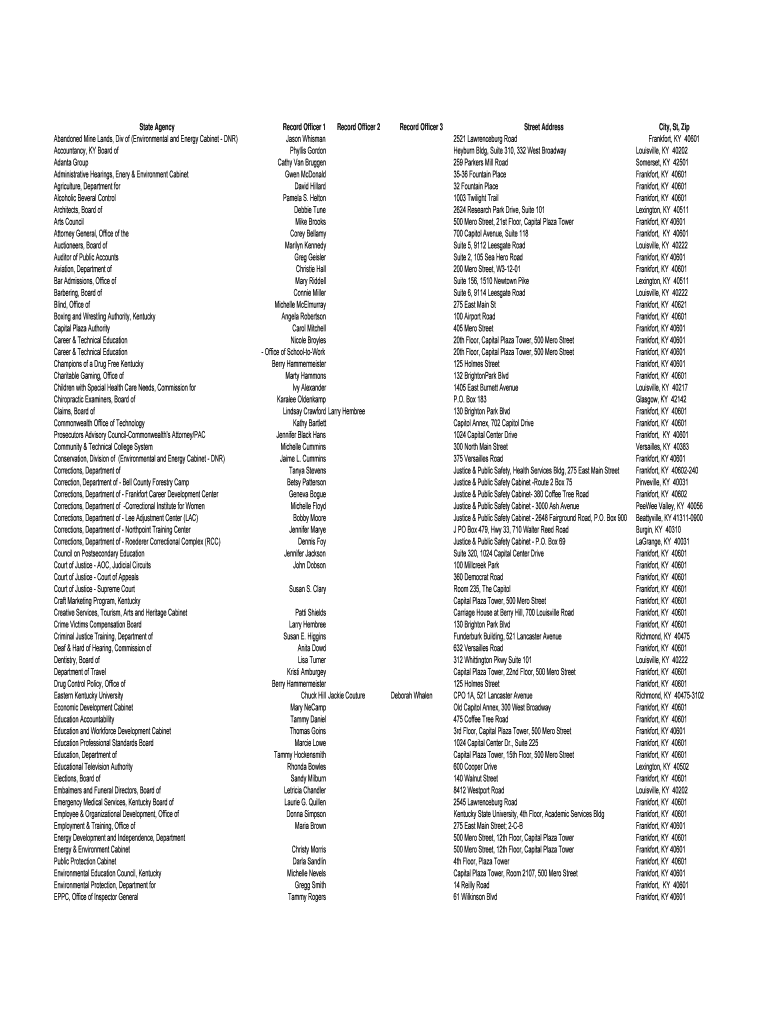
The "State Agency Record Officer 1 Record Officer 2 Record Officer 3 - kdla ky" form is used to formalize the appointment or changes in roles of Record Officers within Kentucky state agencies. Utilizing this form ensures that all appointments are properly recorded and recognized by the KDLA.
- Identify the Appropriate Role: Determine whether you are assigning, updating, or terminating a role for Record Officers 1, 2, or 3.
- Fill Relevant Sections: Complete sections based on the level of the officer, including personal information and specific responsibilities.
- Submit for Approval: Once filled, the form must be submitted for approval to the relevant department within the KDLA.
How to Obtain the Form
To obtain the "State Agency Record Officer 1 Record Officer 2 Record Officer 3 - kdla ky" form, department personnel can request it through the Kentucky Department for Libraries and Archives official website or directly contact the respective department handling record management for guidance.
- Visit the KDLA's official website for downloadable forms.
- Contact the administrative office for physical copies.
- Check departmental intranets, where such forms may be stored for ease of access.
Steps to Complete the Form
Completing the form requires attention to detail to ensure accuracy:
- Gather Required Information: Collect necessary details about the officer candidate, including contact information, previous roles, and qualifications.
- Complete Role-Specific Sections: Each level—Record Officer 1, 2, or 3—has distinct sections that need careful completion pertaining to their responsibilities.
- Review and Confirm: Double-check all entries for accuracy and completeness to avoid delays in processing.
- Submit the Form: Submission can be done online or in-person, based on your department’s guidelines.
Who Typically Uses the Form
This form is primarily used by state agency administrators and human resource departments within Kentucky. It is also relevant for department heads tasked with overseeing compliance with state records management standards.
- State Agency Administrators: Ensure proper documentation and role assignments.
- HR Departments: Manage and track employee role designations.
- Department Heads: Ensure that recordkeeping aligns with state regulations.


Important Terms Related to the Form
Understanding key terms can aid in accurately completing the form and adhering to legal requirements:
- Retention Schedule: A timeline that dictates how long records must be kept.
- Archival: The process of preserving documents for long-term storage.
- Disposition: The process of eliminating records that are no longer needed.
Key Elements of the Form
Several critical elements must be filled out correctly on the form for it to be valid:
- Personal Information Section: Contains the candidate's name, contact information, and relevant experience.
- Role Designation: Specify whether the assignment relates to Officer 1, 2, or 3.
- Authorization Signatures: Required to validate the form submission.
Legal Use of the Form
Using the form ensures compliance with legal and procedural standards set forth by the state. It standardizes the process across various agencies and helps maintain a high level of accountability for managing public records.
- Compliance with State Regulations: Fulfills legal obligations for record management.
- Prevention of Unauthorized Use: Helps deter improper handling or access to official documents.
State-Specific Rules
Kentucky has specific guidelines regarding the use and management of public records, as governed by state law:
- State Records Management Act: Provides the framework for recordkeeping in Kentucky.
- Data Protection Standards: Outlines how sensitive information should be handled and stored.
By adhering to these specific guidelines and comprehending the scope of roles and responsibilities, state agency personnel can effectively utilize the record officer form in their departments.