







Definition & Meaning
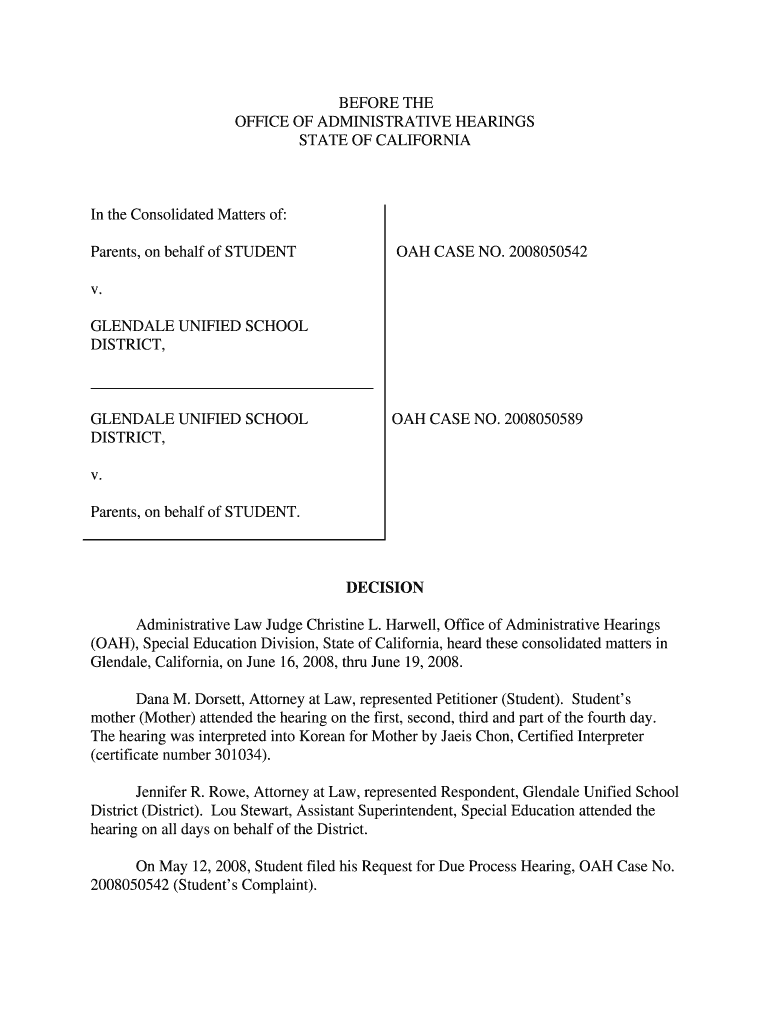
Before the Office of Administrative Hearings (OAH) State of California, the document functions as a formal decision-making process concerning administrative disputes. In particular, these disputes often relate to educational assessments conducted by public school districts, such as Glendale Unified School District, where issues often arise about the adequacy and compliance of psycho-educational evaluations.
Specific Case Use
For instance, in the case involving a student suspected of having ADHD, the OAH adjudicated whether the educational assessment met legal standards. The ruling concluded that the assessment was inadequate and granted the student entitlement to an Independent Educational Evaluation (IEE) at public expense, underlining the importance of adherence to rigorous assessment criteria.
Steps to Complete the Form
When engaging with this form, it is essential to follow a structured process:
- Gather Required Documents: Obtain all relevant documentation, including existing educational assessments and any previous OAH decisions related to the case.
- Form Completion: Carefully complete the form sections, providing detailed information about the specific administrative issue.
- Review and Revise: Ensure accuracy and completeness in all entries. Verify legal compliance issues related to the assessment standards.
- Submit the Form: Depending on the format, you can submit either online, via mail, or in person at the designated administrative office.
Legal Use of the Form
In legal contexts, the OAH form serves a critical function in resolving disputes between educational bodies and individuals. Specifically, it adjudicates cases where educational assessments are contested for failing to meet state-mandated evaluation standards.
Relevant Legal Framework
In California, cases often revolve around compliance with state educational standards and federal statutes such as the Individuals with Disabilities Education Act (IDEA), guiding the development of Individualized Education Programs (IEPs) for students with disabilities.
Key Elements of the Form
The form encompasses several crucial components:
- Parties Involved: Identification of the petitioner and respondent, typically the student's parents and the school district.
- Issue Statement: A concise declaration of the matters under dispute.
- Background Information: Detailed accounts of prior evaluations and meetings, such as IEPs.
- Legal Provisions: Reference to applicable laws and prior legal precedents influencing the decision-making process.
Who Typically Uses the Form
This form is typically used by:
- Parents and Guardians: Advocating for their child's education rights in instances of alleged inadequacies in school district assessments.
- Educational Advocates and Attorneys: Representing clients in hearings before OAH to ensure a fair adjudication process.
- School Districts: Responding to claims and demonstrating compliance with statutory and regulatory obligations.

Important Terms Related to the Form
The language and terminology within the OAH context include key concepts such as:
- IEE (Independent Educational Evaluation): An evaluation conducted by a qualified examiner not affiliated with the school district, usually made necessary after a contested district assessment.
- ADHD (Attention Deficit Hyperactivity Disorder): A common subject for psycho-educational assessment disputes.
- IEP (Individualized Education Program): A plan developed to ensure students with disabilities have access to appropriate educational resources and strategies.
State-Specific Rules and Guidelines
California enforces unique protocols for administrative hearings that must be adhered to:
- Mandatory Compliance: All assessments must align with California’s education laws and guidelines.
- Timely Completion: The process timelines dictated by the OAH must be strictly followed to ensure decisions are rendered in a timely fashion.
- Notification Procedures: All parties must be properly notified of hearing dates and procedural requirements.
Application Process & Approval Time
The application process for an OAH hearing is intricate, requiring:
- Initial Filing: Submit the official request form, initiating the administrative review process.
- Notification of Hearing: Once accepted, a hearing date is scheduled, where parties will present their cases.
- Adjudication Period: Post-hearing, there is a period during which the Administrative Law Judge reviews evidence and renders a decision.
Timeline Constraints
Typically, the resolution and approval of a decision can span several weeks to months depending on the case’s complexity and additional documentation requirements.
Penalties for Non-Compliance
Failure to comply with the assessment standards or follow the proper OAH procedures can lead to several consequences, including:
- Legal Mandates: Required to perform an IEE at public expense.
- Compliance Orders: Directives from the OAH to amend educational practices or evaluation procedures in accordance with state and federal laws.
This comprehensive detail and usage guideline ensures a clear understanding of the OAH process in California, particularly for those engaging in educational disputes related to student assessments and their compliance with statutory requirements.




