He Whakaaturanga O Te R hita Wh nautanga O Te Tamaiti I Wh nau I Aotearoa 2026

Get Form
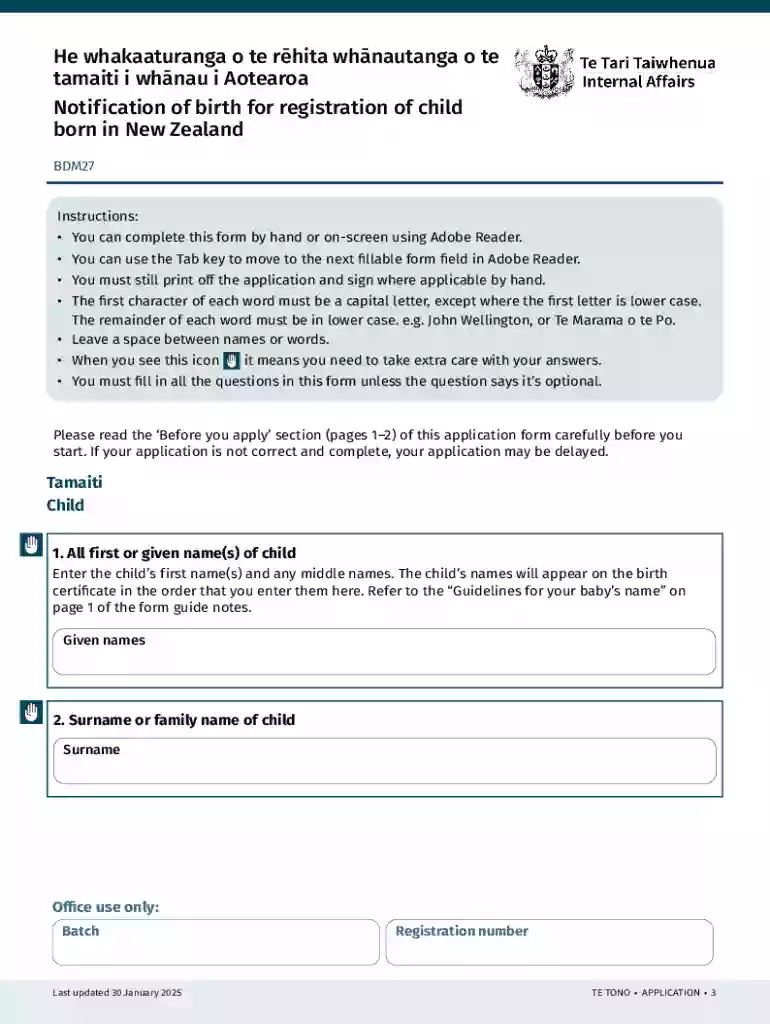
He Whakaaturanga O Te R hita Wh nautanga O Te Tamaiti I Wh nau I Aotearoa Preview on Page 1

Here's how it works

01. Edit your form online
Type text, add images, blackout confidential details, add comments, highlights and more.

02. Sign it in a few clicks
Draw your signature, type it, upload its image, or use your mobile device as a signature pad.

03. Share your form with others
Send it via email, link, or fax. You can also download it, export it or print it out.

Definition & Meaning

The "He Whakaaturanga O Te Rīhita Whānautanga O Te Tamaiti I Whānau I Aotearoa" form, known in English as the Certificate of Birth Registration for a Child Born in New Zealand, is an official document that confirms the registration of a child's birth. This form serves as a legal acknowledgment of the child's existence, providing a record that outlines pertinent details such as the child's name, date, place of birth, and parental information.

Purpose and Importance

  • Provides legal proof of identity and citizenship.
  • Required for enrolling in schools, obtaining a passport, and accessing public services.
  • Establishes a record for future reference, ensuring that the child's identity is recognized under New Zealand law.

Steps to Complete the Form

Completing the He Whakaaturanga O Te Rīhita Whānautanga O Te Tamaiti I Whānau I Aotearoa involves several essential steps that ensure the accurate capture of necessary details.

  1. Gather Required Information:

    • Child's full name, date of birth, and place of birth.
    • Parental details, including names, addresses, and occupations.
    • Information about citizenship and residency status.
  2. Fill Out the Form:

    • Provide all required details accurately and legibly.
    • Ensure that names are spelled correctly to prevent future issues.
  3. Submit Supporting Documents:

    • Parent's identification documents, such as a passport or driver's license.
    • Proof of residence or citizenship, if applicable.
  4. Review and Sign:

    • Double-check all entered information for accuracy.
    • Both parents may be required to sign the form, depending on circumstances.
  5. Submission:

    • Submit the completed form and supporting documents per the instructions provided, which may involve mailing to the relevant authorities or submitting in person.

Key Elements of the Form

The form includes several critical components, each designed to gather comprehensive information about the child and the parents.

Child's Information

  • Full name and potential variations in spelling or hyphenation.
  • Date and place of birth, requiring specific details such as the time if available.

Parental Information

  • Names, including any legal name changes that should be noted.
  • Addresses and contact information to ensure correspondence can be established.

Citizenship and Residency

  • Requires declaration of the child's citizenship, which may involve stating if the child holds dual citizenship.
  • Any additional declarations concerning residency or previous addresses.

Required Documents

When completing this form, certain documents must accompany the submission to verify the provided details.

  • Identification: Passports, driver's licenses, or other government-issued IDs for both parents.
  • Proof of Birth: Hospital records or statements from a registered medical practitioner confirming the birth details.

How to Obtain the Form

Acquiring the He Whakaaturanga O Te Rīhita Whānautanga O Te Tamaiti I Whānau I Aotearoa is straightforward and accessible through multiple channels.

Online Availability

  • Downloadable directly from official government websites, allowing for immediate access and convenience.

Physical Locations

  • Obtainable from select government service centers or registration offices, where staff can provide additional assistance.

Legal Use of the Form

This form carries significant legal implications, serving as the official record of the child's birth.

  • Identity Verification: Accepted by various institutions needing proof of identity for legal or administrative purposes.
  • Citizenship Duties: Validates the child's citizenship, crucial for immigration processes and acquiring a passport.

Penalties for Non-Compliance

Failure to complete the He Whakaaturanga O Te Rīhita Whānautanga O Te Tamaiti I Whānau I Aotearoa in due time can lead to complications.

  • Administrative Consequences: May result in delays when accessing public services or enrolling for educational opportunities.
  • Legal Implications: In some cases, lack of registration may hinder the child's ability to claim rights as a New Zealand citizen.

Examples of Use

This form is widely used across different scenarios, reflecting its importance in the life of a child born in New Zealand.

  • Educational Enrollment: Proof required by schools and universities for enrollment and attendance records.
  • Healthcare Access: Needed to register with healthcare providers and obtain public health services.
  • Passport Issuance: A prerequisite for applying for a New Zealand passport for international travel.

State-Specific Rules

Although this process predominantly follows national guidelines, certain regional variations might exist.

Regional Differences

  • Some regions may have additional forms or processes.
  • Processing times may vary based on the office handling the registration.

Important Terms

Understanding the specific legal and administrative terminology associated with the He Whakaaturanga O Te Rīhita Whānautanga O Te Tamaiti I Whānau I Aotearoa ensures accurate completion and comprehension.

  • Registration: The official documentation of birth details in national records.
  • Citizenship: The status of being a legally recognized subject of a country, with associated rights and obligations.
  • Legitimacy: The lawfulness or validity of the birth record under New Zealand jurisdiction.

These sections provide a thorough exploration of the He Whakaaturanga O Te Rīhita Whānautanga O Te Tamaiti I Whānau I Aotearoa, ensuring clarity and comprehension for those needing to engage with this important administrative process.

be ready to get more

Complete this form in 5 minutes or less

Get form

Got questions?

We have answers to the most popular questions from our customers. If you can't find an answer to your question, please contact us.
Contact us
Stimulated by the rangatira Te Pahi, northern leaders began meeting from about 1808 in formal assembly to agree on law and policy concerning the newcomers. This assembly was called Te Wakaminenga o Ngā Hapū o Nu Tīreni (the General Assembly of the Tribal Nations).
To northern Māori, the United Tribes flag meant that that Britain recognised New Zealand as an independent nation, and thereby acknowledged the mana of their chiefs. The flag continued to fly in various places around the Bay of Islands, and on ships trading with Sydney.
It became known as Te Whakaminenga o nga Hapu o Nu Tirenithe gathering of the hapu of New Zealand. Some Ngapuhi give it a slightly grander translation: the General Assembly of the Tribal Nations of New Zealand. This was the body that declared its sovereignty to the world in 1835.
There are two versions of the Declaration: the English text created by Busby, and the te reo Māori document that was signed. He Whakaputanga (which can be translated as an emergence or declaration) consisted of four articles.
The declaration arose in response to concerns over the lawlessness of British subjects in New Zealand and in response to a fear that France would declare sovereignty over the islands.

Security and compliance

At DocHub, your data security is our priority. We follow HIPAA, SOC2, GDPR, and other standards, so you can work on your documents with confidence.

Learn more
ccpa2
pci-dss
gdpr-compliance
hipaa
soc-compliance

People also ask

Also known as the Declaration of Independence of New Zealand, this Māori-language document is often called by its shortened name, He Whakaputanga.
According to Nuki Aldridge, Te Whakaminenga could make decisions or create laws with hapū consent, but not override hapū authority. He Whakaputanga became a foundation for the assertion of indigenous rights and was another step towards a formal constitutional relationship with Britain.

Related links