01. Edit your form online
Type text, add images, blackout confidential details, add comments, highlights and more.

Type text, add images, blackout confidential details, add comments, highlights and more.

Draw your signature, type it, upload its image, or use your mobile device as a signature pad.

Send it via email, link, or fax. You can also download it, export it or print it out.
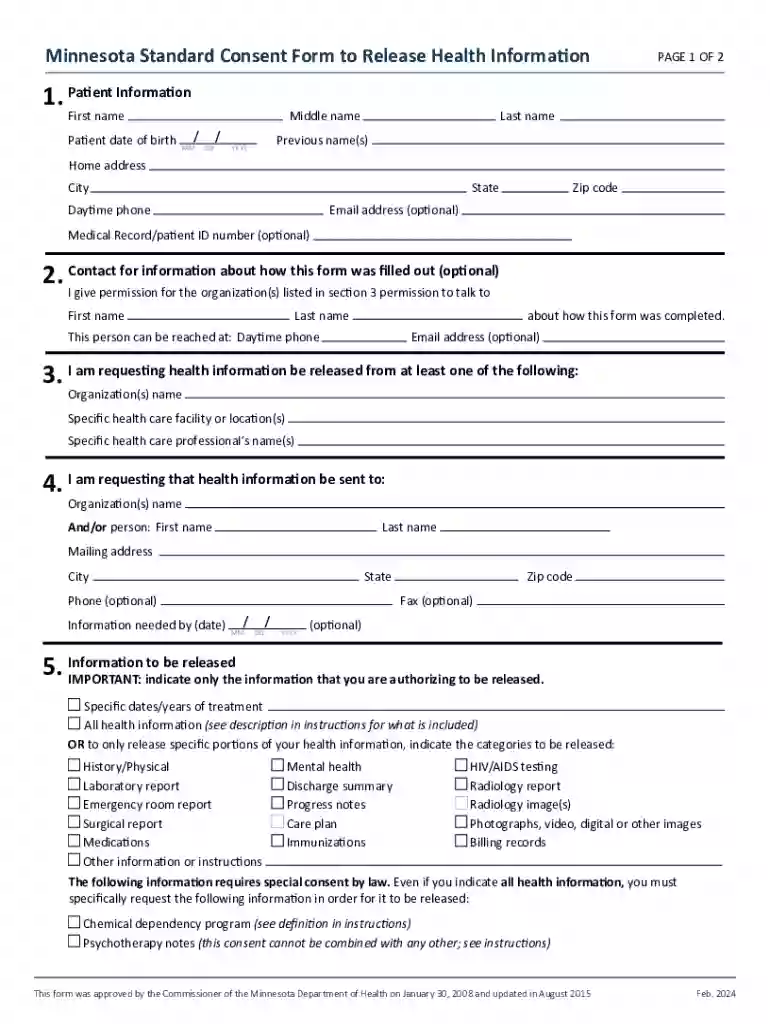
The Minnesota Standard Consent Form to Release Health Information is a document that grants authorization to healthcare providers and entities to disclose a patient's medical records. Developed by the Minnesota Department of Health, this form ensures that medical information is shared in compliance with the Minnesota Health Records Act. The agreement provided by the patient or their legal representative safeguards their privacy while allowing necessary sharing of pertinent health details to facilitate medical care or fulfill legal obligations.
To effectively use the Minnesota Standard Consent Form, begin by identifying the specific health information that needs to be disclosed. Clearly outline who is authorized to release the data and the specific individuals or entities allowed to receive it. Ensure all mandatory fields, such as patient identification, are accurately completed to prevent any legal or administrative delays. Once filled, the form should be signed and dated by the patient or their authorized representative to make the authorization valid, and a copy should be retained for personal records.
The Minnesota Standard Consent Form is legally binding under the Minnesota Health Records Act, ensuring that patient data is shared only with consent. It is used in medical settings to facilitate continuity of care, legal cases requiring medical evidence, or any situation demanding verified disclosure of health records. It aligns with federal privacy regulations such as HIPAA, ensuring compliance in the handling and dissemination of sensitive medical data.
Minnesota law mandates specific procedures for the release of health information. The form must be completed accurately to comply with these rules. Special considerations are required for releasing mental health, HIV status, and chemical dependency records due to their sensitive nature. Any errors or omissions in these sections can lead to processing delays or even rejection of the consent form.
A patient moving to another state may use the form to authorize their previous physician to send medical records to their new healthcare provider. Similarly, during legal proceedings, an attorney might obtain a patient's signed consent to access medical records relevant to the case, ensuring all activities are legally compliant with the state law.
The Minnesota Standard Consent Form can be submitted through various channels depending on the recipient's requirements. Options typically include:
Proper submission ensures that the authorization process is begun promptly, facilitating any necessary action contingent upon the information release.
We've got more versions of the Minnesota Standard Consent Form to Release Health Information form. Select the right Minnesota Standard Consent Form to Release Health Information version from the list and start editing it straight away!
At DocHub, your data security is our priority. We follow HIPAA, SOC2, GDPR, and other standards, so you can work on your documents with confidence.