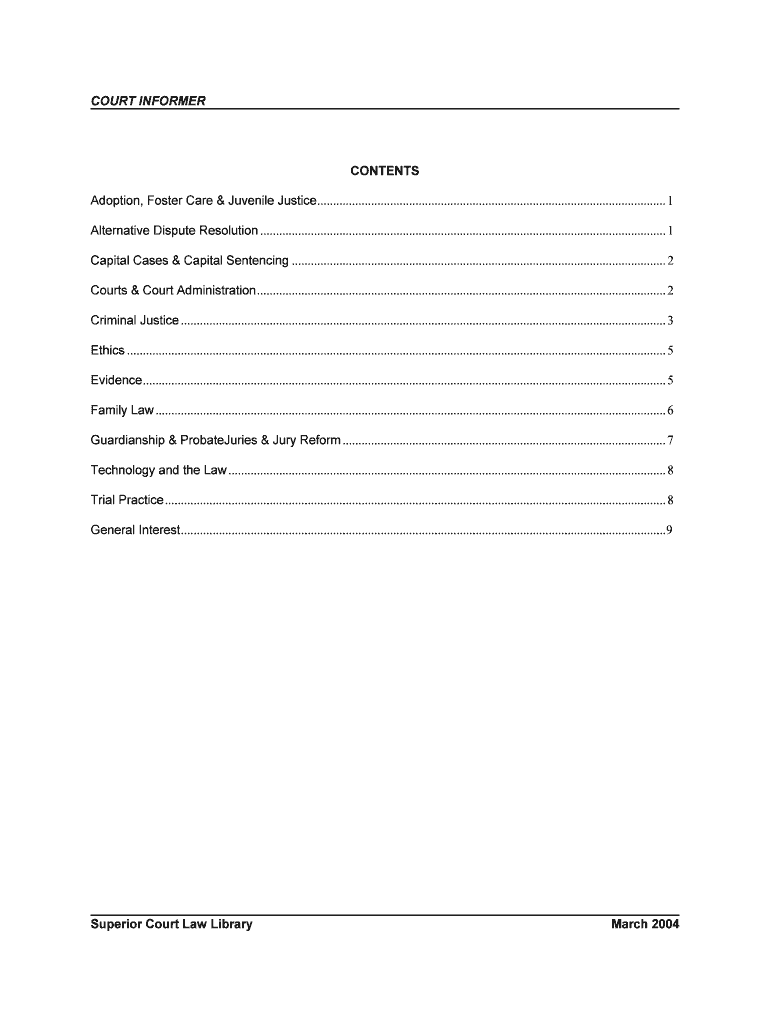







Definition and Meaning of Court Informer - March 2004 - Superior Court
The "Court Informer - March 2004 - Superior Court" is a resource designed to convey critical updates, legal trends, and discussions pertinent to the legal community. This document serves as a curated compilation of articles covering diverse areas within the legal system. Topics include adoption, juvenile justice, alternative dispute resolution, capital cases, and much more. Lawyers, judges, and legal scholars rely on this comprehensive resource to stay abreast of recent changes and discourse within the judicial landscape.
How to Use the Court Informer - March 2004 - Superior Court
To effectively utilize this document, legal professionals should first identify sections relevant to their specific field of interest or practice area. The document is structured to allow for easy navigation across various legal topics. By scanning the table of contents, users can jump directly to sections covering adoption, criminal justice, or technology in law, among others. It is recommended to focus on case studies and summaries of emerging legal precedents to gain insights into practical applications of recent developments.
Obtaining the Court Informer - March 2004 - Superior Court
Legal professionals interested in accessing the "Court Informer - March 2004 - Superior Court" can typically find this document archived in law libraries, court archives, or through online legal databases. It may also be distributed through professional legal associations or networks that have subscriptions to legal publications. Ensuring access to such resources is crucial for a continuous and updated understanding of the legal landscape.
Key Elements of the Court Informer - March 2004 - Superior Court
This document is rich in information due to its extensive coverage of multiple legal areas. Key elements include:
- Summaries of Legal Precedents: These offer insights into recent court rulings and their broader implications.
- Analysis of Legislative Changes: Provides comprehensive reviews of new laws and their anticipated impacts on existing legal frameworks.
- Expert Opinions: Features commentary from seasoned legal professionals, providing interpretations and expectations.
Important Terms Related to Court Informer - March 2004 - Superior Court
Understanding the terminology within "Court Informer - March 2004 - Superior Court" is essential. Key terms frequently found include:
- Adjudication: The legal process of resolving a dispute.
- Precedent: A judicial decision that serves as a rule for future cases of a similar nature.
- Jurisprudence: The theory or philosophy of law.
A glossary section within the document can provide further clarity on complex terms for those unfamiliar with specific legal jargon.
Legal Use of the Court Informer - March 2004 - Superior Court
This resource plays a significant role in supporting legal practices by providing necessary information that aids in case preparation and strategy formulation. Legal professionals use it to understand recent judicial thinking, aiding them in presenting well-informed arguments or in advising clients on potential legal risks and benefits.
Examples of Using the Court Informer - March 2004 - Superior Court
Legal practitioners have found substantial value in practical examples detailed in the document:
- Jury Reform Cases: Insightful for those involved in trials seeking adaptable jury management strategies.
- Technology in Law: An essential reference for cases involving digital evidence or legal technology disputes.
By exploring these examples, practitioners can gain diverse perspectives applicable to current legal challenges they face.
State-Specific Rules for the Court Informer - March 2004 - Superior Court
While the document provides a comprehensive national overview, it also delves into state-specific statutes and practices. This is particularly useful for lawyers who practice across state lines or who need to advise clients with interests in multiple jurisdictions. It addresses variations in state laws concerning jury reform, family law, and court administration.
State-by-State Differences
Understanding state-specific legal nuances is vital for practitioners dealing with interstate legal matters. The "Court Informer - March 2004 - Superior Court" highlights differences in how various states handle legal issues like guardianship or juvenile justice, offering tailored guidance that respects individual state laws.
Software Compatibility and Integration
Law firms looking to manage their workflow efficiently can integrate the use of the Court Informer within Document Management Systems like those provided by DocHub. While the document is traditionally paper-based, digitization allows for compatibility with software solutions that support legal document management, enhancing accessibility and collaborative analysis.