






Definition and Overview
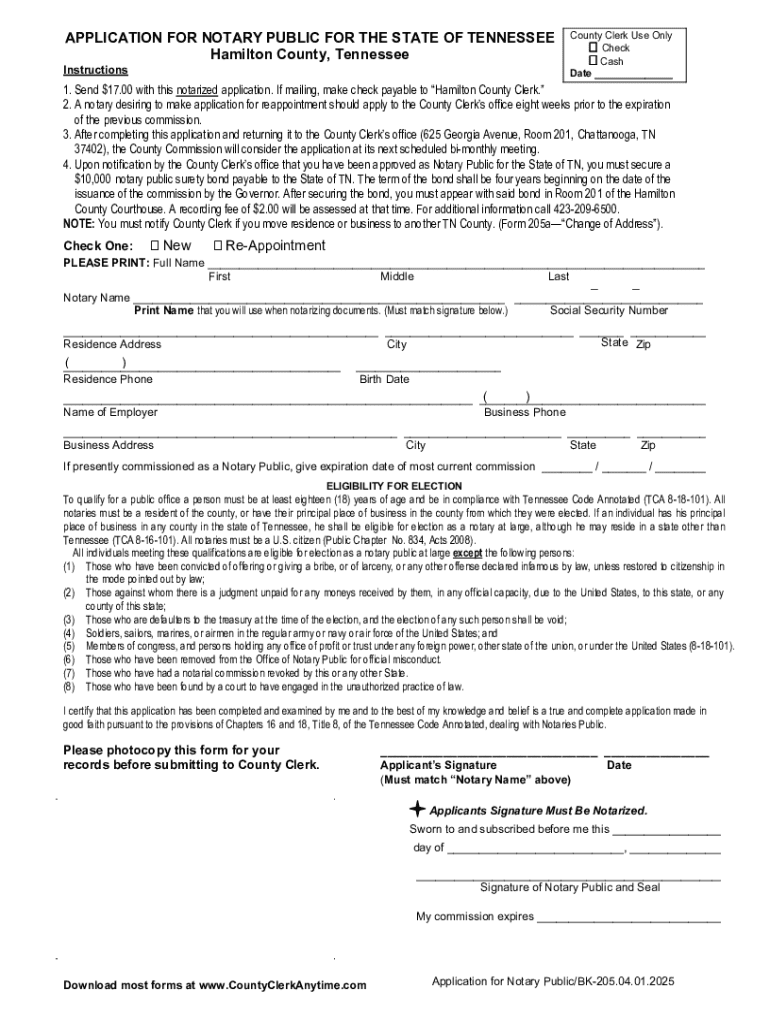
The "Application for Notary Public for the State of Tennessee" is an official form used by individuals seeking to become a Notary Public within the state. A Notary Public is a public officer constituted by law to serve the public in non-contentious matters generally concerned with estates, deeds, powers-of-attorney, and foreign and international business. This form provides relevant stakeholders with the required documentation to assess eligibility and facilitate the appointment process.
Eligibility Criteria
Before applying, candidates must ensure they meet specific eligibility requirements. Applicants should be at least eighteen years old, residents or have a principal business in the county they are applying in, and must not have any disqualifying criminal convictions. The form requires detailed personal information to verify these criteria, ensuring that only qualified individuals can perform the duties of a Notary Public.


Steps to Complete the Application
To properly complete the application, follow these steps:
- Personal Information: Provide your full name, address, and contact information. Ensure all details are accurate.
- Background Information: Disclose any criminal history, as this can affect eligibility.
- Endorsements: Obtain endorsements from a specified number of local citizens.
- Notarization: The form itself must be notarized. Visit a Notary Public to execute this step.
- Attach Supporting Documents: Include any required documents, such as proof of residency or business location.
Required Documents
Along with the application form, applicants need to submit the following documents:
- A notarized affidavit of identity.
- Proof of residency, such as a utility bill or lease agreement.
- Documentation of any legal name changes.
- A surety bond, which will be required upon approval.
Application Process and Approval Time
Submitting the application involves presenting it to the county clerk's office in the applicant's county of residence. Following submission, the review process can take several weeks, during which the applicant may be required to provide additional information or documents. If approved, the applicant will be issued a commission certificate.
Who Typically Uses the Form
This form is primarily used by individuals seeking to serve as Notary Publics for personal or professional reasons. Examples include legal professionals, business owners, and employees in fields where document authentication is frequently needed, such as real estate or financial services.

Legal Use of the Form
The application is legally binding, serving as a formal request to become a Notary Public. It must be completed truthfully and accurately, as providing false information can lead to disqualification and potential legal penalties.
Penalties for Non-Compliance
Failure to comply with the application requirements or submitting false information may result in severe penalties. These include rejection of the application, fines, or even legal action. Additionally, once commissioned, not adhering to the state laws governing notarial acts can result in revocation of the notary commission.
State-Specific Rules
In Tennessee, specific rules govern the application and function of Notary Publics. These include residency requirements and the need for a surety bond upon approval, emphasizing the importance of understanding state-specific legislation before applying.
Form Submission Methods
Applicants can usually submit the form in person or via mail, depending on county regulations. It’s crucial to adhere to the stipulated submission method as per the county clerk's office instructions to avoid delays or complications in processing the application.
Digital vs. Paper Version
While many prefer completing the form digitally for convenience, a paper submission is typically required due to the need for original signatures and notarization. Check with the county clerk to confirm the preferred format and any additional digital resources that can assist with the application.
Key Elements of the Application
Key elements include:
- Personal Identification: Essential for verifying applicant identity.
- Eligibility Confirmation: Ensures compliance with state-specific regulations.
- Endorsements: Validates the applicant's standing within their community.
- Notarization: Confirms the form's authenticity and applicant's intent.
Selecting the right blocks ensures a comprehensive guide tailored to the specific needs of applicants using the form.