01. Edit your form online
Type text, add images, blackout confidential details, add comments, highlights and more.

Type text, add images, blackout confidential details, add comments, highlights and more.

Draw your signature, type it, upload its image, or use your mobile device as a signature pad.

Send it via email, link, or fax. You can also download it, export it or print it out.
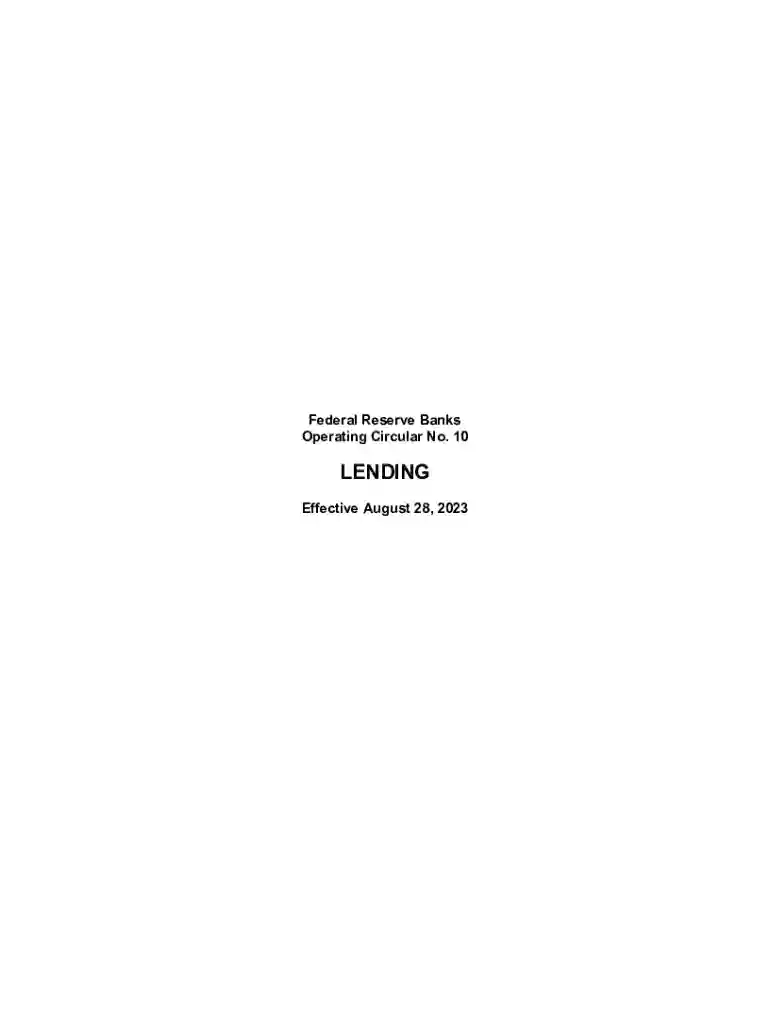
Operating Circular No 10 outlines the terms and conditions under which the Federal Reserve Banks provide lending services. Effective as of August 28, 2023, this circular guides how Reserve Banks manage their lending operations, detailing the scope of lending and defining terms necessary for interpreting its provisions. It helps ensure a standardized approach across all Reserve Banks, providing transparency for financial institutions seeking to engage with or understand federal lending processes.
Understanding how to effectively use Operating Circular No 10 is crucial for institutions interacting with Reserve Banks. Its structured format allows users to navigate easily, ensuring that all necessary procedures are followed.
Operating Circular No 10 provides a comprehensive outline of the processes involved in borrowing from the Federal Reserve. Financial institutions must adhere to these steps to comply with federal requirements.
Understanding the critical components of Operating Circular No 10 can help institutions streamline their interactions with Reserve Banks and optimize their lending strategies.
Operating Circular No 10 employs specific terminology to clarify the scope and procedures of the Reserve Banks' lending operations. Understanding these terms is crucial for compliance.
The Circular specifies a list of documents that must be submitted as part of the borrowing process. Ensuring completeness aids in quick processing and mitigates risks of non-compliance.
Adherence to the legal frameworks outlined in Operating Circular No 10 ensures compliance with federal regulations, protecting both the Reserve Banks and borrower institutions.
To enforce the terms of the Circular, specific penalties are imposed on institutions that fail to comply with its conditions.
Utilizing digital tools to manage compliance with Operating Circular No 10 enhances efficiency and accuracy. Compatibility with software solutions facilitates integration into existing workflows.
By understanding these detailed elements of Operating Circular No 10, institutions can navigate the regulatory landscape with greater confidence and precision.
We've got more versions of the Operating Circular No 10 LENDING Operating Circular No 10 LENDING form. Select the right Operating Circular No 10 LENDING Operating Circular No 10 LENDING version from the list and start editing it straight away!
At DocHub, your data security is our priority. We follow HIPAA, SOC2, GDPR, and other standards, so you can work on your documents with confidence.