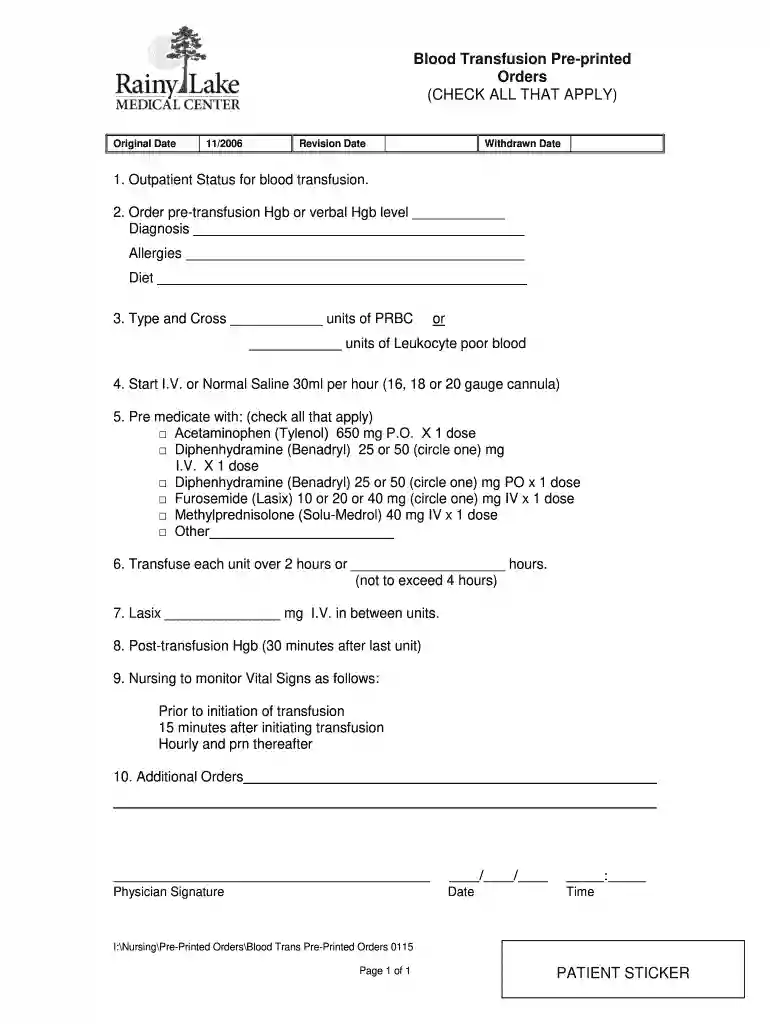
Medical blood transfusion pre printed form 2026

Get Form
blood transfusion order example Preview on Page 1

Here's how it works

01. Edit your blood transfusion order example online
Type text, add images, blackout confidential details, add comments, highlights and more.

02. Sign it in a few clicks
Draw your signature, type it, upload its image, or use your mobile device as a signature pad.

03. Share your form with others
Send blood transfusion order via email, link, or fax. You can also download it, export it or print it out.

Definition and Purpose of Medical Blood Transfusion Pre Printed Forms

A medical blood transfusion pre printed form serves as an essential document in healthcare settings, detailing the procedures and protocols associated with blood transfusion. This form is used primarily by healthcare providers to communicate vital information regarding a patient's transfusion needs and to ensure compliance with established medical guidelines.

Key components typically included in the form are:

  • Patient Information: This section captures essential details about the patient, including their name, identification number, and medical history relevant to transfusion procedures.
  • Transfusion Type: Specifies the type of blood product needed (e.g., whole blood, red blood cells, platelets, plasma).
  • Indications for Transfusion: This part outlines the medical reasons necessitating the transfusion, such as anemia, blood loss from surgery, or thrombocytopenia.

The form facilitates not just effective communication among healthcare professionals but also serves as a legal document that ensures patient safety and adherence to blood transfusion protocols.

Steps for Completing a Blood Transfusion Order Form

Completing a blood transfusion order form requires precise adherence to established protocols to guarantee patient safety and effective treatment. The following steps outline the correct process:

  1. Gather Patient Information: Collect data needed about the patient, ensuring accuracy, especially for patient identifiers like medical record number and blood type.
  2. Select the Transfusion Product: Determine and indicate the specific blood component required based on the patient's current medical condition and previous transfusions.
  3. Provide Indications: Clearly articulate the medical reasons for the transfusion. This may include laboratory test results that necessitate blood products, such as hemoglobin levels or INR values.
  4. Complete Consent: Ensure that the patient or their legally authorized representative has provided informed consent, understanding the potential risks and benefits associated with blood transfusion.
  5. Obtain Physician Signature: The form must be signed by a licensed physician to validate the order, confirming that all information is accurate and compliant with hospital policies.

Each of these steps is critically important and serves to minimize errors during the transfusion process.

Important Components of Blood Transfusion Orders

Blood transfusion orders must include several critical components to ensure safety and compliance with regulations. These elements include:

  • Patient Identification: Accurate patient IDs, including full name, date of birth, and medical record number, are essential for preventing transfusion errors.
  • Transfusion Product Specification: The type of blood component requested must be specified, such as packed red blood cells or fresh frozen plasma.
  • Order Details: This includes the volume to be transfused, any premedications required, and specific administration instructions (e.g., rate of transfusion).
  • Monitoring Protocols: Documentation should indicate how the patient will be monitored, including vital sign checkpoints and guidelines for adverse reaction management.
  • Emergency Contact Information: Essential for any unexpected occurrences during the transfusion, including details of the healthcare provider responsible for the transfusion process.

Including these elements in the order form mitigates risks associated with blood transfusions and promotes a high standard of care.

Legal Considerations for Blood Transfusion Forms

Blood transfusion pre printed forms are also subject to legal oversight and must adhere to stringent regulations to ensure patient safety and compliance with healthcare laws. Key legal considerations include:

  • Informed Consent: Healthcare providers must ensure that informed consent is obtained from the patient, which involves explaining the benefits, risks, and alternative treatments available.
  • Documentation Requirements: Accurate and complete documentation must be maintained according to hospital policies and state regulations. This includes ensuring that all relevant information is included in the order form and that it is signed by the ordering physician.
  • Privacy Regulations: Compliance with the Health Insurance Portability and Accountability Act (HIPAA) is critical to protect patient information throughout the transfusion process.
  • Liability and Risk: Failure to properly document and execute a blood transfusion can expose healthcare providers to liability risks, including lawsuits for negligence or malpractice.

These legal aspects are fundamental to establishing a safe and effective blood transfusion protocol and protecting both patients and healthcare facilities.

Examples of Blood Transfusion Order Forms

Understanding the format and content of blood transfusion order forms can enhance their effective use in clinical situations. Here are a few examples of commonly encountered variations:

  • Basic Blood Transfusion Orders: Typical forms used for standard transfusions, detailing blood type, patient data, and indications for transfusion.
  • Pediatric Blood Transfusion Orders: Customized forms designed for children that accommodate different dosing and monitoring protocols specific to younger patients.
  • Emergency Blood Transfusion Orders: Fast-track forms used in urgent scenarios, which streamline the process for immediate access to blood products, often without standard consent protocols.

These examples highlight the flexibility in design that can cater to different clinical scenarios while maintaining essential safety and documentation requirements.

Best Practices for Using Blood Transfusion Order Forms

Employing best practices enhances the reliability and effectiveness of blood transfusion order forms in clinical settings. Here are several best practices to consider:

  • Training for Healthcare Providers: Regular training sessions to familiarize all staff with the order form processes, including updates to protocols and legal requirements.
  • Utilizing Checklists: Implementing checklists alongside the order forms can serve as a reminder for required steps and documentation, minimizing errors or omissions.
  • Routine Audits: Conducting audits of completed forms to ensure compliance with legal and clinical standards can identify areas for improvement and reinforce training efforts.
  • Technology Integration: Utilizing electronic health records (EHR) to manage blood transfusion orders not only enhances organization but also allows for better tracking and compliance.

Adhering to these best practices can significantly improve the efficacy of blood transfusion protocols and enhance patient safety during treatment.

Conclusion

Medical blood transfusion pre printed forms are a critical part of patient care in healthcare settings. By ensuring thorough and accurate completion of these forms and adhering to legal requirements, healthcare providers can significantly enhance patient safety, streamline workflows, and meet regulatory standards essential for effective medical treatment. The proper use and management of these forms are central to successful blood transfusion practices.

See more medical blood transfusion pre printed form versions

We've got more versions of the medical blood transfusion pre printed form form. Select the right medical blood transfusion pre printed form version from the list and start editing it straight away!
Versions Form popularity Fillable & printable
2006 4.8 Satisfied (123 Votes)
be ready to get more

Complete this form in 5 minutes or less

Get form

Got questions?

We have answers to the most popular questions from our customers. If you can't find an answer to your question, please contact us.
Contact us
Specimen Requirements and Procedure The patients full name, including first and last (family and given) and gender. A unique identifier like date of birth (DOB) or a hospital or health card number. The recipients address. The required blood component/product with appropriate dose/volume. The indication for
This rule states that ASA I patients should have RBC transfusion when their Hb is below 4 mmol/L (6.4 g/dL), ASA II when their Hb is below 5 mmol/L (8.1 g/dL) and ASA III and IV patients when their Hb is below 6 mmol/L (9.7 g/dL).
Pre-transfusion tests include ABO and RhD typing of the patients red blood cells and an antibody screen with the patients plasma. The latter is a method to detect clinically docHub non-ABO antibodies to red cell antigens.
Your blood will be tested before a transfusion to learn whether your blood type is A, B, AB or O. The test also shows whether your blood is Rh positive or Rh negative. The donated blood used for your transfusion is a blood type that can be safely paired with your blood type.
Pretransfusion testing includes all activities from when the blood product is ordered by the physician to the final step when the blood product can be dispensed from the laboratory to the patients bedside. This includes serological testing such as blood typing, antibody screening, and crossmatching in the laboratory.

Security and compliance

At DocHub, your data security is our priority. We follow HIPAA, SOC2, GDPR, and other standards, so you can work on your documents with confidence.

Learn more
be ready to get more

Complete this form in 5 minutes or less

Get form

People also ask

Pre-transfusion patient assessment and a measurement of baseline vital signs must be documented within 30 minutes prior to transfusion. Identify any potential risks of a transfusion reaction or any pre-existing symptoms that could later to be mistaken for a transfusion reaction (e.g., pre-existing rash).

transfusion order sample