






Definition and Meaning of the Treaty Annuity Payment Request
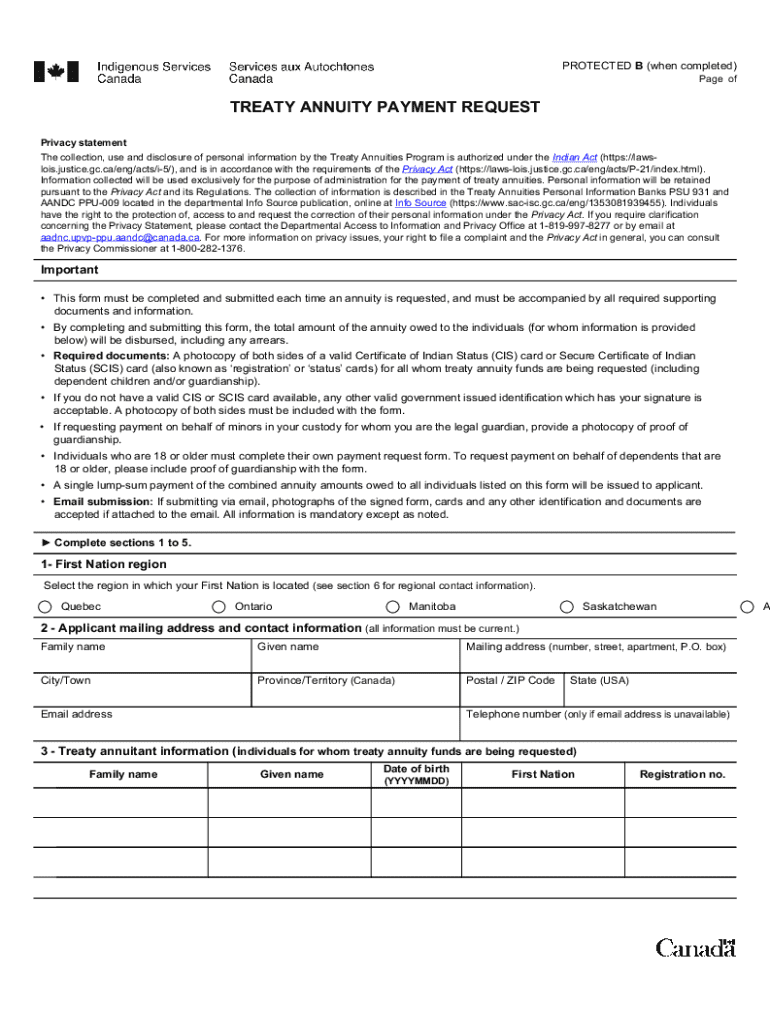
The Treaty Annuity Payment Request is a formal document used by individuals to request treaty annuity payments, which are disbursed as part of treaties made with various indigenous groups and the federal government. Typically, these payments are a result of historic treaties and agreements that acknowledge annuities owed to members of specific indigenous communities. The form ensures that recipients are authorized and their information is up-to-date to facilitate seamless processing.
Key Elements of the Treaty Annuity Payment Request
- Personal Information: Includes the recipient's full name, address, and contact details for identifying the requester.
- Documentation: Proof of identity and any additional documents proving eligibility under relevant treaties may be necessary.
- Privacy Statement: Offers insights into the handling of personal data under the Indian Act and Privacy Act.
- Authorization: Signature or verification to authenticate the request.
The form is essential for managing the accurate disbursement of funds, ensuring legality, and protecting the privacy of individuals involved.
How to Obtain the Treaty Annuity Payment Request
Obtaining this form is straightforward. The form is generally distributed by governmental agencies responsible for treaty negotiations and compliance. Interested individuals can access the form:
- Online: Some governmental websites provide downloadable versions.
- In-Person: Visit designated government offices tasked with Indigenous affairs.
- Mail Request: Contact the concerned office to mail a copy.
Ensure access to necessary identification documents and proof of eligibility before requesting the form.
Steps to Complete the Treaty Annuity Payment Request
Completing the form correctly is vital for a successful annuity payment request. Follow these steps:
- Fill in Personal Details: Input accurate personal information, ensuring it matches the records held by treaty offices.
- Attach Necessary Documentation: Provide proof of identity and any treaty-related documentation.
- Signature: Sign the document where required, indicating understanding and authorization.
- Review: Double-check all entered information for accuracy.
- Submit: Follow official submission guidelines, whether online, by mail, or in person.
Mistakes or missing information can lead to delays, so thoroughness is critical.
Required Documents for the Treaty Annuity Payment Request
Having the right documents is imperative:
- Identification: Government-issued ID such as a driver's license or passport.
- Proof of Treaty Eligibility: Documentation connecting the requester to the treaty involved.
- Supplementary Documents: Any additional paperwork specified by the issuing authority.
These documents ensure authenticity and compliance with treaty stipulations.
Legal Use of the Treaty Annuity Payment Request
The Treaty Annuity Payment Request adheres to the frameworks established by certain laws:
- Indian Act & Privacy Act: These provide the legal context for privacy and processing of personal data.
- Contractual Obligations: Reflects historical agreements between indigenous groups and the government.
Unauthorized use or fraudulent representation can lead to severe penalties.
Examples of Using the Treaty Annuity Payment Request
Real-world scenarios illuminate the utility of this form:
- Indigenous Community Member: A member submits the form to receive periodic annuities as part of a historical treaty.
- Elder's Caregiver: Managing annuities on behalf of an elder who cannot physically complete the form themselves.
These examples highlight the diverse applications and importance of the form.
Who Typically Uses the Treaty Annuity Payment Request
Primarily used by:
- Indigenous Individuals: Members of communities with treaty rights.
- Legal Representatives: Individuals managing affairs for those entitled to annuities.
Community discussions and workshops often assist eligible members in understanding the form's importance and process.


Form Submission Methods
Various methods accommodate the form's submission:
- Online: E-submission through official government portals.
- Mail: Traditional mailing methods.
- In-Person: Submission at designated offices.
Each method offers distinct benefits, such as immediate submission online or in-person consultations for clarity.
Penalties for Non-Compliance
Non-compliance with requirements could result in:
- Denial of Payments: Incorrect or fraudulent submission can halt annuity disbursements.
- Legal Repercussions: Deliberate misinformation may lead to fines or legal action.
Understanding and adhering to the form's stipulations ensures uninterrupted benefit flow.
Digital vs. Paper Version of the Treaty Annuity Payment Request
Both versions have distinct benefits:
- Digital: Immediate submission and quicker processing; environmentally friendly.
- Paper: Traditional, familiar format; useful for those with limited digital access.
The choice depends on personal preference, access to technology, and specific needs of the requester.
Eligibility Criteria for the Treaty Annuity Payment Request
Specific eligibility requirements are often associated with treaty agreements. These may include:
- Provenance: Direct relationship to a community under a valid treaty.
- Documentation: Historical record or proof validating claims.
- Age and Residency: Certain age and residency constraints, where applicable.
Meeting these requirements ensures legitimate and uninterrupted access to treaty annuities.