01. Edit your form online
Type text, add images, blackout confidential details, add comments, highlights and more.

Type text, add images, blackout confidential details, add comments, highlights and more.

Draw your signature, type it, upload its image, or use your mobile device as a signature pad.

Send it via email, link, or fax. You can also download it, export it or print it out.
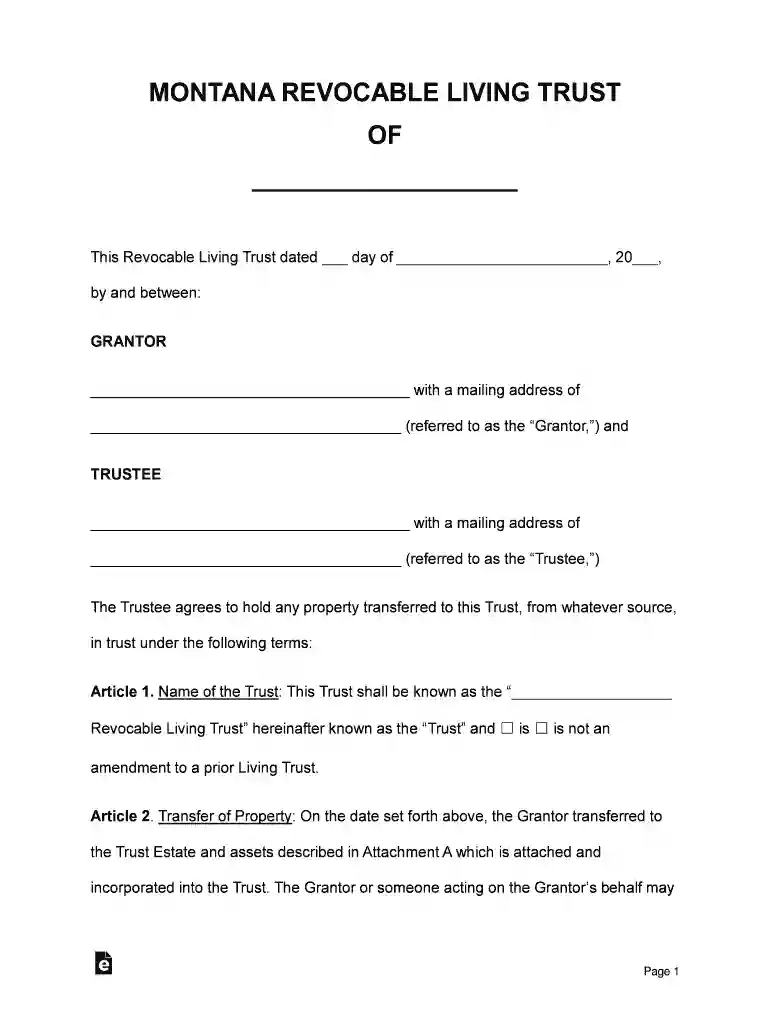
The Montana Revocable Living Trust Form is a legal document that establishes a fiduciary arrangement whereby a grantor transfers their assets to a trustee. The trustee then manages and holds these assets on behalf of beneficiaries until such time as the grantor specifies. During the grantor's lifetime, this trust can be modified or revoked, providing flexibility and control over the management and distribution of the property. Upon the grantor's death, the trust becomes irrevocable and the assets are distributed according to the grantor’s wishes, avoiding probate.
Utilizing the Montana Revocable Living Trust Form involves several key steps. Initially, the grantor must identify and list all assets being transferred to the trust. Next, they select a trustworthy individual or entity to serve as the trustee. The grantor then outlines the terms of asset management and distribution within the form. Importantly, the trust form must be signed and often notarized to be valid. This form is then used to manage the transferred assets, ensuring adherence to the outlined instructions and wishes.
Creating a Montana Revocable Living Trust offers numerous benefits. It allows for the private and efficient management of assets without the need for probate, providing a streamlined process for heirs. This form offers flexibility, as the grantor can modify or revoke the trust during their lifetime. Additionally, it provides a structured plan for asset distribution, reducing the possibility of disputes among beneficiaries. It helps in maintaining financial privacy, as its details are not made public, unlike a will.
Montana law offers specific guidelines that govern revocable living trusts. Key aspects include adhering to state statutes on trustee powers and responsibilities and ensuring conformity with Montana regulations concerning property titles and deed transfers. Montana also requires any trust dealing with real estate to adhere to state recording rules when transferring property titles to the trust. Understanding these nuances is critical to ensure the trust is legally binding and smoothly operational.
This form serves a legal purpose in estate planning by specifying how assets under control are managed and distributed. It offers a method for avoiding probate court processes, providing continuity for asset control in cases of incapacitation, and ensuring personal wishes are respected posthumously. It's essential for establishing fiduciary relationships, defining legal powers of trustees, and guiding the division of assets according to specific legal requirements.
We've got more versions of the Montana Revocable Living Trust Form - eforms form. Select the right Montana Revocable Living Trust Form - eforms version from the list and start editing it straight away!
| Versions | Form popularity | Fillable & printable |
|---|---|---|
| 2017 | 4.8 Satisfied (74 Votes) |
At DocHub, your data security is our priority. We follow HIPAA, SOC2, GDPR, and other standards, so you can work on your documents with confidence.