01. Edit your form online
Type text, add images, blackout confidential details, add comments, highlights and more.

Type text, add images, blackout confidential details, add comments, highlights and more.

Draw your signature, type it, upload its image, or use your mobile device as a signature pad.

Send it via email, link, or fax. You can also download it, export it or print it out.
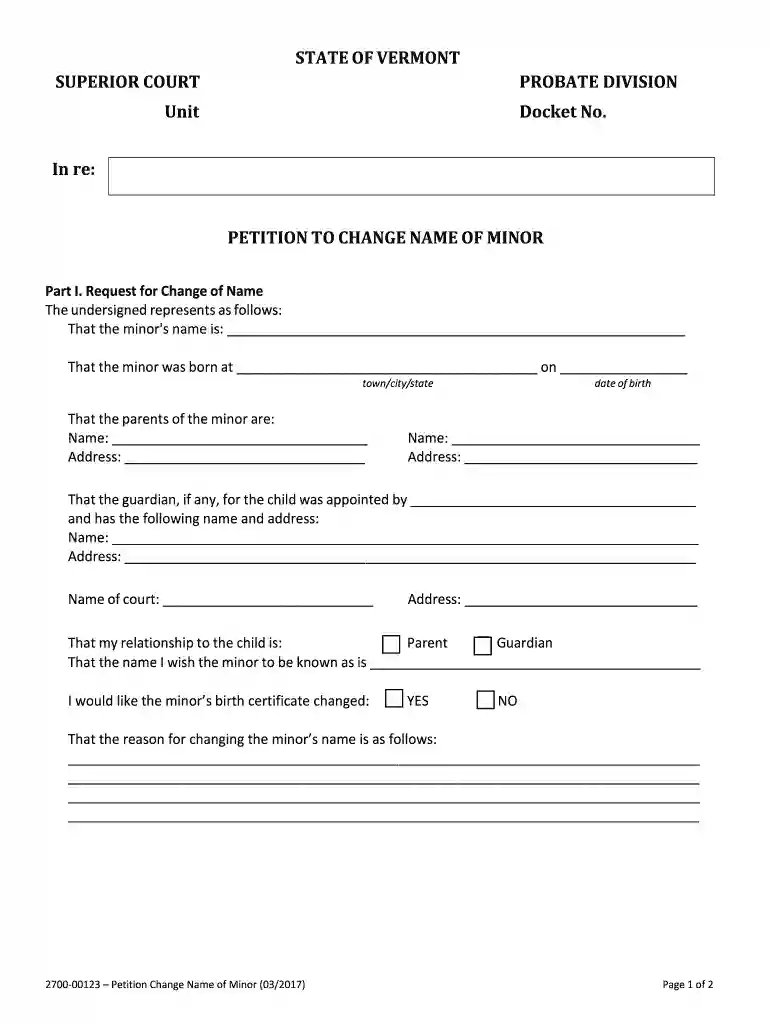
The Form3 Petition to Change Name of Minor - Vermont is a legal document used to formally request a change in the name of a minor child through the Vermont Superior Court, Probate Division. This form is essential for legal guardians or parents who wish to alter the minor's name for various reasons, such as adoption, family preference, or correcting a birth certificate error. It ensures that the name change is recognized legally and accurately reflects the minor’s identity across legal documents.
Completing the Form3 involves a detailed and careful approach to ensure accuracy and compliance with Vermont law. Below is a step-by-step guide on how to correctly fill out the form.
Compile Required Information: Gather all necessary details about the minor, including their legal documentation, birth certificate, and any previous legal name change documents.
Fill Personal Details: Enter the minor's current name, proposed name, birth details, and address.
Provide Parental Information: Complete the sections with parental or legal guardian information, including their relationship to the minor.
State the Reason: Clearly outline the reasons for requesting the name change, ensuring that it aligns with the guidelines for permissible requests.
Consent & Signatures: If the minor is over 14 years, their written consent is needed. The petition must be signed by the petitioner(s).
Submit the Form: File the completed form with the Vermont Superior Court, Probate Division, either online, via mail, or in person.
The eligibility for the Form3 is specific to the state of Vermont and generally applies to minors under the legal guardianship of the petitioners. Parents or legal guardians can file this petition on behalf of the minor, provided they can demonstrate a valid reason for the name change.


The typical users of Form3 include parents, legal guardians, and sometimes the minors themselves (if over 14) in Vermont. This form is also relevant for attorneys representing families in legal name changes as part of adoption procedures, identity reconstruction, or other family legal matters.

The primary legal use of Form3 is to officially alter the name of a minor for lawful recognition in all state records, such as school documents, medical records, and legal certificates. The form ensures that the change is sanctioned by the Vermont Superior Court, ensuring compliance with state laws.
Vermont has specific rules governing the name change process, reflecting the state's legal framework and ensuring the process's integrity. These rules determine eligibility, procedural requirements, and any legal constraints.
To successfully file the Form3, certain supportive documents are required to accompany the petition. These documents authenticate the petitioner’s claims and prove the eligibility of the request.
Submitting the Form3 can be accomplished through multiple methods, offering flexibility based on personal preference or situational convenience.
We've got more versions of the Form 700-00123 Petition to Change Name of Minor - Vermont form. Select the right Form 700-00123 Petition to Change Name of Minor - Vermont version from the list and start editing it straight away!
| Versions | Form popularity | Fillable & printable |
|---|---|---|
| 2017 | 4.8 Satisfied (67 Votes) |
At DocHub, your data security is our priority. We follow HIPAA, SOC2, GDPR, and other standards, so you can work on your documents with confidence.