Definition and Meaning of the Georgia Final Order Changing Name(s) of Minor Child(ren)
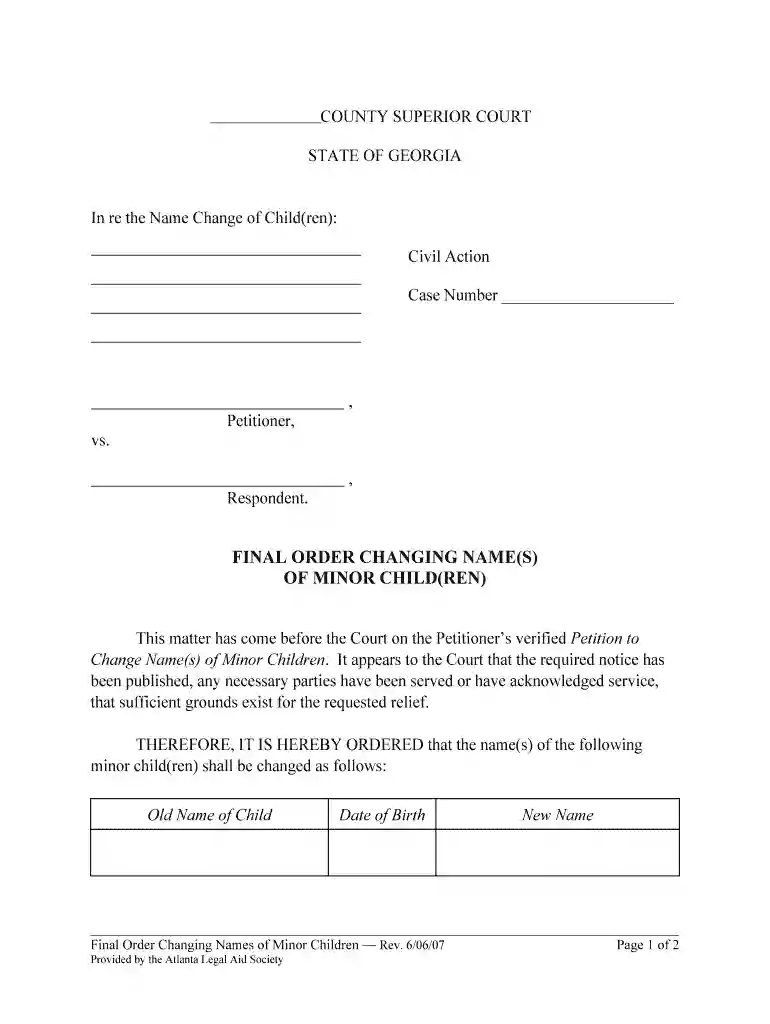
The Georgia Final Order Changing Name(s) of Minor Child(ren) is a legal document issued by the County Superior Court of Georgia to formally approve and document a name change request for minor children. This order is the culmination of the petition process initiated by a parent or legal guardian seeking to change a child’s legal name. The document signifies that all procedural steps, including the necessary notifications and hearings, have been satisfactorily completed, and it grants the name change as requested.
How to Use the Georgia Final Order
Once obtained, the Georgia Final Order serves as the child’s new identity documentation. It is essential for updating all relevant records, including birth certificates, social security records, and school enrollments. Here are the steps to effectively use this document:
- Update Legal Documents: Use the order to amend the child’s birth certificate and social security records to reflect the new name.
- Notify Schools and Medical Providers: Provide copies to schools and healthcare providers to update the child's name in their records.
- Secure Personal Identification: Ensure all identification documents such as passports, are updated with the new name.
Steps to Complete the Georgia Final Order Process
Completing the Georgia Final Order requires following several key steps:
- File a Petition: Begin by filing a petition with the County Superior Court in the jurisdiction where you reside.
- Notify Interested Parties: Provide notice to the other parent or legal guardians, as well as any other parties required by law.
- Attend a Court Hearing: Present your case to a judge, demonstrating compliance with all procedural requirements.
- Receive the Final Order: Once approved, obtain the official court order document.
Court Hearing Details
- Preparation: Gather relevant documentation, including reasons for the name change and consent from necessary parties.
- Judicial Evaluation: The judge will evaluate the petition's merits and adherence to legal obligations.
- Outcome: The court will issue the final order if the petition satisfies all legal criteria.
Important Terms Related to the Georgia Final Order
Understanding specific legal terms is essential when dealing with the Georgia Final Order:
- Petitioner: The individual who files the petition for the name change.
- Respondent: A person, often a parent or guardian, who may have legal rights that need consideration in the process.
Legal Use and Implications
The Georgia Final Order is legally binding, thus establishing the child’s new identity. It serves multiple legal purposes:
- Identity Verification: Acts as proof of the child's legal name change.
- Judicial Authority: Gives the petitioner the legal backing to update documents across various institutions.
- Compliance: Adheres to Georgia state laws concerning identity modifications for minors.
Key Elements of the Georgia Final Order
Several components are critical to the Georgia Final Order’s validity:
- Court Seal: Ensures authenticity and legal recognition.
- Judge’s Signature and Date: Validates the document's issuance.
- Case Number: Provides a unique identifier for the legal proceeding.
State-Specific Rules for the Georgia Final Order
Georgia has particular rules for processing name changes for minors:
- Residency Requirement: The petitioner must reside in Georgia.
- Consent from Both Parents: Typically required unless waived for substantial cause.
- Publication: A public notice of the name change may be mandated in some cases.
Required Documents for the Georgia Final Order
Certain documents are needed to complement the Final Order:
- Petition Form: Initial document filed to initiate the name change.
- Consent Forms: Necessary if both parents are involved.
- Proof of Identification: Required to verify the petitioner’s identity.
Form Submission Methods
The filing procedure for the Georgia Final Order can follow various routes:
- Online: Courts may offer an electronic filing option for initial petitions.
- Mail: Physical submission through postal services is commonly accepted.
- In-Person: Direct submission at the Clerk’s Office of the County Superior Court.
Application Process and Approval Time
Obtaining the Georgia Final Order involves the following timeline:
- Initial Filing: Upon submission, processing times can vary by county.
- Review Period: Typically involves a 30-60 day period for review and notifications.
- Final Hearing: Scheduled following preliminary approvals, leading to the issuance of the order.
Approval Time Variables
- Court Backlog: The number of active cases can influence processing time.
- Completeness of Filing: Accurate and complete submissions result in quicker approvals.
Key Takeaways
- The Georgia Final Order Changing Name(s) of Minor Child(ren) is essential for legally altering a child’s name.
- Effective use of the order involves comprehensive updates to all pertinent legal and personal records.
- Procedural adherence is key, necessitating thorough preparation and understanding of Georgia’s legal requirements for minor name changes.