01. Edit your form online
Type text, add images, blackout confidential details, add comments, highlights and more.

Type text, add images, blackout confidential details, add comments, highlights and more.

Draw your signature, type it, upload its image, or use your mobile device as a signature pad.

Send it via email, link, or fax. You can also download it, export it or print it out.
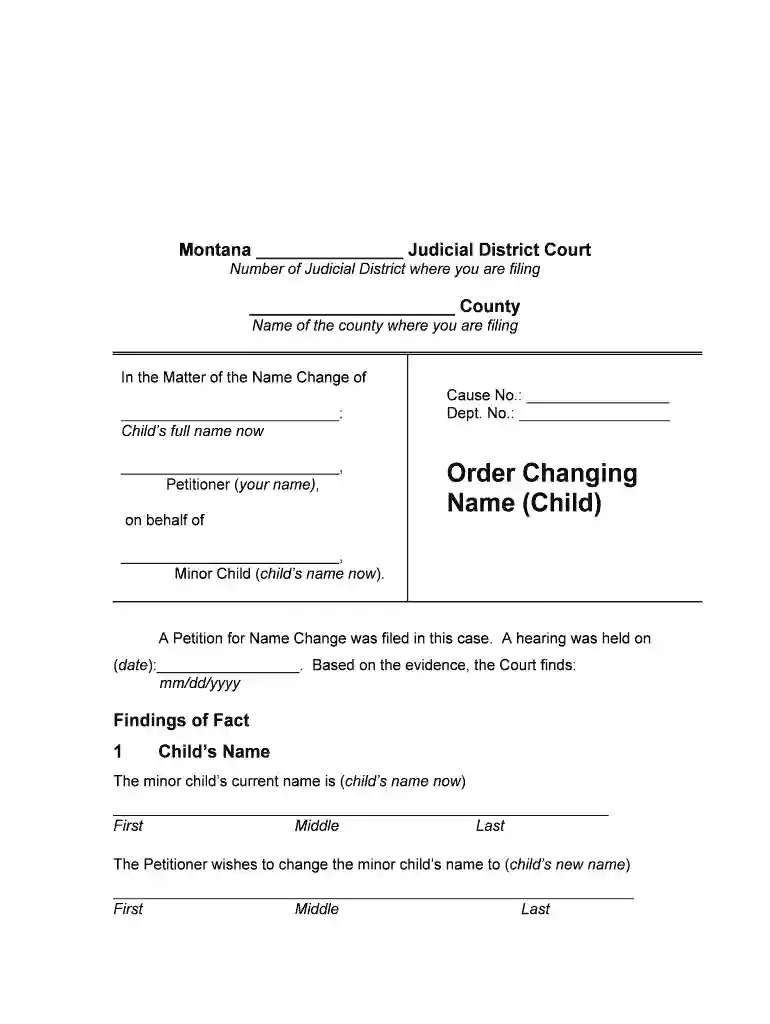
The "Order Changing Name (Child)" is a legal document issued by the court when a parent or guardian petitions to change the name of a minor child. This order serves as official proof of the name change and is typically required to update records with government agencies, including birth certificates, social security records, and school documents. The petition must outline the child's current and proposed new name, birth information, and the reasons for the requested change. The court ensures that the name change is not for fraudulent or improper purposes and complies with state laws.
Once issued, the Order Changing Name (Child) must be used to update the child's identification records. This involves submitting the order to relevant agencies, such as the Department of Motor Vehicles (if applicable), Social Security Administration, and the child's school. The order may also be used to update the name on insurance policies, medical records, and other personal documents. When utilizing the order, ensure it is the certified copy obtained from the court, as copies without certification might not be accepted by some institutions.
Petition Initiation: Begin by filing a petition in your local judicial district court, including details about the current and desired new name, and the reasons for the name change.
Filing Fees and Paperwork: Submit the necessary paperwork along with the filing fee. Some jurisdictions may offer fee waivers for those who cannot afford the cost.
Hearing Schedule: A court hearing date will be set, during which you must present your case to a judge. Be prepared to explain the need for the name change and demonstrate compliance with state laws.
Name Change Publication: Some states require publishing a notice of the name change in a local newspaper, unless waived for privacy concerns.
Court Decision: The judge will either approve or deny the petition based on the presented evidence and adherence to legal protocols.
Obtain Certified Copy: If approved, obtain certified copies of the order for documentation and record changes.
Changing a child's name can be significant for various reasons, such as aligning with cultural heritage, ensuring familial consistency after a marriage or divorce, or simply rectifying errors in a child's legal documents. Additionally, a name change might be desired for personal or psychological reasons, supporting the child’s identity and sense of self in family dynamics.
This form is primarily used by parents or legal guardians who have custody of the child in question. It may also involve other family members or advocates acting on behalf of the child in situations where the guardian is unavailable or unable to file. Legal professionals, such as family lawyers, often assist in preparing and submitting these petitions to ensure that all legal requirements are met.


Montana: The order requires clear evidence that the change is in the child’s best interest. Court instructions must be followed for updating the child’s birth certificate.
California: Additional requirements include a background check and criminal records review for adults filing the petition on behalf of a child.
New York: Unlike many states, does not require publication notice when the name change poses a safety risk to the child.
Current and New Name: Clearly listed on the order to establish a link between the child’s old and new identities legally.
Court's Approval Statement: Official authorization and recognition from the court verifying the legitimacy of the name change.
Conditions and Limitations: Any specific provisions related to the name change, like jurisdictional limitations or future identity considerations.
The document serves as an official, legally binding authorization that must be recognized across federal and state institutions. This includes federal entities like the Social Security Administration and state bureaus such as the Department of Health when altering vital records. Legal professionals often utilize the order to facilitate custody arrangements or when the child enters a new guardianship circumstance.
When petitioning the court, a comprehensive package of required documents should be prepared, including:
Birth Certificate: A certified copy of the child's original birth certificate.
Parental Consent: If one parent is initiating the petition alone, proof of consent from the other parent is often required, unless exceptional circumstances apply.
Proof of Residency: Documentation proving the child resides within the jurisdiction where the petition is filed.
Online: Many jurisdictions offer electronic filing options through their court services website, which expedites the submission and tracking process.
Mail: Filing through postal services remains a common practice, necessitating the inclusion of all required documents and the filing fee.
In-Person: Direct submission at the courthouse can provide immediate confirmation of receipt and address any clarifications needed by court staff.
Each method has specific guidelines, and selecting the appropriate one can depend on personal convenience, court facilities, and the urgency of the matter.
At DocHub, your data security is our priority. We follow HIPAA, SOC2, GDPR, and other standards, so you can work on your documents with confidence.