






Definition and Meaning
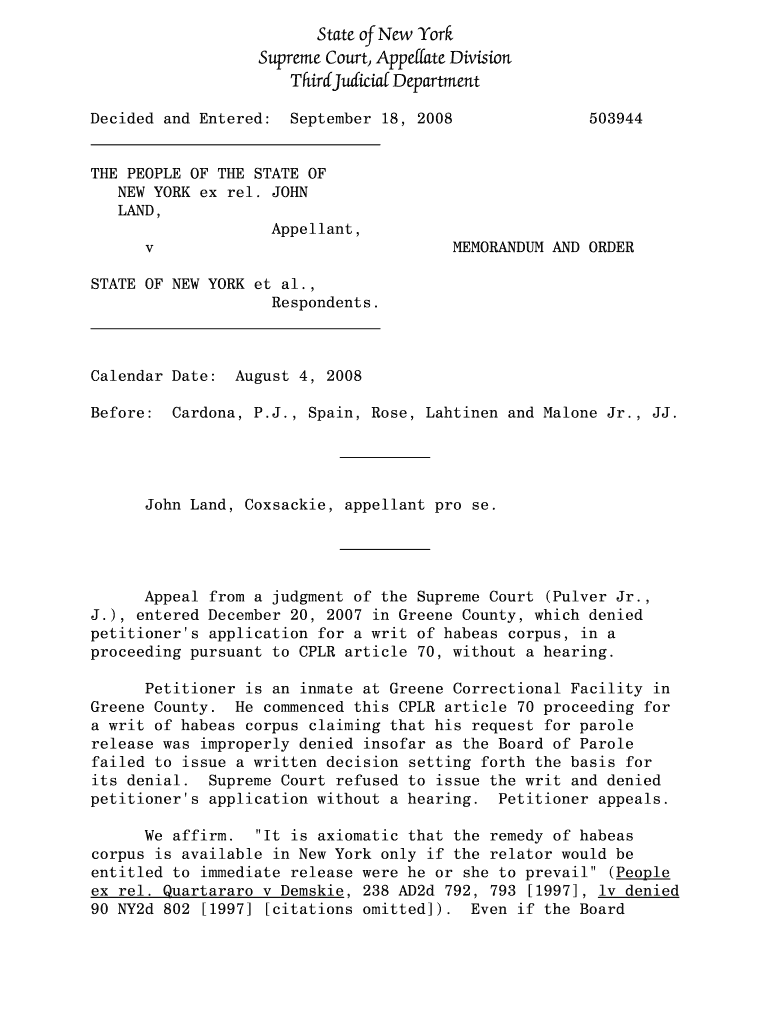
The form "503944 People ex rel Land v State of New York - decisions courts state ny" pertains to a legal memorandum and order from the New York Supreme Court, Appellate Division. It addresses the denial of a writ of habeas corpus filed by John Land, an inmate seeking parole release. This decision highlights the discretionary nature of parole decisions and the criteria used by the Board of Parole in reviewing applications. It confirms that a lack of a written decision by the Board does not guarantee parole release.
Key Details
- Legal Context: This decision is rooted in the principles of habeas corpus, which challenges unlawful detention.
- Court Involved: New York Supreme Court, Appellate Division, which handles appeals from lower courts.
- Outcome: The denial of Land's writ was upheld, asserting that parole decisions are not automatically reversible based on procedural errors alone.
How to Use the 503944 People ex rel Land v State New York
For individuals involved in parole procedures or legal practitioners, understanding the utilization of this form is essential for navigating similar cases. It serves as a reference point for legal arguments and the interpretation of parole board decisions.
Application in Legal Settings
- Legal Precedents: Cited in future cases where parole board decisions are contested.
- Parole Hearings: Used to understand the discretionary power of parole boards and legal standards applied.
- Legal Education: Essential for law students and educators exploring habeas corpus and parole-related jurisprudence.
Steps to Complete the Process Related to the Form
Engaging with the legal processes surrounding this form involves several steps, particularly for those appealing parole board decisions.
Detailed Procedure
- Understand the Initial Decision: Review the parole board's decision rationale.
- Drafting a Writ: Prepare a writ of habeas corpus, arguing any alleged procedural errors.
- File with the Appropriate Court: Submit the writ to the New York Supreme Court, Appellate Division.
- Prepare for Hearings: Gather supporting legal documents and evidence for any subsequent hearings.
- Review Court’s Decision: Analyze the court's decision for future appeal opportunities or compliance.
Important Terms Related to 503944 People ex rel Land v State of New York
Familiarity with specific legal terminology helps in comprehending the intricacies of this form.
Terminology Overview
- Habeas Corpus: Legal action challenging unlawful detention.
- Parole Board: Authority that decides on the conditional release of inmates.
- Discretionary Decisions: Decisions made by an authority based on judgment and interpretation.
Legal Use of the Form 503944 People ex rel Land v State of New York
This form is used primarily in legal settings as both a reference and a precedent in similar cases, understanding its legal use can guide strategic decisions in court proceedings.
Applications in Court
- Challenge Grounds: Used in arguing procedural failures in parole hearings.
- Appeals: Reference in appeals processes before higher courts.
- Case Studies: Educates legal professionals on the standards applied in parole decision reviews.
State-Specific Rules for Parole Decisions in New York
The ruling from the New York Supreme Court emphasizes specific state rules regarding parole decisions, influencing legal proceedings throughout the state.
Details on New York Regulations
- Parole Criteria: Understanding the criteria set by New York’s Board of Parole helps interpret court rulings.
- Judicial Review Limits: Defines the scope of judicial review over parole board decisions.
Examples of Using the Form in Legal Proceedings
Utilizing the form as a reference in various legal environments offers insights into its practical application.
Real-World Scenarios
- Educational: Law schools using this case for mock trials or legal analysis courses.
- Legal Practices: Firms referencing the decision in parole-related cases to build stronger arguments.
- Public Documentation: Available for public access as part of legal archives, beneficial for self-representing individuals.
Penalties for Non-Compliance with Parole Decision Protocols
Understanding the consequences of non-compliance with parole procedures is crucial for legal practitioners and inmates.
Possible Penalties
- Loss of Parole Opportunity: Procedural non-compliance can result in extended incarceration.
- Legal Sanctions: Potential for additional legal proceedings if procedural errors affect court outcomes.
Application Process and Approval Time for Related Cases
Navigating the application process in a legal context, especially when challenging parole board decisions, involves several key steps and considerations.
Detailed Process Outline
- Filing Timeline: Understanding court-specific deadlines for filing appeals or writs.
- Processing Time: Expected duration from filing to final decision, varying by court backlog and complexity.
This comprehensive coverage ensures that all relevant aspects of "503944 People ex rel Land v State of New York - decisions courts state ny" are thoroughly understood and applied effectively within legal contexts.