







Definition and Meaning
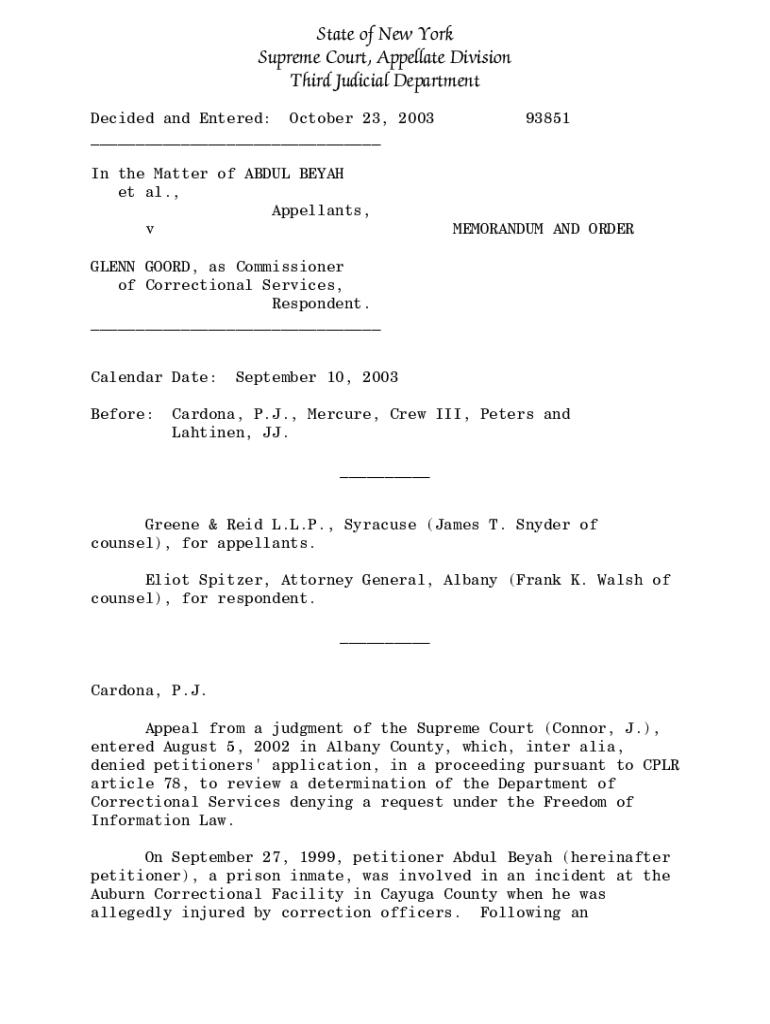
The "In the Matter of Abdul Beyah" refers to a memorandum and order issued by the New York Supreme Court, Appellate Division, concerning a legal proceeding initiated by Abdul Beyah. The case involves a CPLR Article 78 proceeding, a special proceeding used in New York to challenge the decisions of administrative agencies, public bodies, or officers. Beyah's case specifically relates to the denial of access to records under the Freedom of Information Law (FOIL) concerning an incident where he was allegedly injured by correction officers at Auburn Correctional Facility. Understanding the specifics of this case requires familiarity with New York's legal procedures and FOIL provisions.
Legal Use and Purpose
The legal use of the "In the Matter of Abdul Beyah" falls under the framework of challenging administrative decisions, particularly in relation to the access of records under FOIL. FOIL is a New York State law that provides the public the right to access government records. In this instance, Beyah sought access to records that he believed were wrongfully withheld, arguing they were necessary for addressing his grievances about the incident in the correctional facility. The court's involvement illustrates the legal avenues available for individuals seeking transparency and accountability from public institutions.
Key Elements
Key elements of the "In the Matter of Abdul Beyah" include the types of records requested, the rationale for granting or denying access, and the legal standards applied by the court. The court analyzed several categories of records requested by Beyah, determining the disclosure was warranted for some documents while others were exempt to protect privacy or due to safety risks. This deliberation highlights the court's responsibility to balance transparency with privacy concerns and security considerations.
Steps in the Process
- Filing of CPLR Article 78 Proceeding: Abdul Beyah initiated a CPLR Article 78 proceeding to contest the denial of records access.
- Review and Ruling by Court: The court reviewed the categories of records requested and ruled on which should be disclosed and which remained exempt.
- Disclosure with Redactions: Certain records were ordered to be disclosed but with necessary redactions to protect personal privacy.
- Exemption of Certain Records: Records deemed a risk to safety or carrying significant privacy concerns remained exempt as per the court ruling.
Obtaining the Form
Obtaining records related to court cases like "In the Matter of Abdul Beyah" generally requires a formal request through legal channels. Interested parties may need to contact the relevant court's clerk office to learn the process for accessing public records or filings related to the case. Additionally, FOIL requests might be necessary for retrieving documents from public institutions involved in similar proceedings.
Who Typically Uses This Process
"In the Matter of Abdul Beyah" is relevant to individuals, legal practitioners, and entities involved with administrative law and record access issues. It is particularly significant for individuals in correctional facilities and their legal representatives who seek to challenge administrative decisions impacting access to information. Legal professionals specializing in administrative and data access law would find knowledge of this matter crucial for representing clients effectively.
FOIL Interpretations and Implications
The decisions in "In the Matter of Abdul Beyah" impact how FOIL is interpreted, especially concerning cases that involve privacy and security aspects. The ruling sets precedent for balancing the public's right to information with the necessity to protect privacy and maintain security in sensitive environments like correctional facilities. Understanding these interpretations is essential for legal practitioners dealing with similar record access claims.
Security and Privacy Concerns
Security and privacy are central to the court's decision-making in cases like Abdul Beyah's. The court must weigh the public's right to know against potential risks that full disclosure might pose. In this proceeding, redactions were a crucial tool used to provide transparency while safeguarding sensitive information. Practitioners must be well-versed in privacy laws and redaction techniques when handling such records.
Examples and Precedents
Examples of how "In the Matter of Abdul Beyah" can be applied range from other legal challenges against record denials to academic discussions on the limits of information access laws. Legal analysts often examine such cases to understand the nuances of administrative law, providing a framework for handling similar records issues. Each example helps carve the legal landscape around FOIL and administrative law in New York.
Variations and Alternatives
While "In the Matter of Abdul Beyah" is specific to New York State, similar processes exist in other states, varying based on local laws concerning records access and administrative challenges. It is crucial for individuals and legal practitioners in other jurisdictions to consult their state-specific laws, as variations in procedures can significantly affect outcomes.
Role of Court in Administrative Challenges
The court's role in cases like Abdul Beyah’s highlights its function as a mediator between public bodies and citizens. By reviewing and ruling on record access denials, courts configure general principles and ruling standards that shape future access rights. The judiciary’s interpretative function in these matters is key to sustaining the balance between transparency and confidentiality.
Implications for Correctional Systems
Cases involving record access in correctional facilities, such as this one, also carry implications for the broader correctional system. Increased scrutiny and transparency are parts of the ongoing dialogue to ensure accountability and respect for individuals' rights within such institutions. Legal outcomes may drive reforms and policy adjustments in managing and handling records in these settings.




