







Definition and Purpose of the Certificate of Liability Insurance - Office of General Services
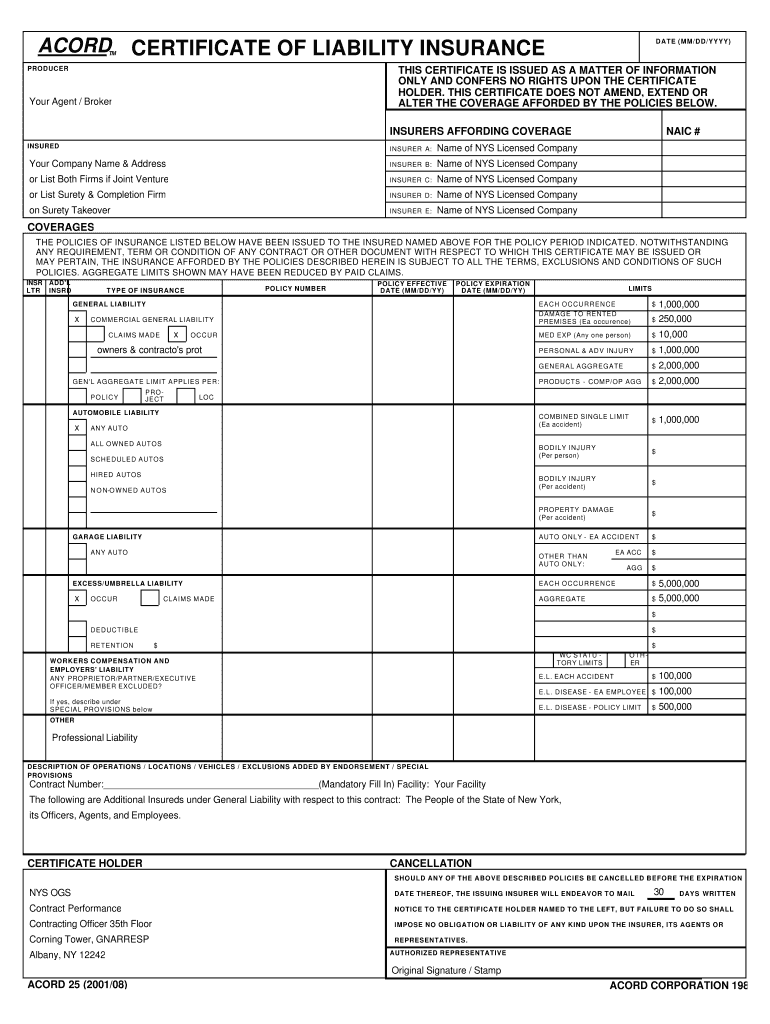
A Certificate of Liability Insurance serves as documentary proof of insurance coverage provided to a business or individual by an insurance producer. Specifically within the context of the Office of General Services, this certificate is used to verify that the insured party holds the necessary insurance policies required by entities like government offices or contractors. The certificate lists the types of insurance, policy numbers, effective dates, and coverage limits. It provides a comprehensive view of the insured party's liability coverage without modifying the core policies themselves. Although it serves an informational purpose, it’s critical in contracts or agreements where proof of insurance is needed for compliance.
How to Use the Certificate of Liability Insurance - Office of General Services
This certificate is typically used in situations where evidence of liability coverage is a prerequisite. For businesses entering contracts with federal or state agencies, such as the Office of General Services, the certificate confirms compliance with insurance requirements. When signing contracts, the certificate might be included in documentation packages to assure partners that all liabilities are covered according to specified limits and terms. In practical terms:
- Provide the certificate during contract bidding processes
- Attach it to the compliance sections of contracts
- Distribute copies to stakeholders requiring verification of insurance
In case of a claim or dispute, while the certificate itself is not a part of the insurance policy, it can demonstrate to all parties involved that insurance obligations were fulfilled at the time of interest.
Steps to Complete the Certificate of Liability Insurance - Office of General Services
Completing a Certificate of Liability Insurance involves several detailed steps:
- Gather Insurance Details: Collect all necessary information from existing insurance policies including types of coverage, insurer names, policy numbers, and limits.
- Access the Template: Use an existing template provided by your insurance broker or create one based on industry standards specific to the Office of General Services requirements.
- Fill in Required Information: Enter all essential details accurately such as coverage types, effective and expiration dates, and any additional insured parties.
- Verification: Cross-check all the filled information with your insurance policies to ensure accuracy.
- Submission: Submit the completed document to the Office of General Services or relevant authority in accordance with the submission guidelines provided by the contractual agreement, either via email or through a dedicated portal.
Important Terms Related to the Certificate of Liability Insurance - Office of General Services
Understanding the terminology associated with a Certificate of Liability Insurance is crucial for correctly interpreting the document:
- Insured Party: The individual or business entity covered by the insurance policy.
- Additional Insured: Parties added to the policy who are also covered under specific circumstances.
- Coverage Limits: Maximum amounts the insurer will pay for a covered loss.
- Effective Date: The date when the insurance coverage begins.
- Cancellation Clause: Specifies the terms under which the insurer or insured can terminate the coverage before the policy’s expiry.
These terms ensure that both insured and insurers have a clear understanding of rights and obligations, fostering transparency in the insurance process.
Legal Use and Compliance with the Certificate of Liability Insurance - Office of General Services
The Certificate of Liability Insurance is not just an informational document; its legal use extends into ensuring compliance with stipulated contract requirements. When working with the Office of General Services, certificates:
- Confirm adherence to insurance coverage as demanded by contracts
- Provide a record for legal purposes ensuring that proper coverage was in place
- Act as a preliminary document in dispute resolution, demonstrating commitments to fulfill insurance obligations
For any business or individual interacting in contractual obligations with government entities, maintaining up-to-date and accurate certificates is critical to avoiding legal complications.
Who Typically Uses the Certificate of Liability Insurance - Office of General Services
Entities that frequently engage with the Office of General Services or similar governmental bodies make regular use of these certificates:
- Construction Companies: Validating insurance when bidding for public infrastructure projects.
- Professional Services Firms: Serving governmental agencies requiring proof of liability coverage.
- Vendors and Suppliers: Engaged in contracts requiring documented insurance protections.
These users rely on certificates to streamline their operations, ensuring compliance while protecting against potential liabilities.

Key Elements of the Certificate of Liability Insurance - Office of General Services
Several core components constitute a Certificate of Liability Insurance specific to the Office of General Services:
- Insurer Details: Includes the names and contact information of all insurers involved.
- Types of Coverage: General liability, auto liability, excess liability among others, as specified in the contract.
- Policy Numbers and Terms: Unique identifiers and the coverage period that align with the policy documents.
- Coverage Limits and Additional Insured: Specified monetary limits and any third parties covered under the insurance.
- Authorized Signature and Date: Validation by the insurance provider confirming authenticity and accuracy.
Understanding each element ensures stakeholders comprehend what the certificate covers and whom it protects, thereby minimizing misunderstandings.
Examples of Using the Certificate of Liability Insurance - Office of General Services
Real-world scenarios illustrate the importance and utility of the Certificate of Liability Insurance:
- Bidding on Public Projects: Construction companies present certificates as part of a compliance package to meet insurance requirements.
- Vendor Agreements with State Agencies: Vendors provide certificates to verify liability protection, ensuring they can fulfill contractual responsibilities without undue risk.
- Annual Contract Renewals: As part of the renewal process, public service providers update their certificates to maintain contract eligibility.
Each example demonstrates a scenario where these certificates are integral to meeting legal, compliance, and operational needs.
State-Specific Rules Regarding the Certificate of Liability Insurance - Office of General Services
Navigating the variances in state requirements is essential for businesses operating across multiple jurisdictions:
- New York: Requires certificates to detail exact coverage amounts and include state-specific clauses addressing cancellation terms.
- California: Emphasizes strict verification procedures, requiring additional documentation for certain high-risk industries.
- Texas: Demands inclusion of specific statement forms keyworded for state government compliance.
For businesses with operations across states, understanding these differences ensures accurate and compliant documentation, proving invaluable in applications for state-based projects.
How to Obtain the Certificate of Liability Insurance - Office of General Services
Obtaining a Certificate of Liability Insurance involves a clear process:
- Request from Your Insurance Provider: Contact your insurer to provide the necessary certificate specific to the Office of General Services.
- Verify Coverage Details: Ensure all aspects of your policies, including limits and terms, are accounted for and accurately reflected.
- State Requirements: Provide any state-specific data to your insurer to ensure full compliance with regional regulations.
Following this procedure ensures that you receive a legally accepted document that meets all necessary criteria for business operations within governmental contracts.




