






Definition and Meaning of Dewey Summaries - OCLC
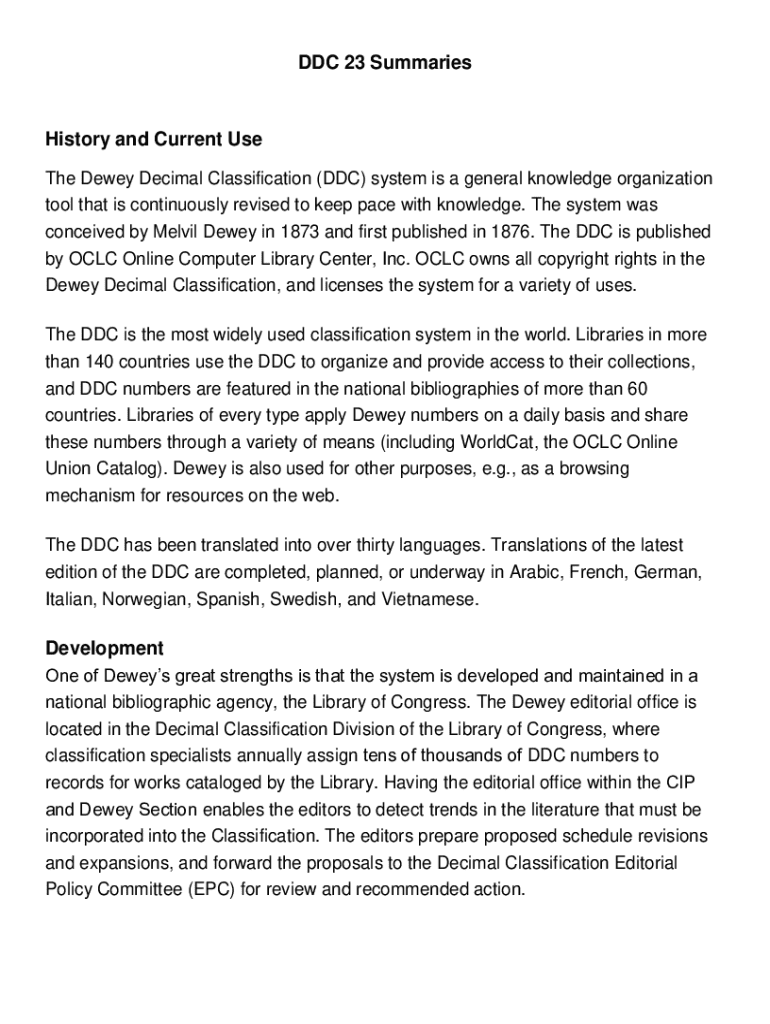
The Dewey Summaries are a concise version of the Dewey Decimal Classification (DDC) system, which is instrumental in organizing library collections. Managed by the Online Computer Library Center (OCLC), these summaries highlight the essential structure of the DDC, enabling libraries to implement a simplified classification system. The Dewey Summaries consist of ten main classes, each with further subdivisions into divisions and sections, providing a practical tool for smaller libraries and specific informational needs.
How to Use Dewey Summaries - OCLC
Using the Dewey Summaries involves understanding its hierarchical structure. Libraries and institutions begin by identifying the ten primary classes, which represent broad subjects like technology, arts, or history. From there:
- Identify the specific subject area of the material.
- Refer to the relevant main class.
- Drill down to divisions and sections for more specific classification.
This approach ensures consistent organization and retrieval of materials. Effective use also involves regular updates to align with any modifications in the broader DDC.
Obtaining the Dewey Summaries - OCLC
Libraries and other organizations interested in the Dewey Summaries can access them through the OCLC. The summaries are typically available as part of the DDC system's online resources, which may require an institutional or individual affiliation with OCLC. Some versions might also be available in printed or digital formats, depending on the institution’s subscription to OCLC services.
Steps to Complete the Dewey Summaries - OCLC Form
For organizations seeking to implement or update their Dewey Summaries, the process generally includes:
- Determine the need for Dewey Summaries within your institution.
- Access the OCLC platform for the latest summaries.
- Ensure institutional affiliation or set up an account with OCLC.
- Review the summaries and integrate the classification into your system.
- Train library staff on using the summaries for consistent classification.
- Update regularly based on OCLC’s revisions.
Importance of Dewey Summaries - OCLC
The Dewey Summaries serve a critical role in library science by providing a simplified taxonomy for organizing library resources. They facilitate efficient categorization and retrieval of information, especially in smaller libraries or institutions with specific collections. The summaries help maintain uniformity across libraries, ensure inclusive access to resources, and streamline cataloging processes.
Key Elements of the Dewey Summaries - OCLC
- Ten Main Classes: Broad areas such as philosophy, social sciences, and language form the foundation.
- Divisions and Sections: These provide more granular classification, allowing for detailed categorization.
- Universal Application: Adaptable for various libraries, regardless of size.
- Updates and Revisions: Regularly updated by OCLC to reflect new knowledge domains.
Each element is crucial for ensuring that the summaries remain a relevant and efficient tool for library classification.
Examples of Using Dewey Summaries - OCLC
Consider a small public library looking to organize a collection of children's books. Using Dewey Summaries:
- They would locate the relevant main class, like "800" for literature.
- Within this class, they could then find subdivisions pertaining to children's poetry or fiction.
- This structured approach allows staff to consistently categorize new arrivals and existing collections.
Who Typically Uses Dewey Summaries - OCLC
The primary users include:
- Public Libraries: For broad, general access and classification.
- School Libraries: To simplify the accessibility of educational materials.
- Special Collection Libraries: Focused on maintaining specific subject areas.
- Library Professionals: Implementing classification systems within institutions.
The summaries are a preferred resource for institutions looking to maintain structured, yet straightforward classification systems.