






Definition & Meaning
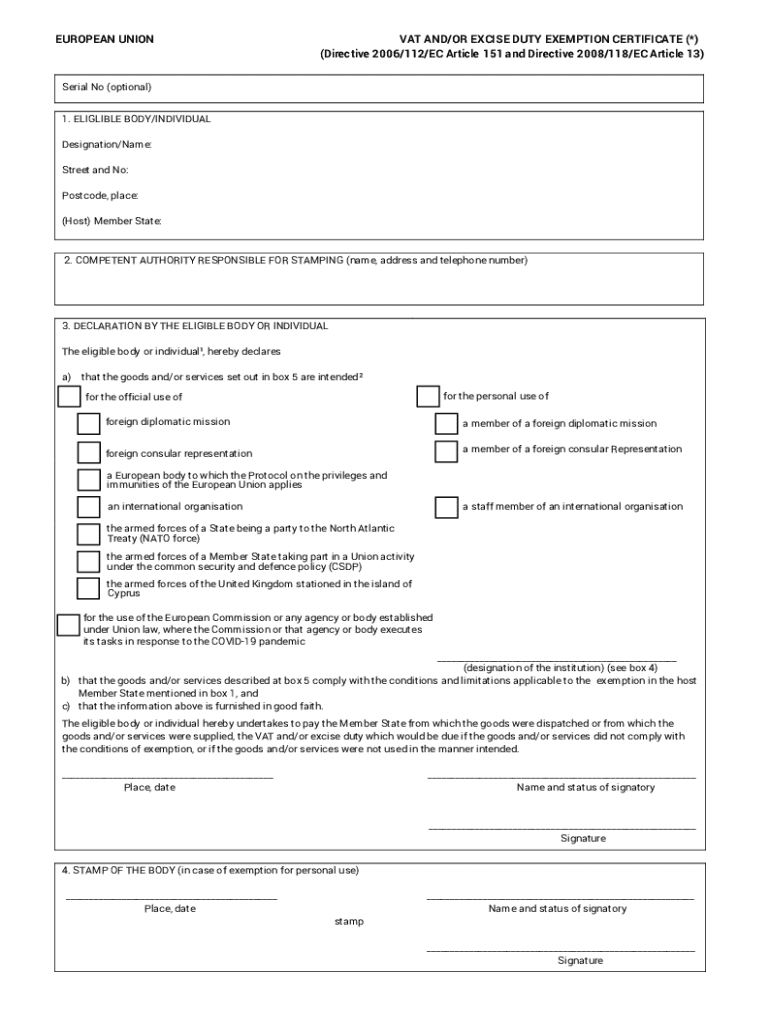
The VAT and/or Excise Duty Exemption Certificate is a crucial document for businesses and individuals seeking relief from certain taxes within the European Union. These taxes typically apply to goods and services crossing borders within the EU. The certificate grants an exemption from value-added tax (VAT) or excise duties, provided specific conditions are met. The exemption applies only to eligible entities and is recognized by various EU member states under specific directives. Understanding its complexities is essential to ensure compliance and optimize tax relief strategies.
Eligibility Criteria
Entities eligible for the VAT and/or Excise Duty Exemption Certificate must meet defined conditions. These often include:
- Non-profit organizations operating in specific sectors, such as education or healthcare.
- Governmental bodies involved in international duties.
- Companies engaged in cross-border trade within the EU that qualify under specific industry criteria.
Each member state may have additional parameters or interpretations of who qualifies, thus requiring potential applicants to carefully assess their eligibility based on both EU-wide and local regulations.


How to Use the VAT and/or Excise Duty Exemption Certificate
Effectively utilizing the certificate involves presenting it at the point of sale or during transactions where VAT or excise duty is applicable. Businesses should provide this documentation to vendors or tax authorities to avoid the automatic application of these taxes.
Steps to Utilize the Certificate
- Identify Eligible Transactions: Determine which of your purchases or services are covered by the exemption.
- Provide Proof to Vendors: Present the certificate at the time of purchase to ensure taxes are not charged.
- Keep Detailed Records: Maintain copies of all transactions where the exemption was applied for future reference and audits.
- Ensure Compliance: Regularly review changes in eligibility criteria or tax laws to ensure continued compliance.
How to Obtain the VAT and/or Excise Duty Exemption Certificate
Obtaining this certificate is a multi-step process that requires thorough preparation and submission of necessary documentation. The exact process may vary by country but usually involves application through competent tax authorities within the EU.
Step-by-Step Application Process
- Research Requirements: Begin by checking both EU directives and local state regulations to understand submission criteria.
- Prepare Necessary Documents: Gather all required documents, such as proof of business operations, eligibility justification, and past financial records.
- Submit Application: Complete the application form, ensuring all details are accurate and in compliance with guidelines.
- Await Approval: Be prepared for a period of review; approval times can vary depending on the volume of applications and the complexity of your request.
Key Elements of the VAT and/or Excise Duty Exemption Certificate
The certificate encapsulates several critical components necessary for its acceptance and application:
- Identification Details: Information about the applicant, including name, address, and tax identification number.
- Purpose of Exemption: Clear indication of the goods or services the exemption will apply to, including the reasons for eligibility.
- Duration: Specific time frame for which the exemption is valid, often needing renewal after a certain period.
- Authorizing Signature: An official signature from an authorized tax body or governmental entity confirming the exemption.
State-Specific Rules for the VAT and/or Excise Duty Exemption Certificate
Though EU-wide directives provide a framework, individual member states enforce specific rules regarding the exemption certificate. Variations can include:
- Additional Eligibility Requirements: States may have industry-specific or entity-specific conditions.
- Documentation Formats: Some states require additional forms or specific submission formats.
- Language Requirements: Submissions may need translations if the primary language differs from the state’s official language.
Legal Use of the VAT and/or Excise Duty Exemption Certificate
Using the certificate legally ensures both compliance and maximized benefits. Legal uses must align strictly with the provision’s intent:
- Non-Sale Activities: The certificate is valid only for declared exempt purposes, not for reselling goods tax-free.
- Correct Application: Taxes must not be claimed back on goods that are not within the scope of the exemption.
Penalties for Non-Compliance
Failure to comply with application or use regulations can result in significant penalties, such as:
- Fines: Monetary penalties for misuse or fraudulent claims.
- Certificate Revocation: Permanent or temporary loss of eligibility to use the certificate.
Required Documents
Completing the application for the VAT and/or Excise Duty Exemption Certificate mandates several key documents:
- Proof of Eligibility: Include financial statements, business registration, and sector-specific documentation.
- Transaction Records: Previous transactions where exemption could apply.
- Additional Local Requirements: Other documents as required by specific EU states.
Who Typically Uses the VAT and/or Excise Duty Exemption Certificate
The certificate is predominantly used by specific groups:
- Educational Institutions: Seeking exemptions on tools and materials.
- Charitable Organizations: Engaged in operations within eligible categories.
- Cross-Border Traders: Businesses importing or exporting goods.
These entities rely on the exemption certificate to effectively manage costs associated with tax payments on applicable goods and services.